Bank Withdrawal Restrictions Lead to Bank Vandalism and Arson
Lebanon Faces Triple Crisis: Economic Hardship, Currency Collapse, and Soaring Prices
Lebanese banks, facing the worst economic crisis, have blocked long-term deposit withdrawals, prompting angry depositors to attack banks.
According to AFP and other foreign media on the 17th (local time), more than 50 depositors attacked multiple bank branches in downtown Beirut, the capital of Lebanon, the previous day. They smashed the glass doors of bank branches with hammers, pickaxes, and stones, piled tires in front of the entrances, and set them on fire. It is reported that at least six bank branches were attacked by the depositors.
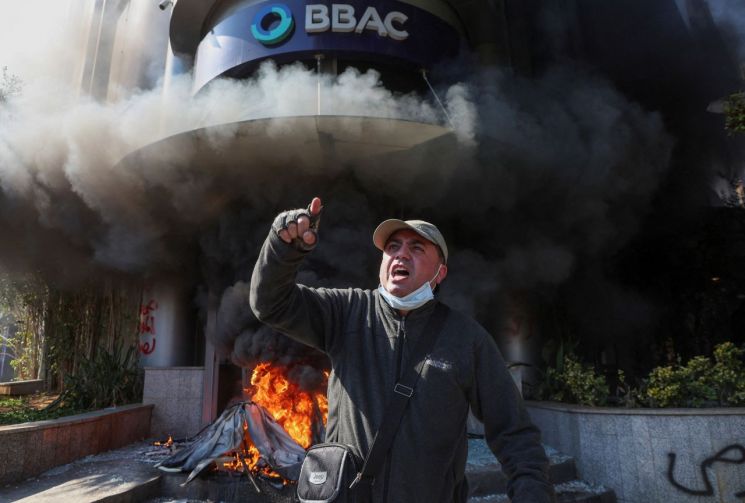 On the 16th (local time), a fire broke out in front of a bank in Beirut, the capital of Lebanon, where angry depositors are protesting against withdrawal restrictions.
 [Photo by Reuters Yonhap News]
Since the economic crisis began in 2019, Lebanese banks have restricted most customers' deposits, especially US dollar withdrawals, to prevent a "bank run" (a large-scale withdrawal of deposits by customers fearing the bank's insolvency). Because of this, many Lebanese depositors have money in their bank accounts but cannot access it. Since last year, frustrated depositors have even resorted to using force to try to withdraw their deposits.
Behind them is a depositors' group called "Yegumja Jeolgyu" (Scream of Depositors). "Yegumja Jeolgyu" is an organization supporting citizens' rights to withdraw deposits, encouraging depositors to no longer endure but to take active action.
Pascal Al-Raisi, who participated in the protest, told AFP, "They (the banks) stole, seized, and plundered our money three years ago," expressing frustration, "Some of us own millions of dollars, but we have not a single penny in our pockets." He added, "There is no other solution. We will escalate our actions until we regain our rights."
Police officers were present around the protesters but did not actively stop the depositors' actions, and firefighters extinguished the arson.
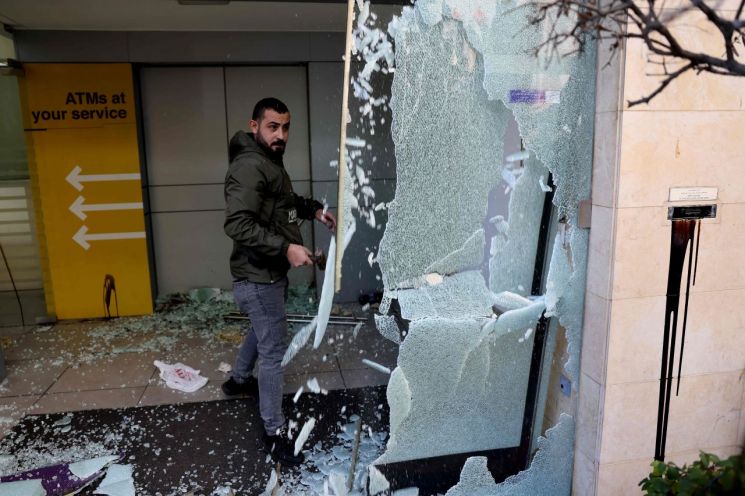 The glass entrance door of the bank branch destroyed by angry depositors.
 [Photo by AFP Yonhap News]
In Lebanon, the exchange rate began to soar as national debt increased due to an incompetent government in 2019. Subsequently, a series of adverse events such as the COVID-19 pandemic, the massive Beirut port explosion in 2020, and the Ukraine war followed, pushing the situation to an irrecoverable level and causing the Lebanese pound to plummet in value. As a result, prices in Lebanon have surged by more than 400% over three years.
Lebanese Pound Exchange Rate Adjusted from 1,507 to 15,000 per Dollar
On the 1st of this month, the Central Bank of Lebanon announced it would adjust the exchange rate of the local currency, the Lebanese pound, from 1,507 to 15,000 per US dollar. This is the first time in 26 years since 1997 that Lebanon has changed its official exchange rate. Although the official exchange rate change lowered the local currency's value by more than 90%, the market had already been applying a much higher rate.
According to the UN, Lebanon's poverty rate reaches 80% of the population, making it difficult for Lebanese people to sustain their livelihoods. The World Bank (WB) also described Lebanon's economic crisis as the most severe and prolonged depression in world history since the mid-19th century.
Lebanon has recently lost its voting rights at the UN General Assembly due to unpaid UN dues, and it remains in a total crisis with the presidency vacant, as no successor has been elected for former President Michel Aoun, whose term expired in October last year.
© The Asia Business Daily(www.asiae.co.kr). All rights reserved.
![Clutching a Stolen Dior Bag, Saying "I Hate Being Poor but Real"... The Grotesque Con of a "Human Knockoff" [Slate]](https://cwcontent.asiae.co.kr/asiaresize/183/2026021902243444107_1771435474.jpg)

















