From May, 140% of Officially Announced Price
90% Jeonse-to-Price Ratio Applied
Jeonse Deposit Insurance Not Available Under Same Conditions
Concerns Over Sharp Increase in Gap Investment Landlords' Non-Return of Deposits Cases
[Asia Economy Reporter Minyoung Kim] An analysis has emerged that 71% of villa jeonse contracts expiring in the second half of this year in the Seoul metropolitan area will not be able to subscribe to the jeonse deposit guarantee with the same jeonse deposit amount. There are concerns that the reverse jeonse crisis will intensify, causing a rapid increase in landlords who cannot return deposits to tenants currently residing.
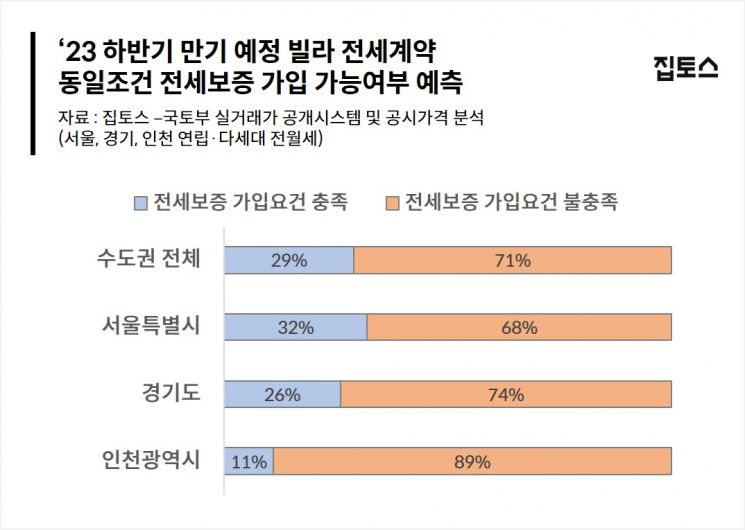
On the 16th, real estate brokerage firm Jiptos analyzed and compared the actual transaction prices of multi-family and row houses' monthly and jeonse rents from the Ministry of Land, Infrastructure and Transport in Seoul, Gyeonggi, and Incheon areas with the official housing prices. The result showed that 71% of villa jeonse contracts expiring in the second half of this year will not be able to subscribe to the jeonse deposit return guarantee with the same jeonse deposit amount as before. This exceeds the jeonse rate of 90%, which is the new requirement for subscribing to the jeonse guarantee starting from May. The prediction was made assuming a 10% drop in official housing prices, amid prevailing forecasts that the official housing prices to be announced in March will sharply decline by double digits.
By region, it was analyzed that 68% in Seoul, 74% in Gyeonggi Province, and 89% in Incheon of the expiring villa jeonse contracts will not be able to subscribe to the jeonse deposit return guarantee with the existing jeonse deposit amount. In Seoul, Gangseo-gu had the highest rate of non-subscription at 90%, followed by Geumcheon-gu (87%), Yeongdeungpo-gu (84%), and Gwanak-gu (82%). In Incheon, Namdong-gu and Gyeyang-gu (94%), and Seo-gu (90%) showed high rates of non-subscription.
Regarding this, the Ministry of Land, Infrastructure and Transport rebutted that since jeonse prices are rapidly falling, assuming both jeonse prices and official prices fall by the same rate (10%), the decrease in the number of eligible subscriptions would be limited.
They also explained that since the proportion of houses with a jeonse rate exceeding 100% is included among houses exceeding the 90% jeonse rate, the number of villas unable to subscribe should be estimated excluding those. This is because houses with a jeonse rate over 100% are originally difficult to subscribe to the guarantee.
By resetting these conditions, it was estimated that about 20% of houses would be restricted from subscribing to the guarantee based on simple calculations applying the subscription criteria.
The Ministry stated, "A tenant-favorable market environment is recently being formed, and even if the jeonse rate exceeds 90%, tenants can subscribe to the guarantee by choosing guarantee-backed monthly rent, etc."
There is also a forecast that jeonse prices will be formed according to the jeonse deposit guarantee subscription criteria. This is because the number of incidents of non-return of deposits has recently surged, and most tenants hope to subscribe to the jeonse deposit return guarantee when signing jeonse contracts. Reflecting this atmosphere, it is highly likely that future villa jeonse prices will be set at amounts that allow subscription to the jeonse deposit guarantee.
Furthermore, if a new contract is signed with a lower deposit than the existing contract, landlords must prepare funds to return the deposit to the existing tenants. If they fail to prepare the deposit return funds, problems may arise where existing tenants cannot get their deposits back. Jin Tae-in, head of Jiptos Apartment Brokerage Team, said, "Due to the impact of falling jeonse prices, problems related to non-return of deposits are expected to continue for the time being."
Jin Tae-in, head of the Apartment Brokerage Team, said, "As jeonse prices continue to fall, landlords who made gap investments should prepare to return deposits in advance," and added, "One way is to switch to half-jeonse (banjeonse) in accordance with the jeonse deposit guarantee subscription requirements and find new tenants."
© The Asia Business Daily(www.asiae.co.kr). All rights reserved.
![Clutching a Stolen Dior Bag, Saying "I Hate Being Poor but Real"... The Grotesque Con of a "Human Knockoff" [Slate]](https://cwcontent.asiae.co.kr/asiaresize/183/2026021902243444107_1771435474.jpg)
















