Joint Research by Korea Institute of Ocean Science and Technology and Korea Atomic Energy Research Institute
Prediction of Tritium Concentration Due to Contaminated Water Discharge
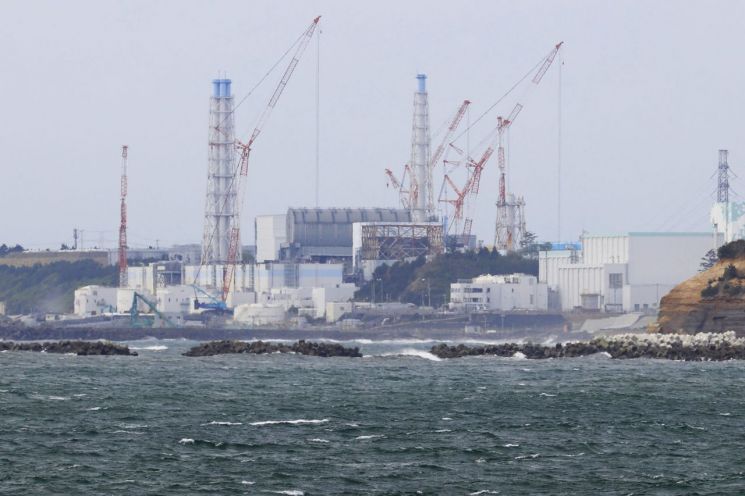
A joint simulation by national research institutes has shown that if contaminated water from the Fukushima nuclear power plant accident in Japan is discharged into the sea, tritium contained in the contaminated water will flow into the waters around Jeju Island in 4 to 5 years.
However, since this simulation result only considered the inflow of tritium, separate studies are needed to assess the impact on the ecosystem.
First Announcement of Joint Simulation Results by National Research Institutes
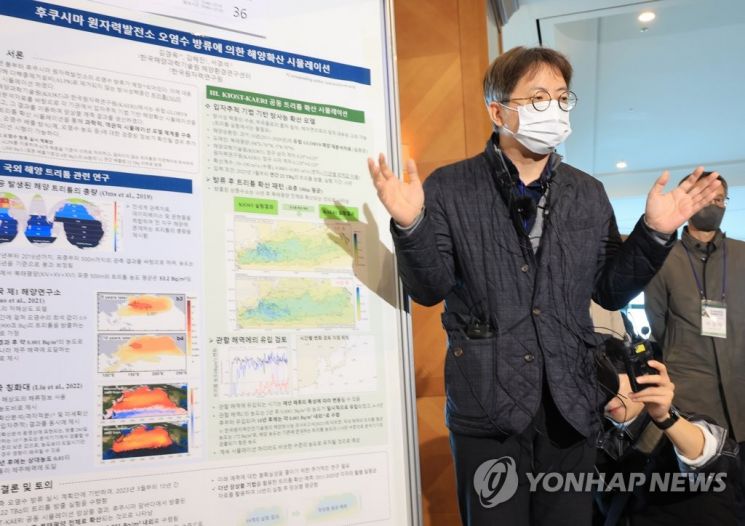
The joint research team from the Korea Institute of Ocean Science and Technology and the Korea Atomic Energy Research Institute announced the simulation results of tritium diffusion in Fukushima contaminated water at the Korean Society of Disaster Prevention conference held in Jeju on the 16th, according to Yonhap News Agency.
This is the first time that joint simulation results by national research institutes on the domestic impact of Fukushima contaminated water discharge have been announced.
The simulation assumed that Japan would discharge contaminated water into the sea in front of the Fukushima nuclear power plant at an annual rate of 22 TBq (tera becquerels, 22 trillion Bq) for 10 years starting next month. 22 TBq is the maximum annual discharge amount planned by Japan.
Significant Inflow into Jeju Waters 4 to 5 Years After Discharge
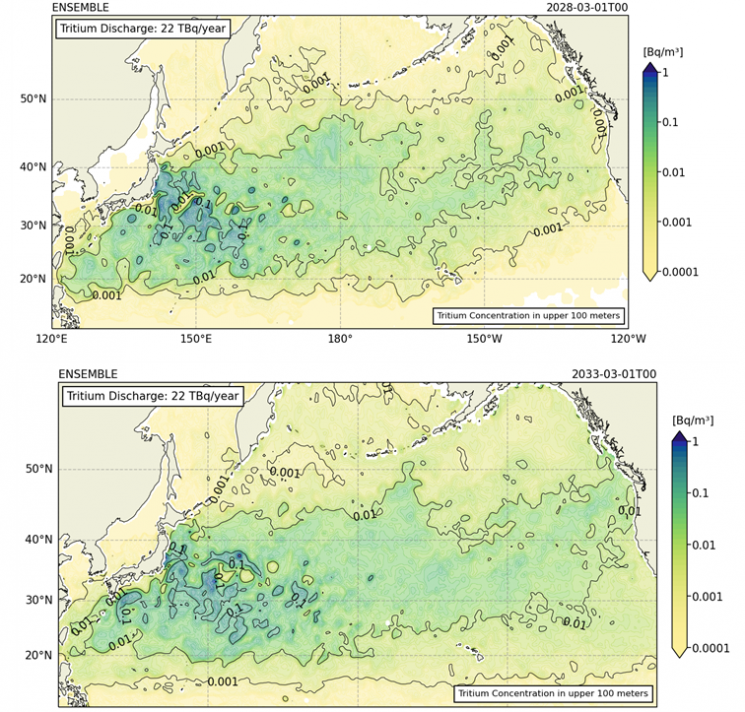 Prediction of the spread and concentration of 'tritium' in contaminated water from the Fukushima nuclear power plant released by domestic researchers. The upper image shows the prediction 5 years after discharge, and the lower image shows the prediction 10 years after discharge. Colors closer to yellow indicate low concentration, while colors closer to blue indicate high concentration. [Image source=Korean Society of Disaster Prevention]
According to the research results, tritium in the contaminated water discharged into the sea in front of Fukushima temporarily flows in at a low concentration of 0.0001 Bq (becquerels) per cubic meter of water two years after discharge due to the influence of ocean currents.
From 4 to 5 years after discharge, it is expected to flow significantly into the waters around Jeju, reaching a concentration of about 0.001 Bq/㎥ after 10 years. This concentration is approximately 1/172,000 of the tritium concentration of 172 Bq/㎥ present in domestic marine waters.
However, the researchers explained, "The timing of tritium inflow in contaminated water may vary annually depending on the characteristics of ocean currents," and added, "Information predicting how seawater will circulate is necessary."
They also stated, "Tritium discharged into the sea in front of Fukushima was found to spread throughout the North Pacific Ocean after 10 years."
This result was similar to simulations previously conducted overseas in countries such as Germany and China.
Tokyo Electric Power Company (TEPCO) planned to start discharging contaminated water from next month, but the schedule may be delayed if the review by the Japan Nuclear Regulation Authority and the International Atomic Energy Agency (IAEA) takes longer.
"Concerns Persist Over Tritium's Impact on DNA and Adverse Effects on Human Health"
Voices expressing concern over the discharge of contaminated water continue to emerge. It is argued that tritium, when incorporated into the hydrogen positions that make up human DNA, transforms into helium and affects DNA, potentially causing cell death, reduced reproductive function, and other adverse effects on the human body.
Furthermore, this simulation analysis only modeled the diffusion of tritium, and the researchers themselves stated, "The study did not include the effects on the ecosystem when tritium flows into Korea’s jurisdictional waters."
They explained that the process of various radioactive nuclides discharged accumulating and moving through the ecosystem’s food chain was not considered.
Additionally, some voices express concern about the sedimentation of radioactive substances remaining in the contaminated water even after passing through the Advanced Liquid Processing System (ALPS), which removes multiple radioactive nuclides. Therefore, it is currently impossible to accurately predict the concentration of radioactive substances in Fukushima contaminated water.
Thus, there is an analysis that this simulation does not fully show the environmental impact of contaminated water discharge.
Meanwhile, since the Japanese government decided to discharge contaminated water into the ocean in April 2014, both the previous Moon Jae-in administration and the current Yoon Suk-yeol administration have stated that "national research institutes will further advance the analysis models and conduct studies" in response to calls for discharge result simulations. This research result was produced using an independently developed analysis model that completed its advancement work by the end of last year.
© The Asia Business Daily(www.asiae.co.kr). All rights reserved.



















