IBS Develops New Platinum Catalyst Synthesis Technology
A catalyst synthesis technology that can double the power generation efficiency of fuel cells, a core power generation system across the hydrogen economy, compared to existing technology has been developed.
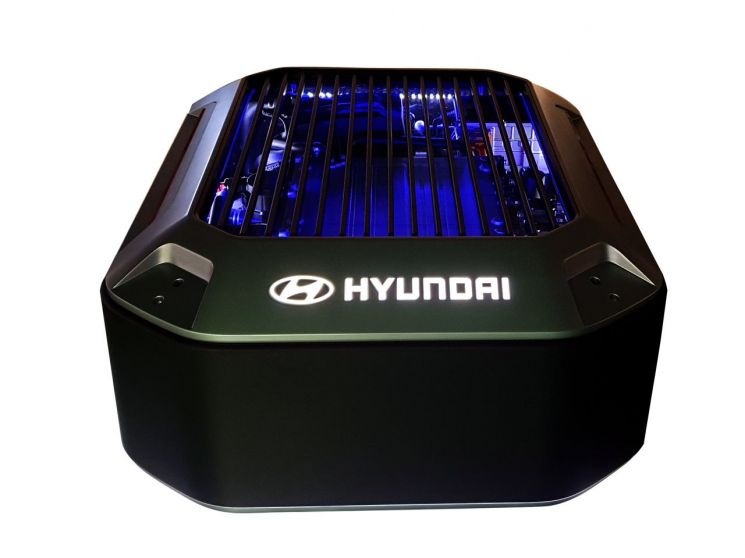
The Institute for Basic Science (IBS) announced on the 16th that the research team led by Sung Young-eun, Deputy Director of the Nanoparticle Research Division and a professor in the Department of Chemical and Biological Engineering at Seoul National University, developed a technology to synthesize platinum-based fuel cell catalysts simply through a heat treatment process, improving the power generation performance per platinum content by about twice compared to existing catalysts.
Fuel cells are the most widely used technology for converting hydrogen energy into electrical energy. Fuel cells produce electricity using hydrogen (H2) and oxygen (O2), emitting only water (H2O) as a byproduct, making them an eco-friendly power generation system expected to be widely utilized across the hydrogen industry, including hydrogen power plants. In particular, hydrogen cars and hydrogen electric trucks can achieve higher efficiency than electric vehicles, making them ideal modes of transportation.
However, the price of platinum (Pt), used as a catalyst in fuel cells, is very high at over 30 million KRW per kilogram, and sufficient power generation performance has not yet been secured, meaning the business feasibility is still low. For fuel cell systems to be widely used across industries, it is necessary to develop technology that can easily mass-produce platinum-based catalysts and significantly improve power generation performance with less catalyst than currently used.
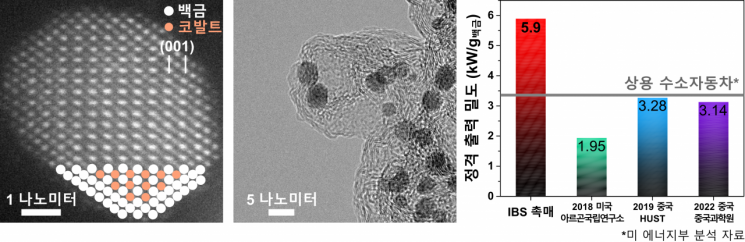 Microscopic image of platinum-cobalt nanocatalysts for hydrogen fuel cells developed by the IBS research team. Photo by IBS
The research team devised a new method to synthesize platinum-based catalysts through a simple heat treatment process. The catalyst developed by the team has a structure combining two metal elements, platinum (Pt) and cobalt (Co). When these two elements are placed on a carbon support and heated up to 900℃, the two metal elements arrange themselves regularly, forming nanocrystals about 4 nm in size. Platinum atoms regularly surround and protect the unstable cobalt, resulting in excellent catalyst performance and stability. Additionally, the synthesis process does not require toxic solvents or surfactants, which is another advantage.
Using the synthesis method devised by the research team, a large number of nanoparticles can be densely arranged on the carbon support, facilitating the movement of oxygen gas. This means that the inflow of oxygen gas, used as a reactant in fuel cells, becomes easier, improving efficiency. Furthermore, by evenly dispersing an additive called ionomer, which facilitates ion movement, on the carbon substrate, the problem of existing catalysts not achieving their full performance when implemented in fuel cells was resolved.
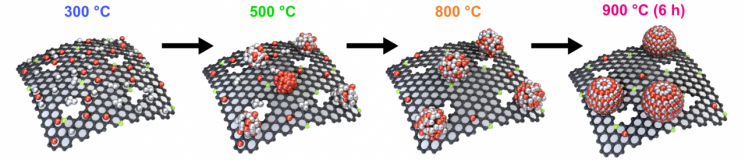 The formation process of platinum-cobalt nanocatalysts for hydrogen fuel cells developed by the IBS research team. Photo by IBS
Performance evaluation confirmed that when using the same weight of platinum, the catalyst produces nearly twice the power (5.9 kW/gpt) compared to existing hydrogen cars. This means the amount of expensive platinum, which accounts for 40% of the fuel cell cost, can be reduced by half. This is an excellent performance that meets the 2025 development target set by the U.S. Department of Energy (DOE).
Director Hyun Taek-hwan said, “This is a core technology that can easily mass-produce expensive platinum catalysts and achieve higher power generation performance and durability with a small amount of catalyst,” adding, “It will contribute not only to fuel cell catalysts but also to improving the performance and durability of catalysts used in various electrochemical industries.”
Deputy Director Sung Young-eun, who led the research, said, “We have solved the problems that were obstacles to the commercialization of fuel cells and secured world-class fuel cell performance,” and added, “We expect this to greatly contribute not only to the industrial development of hydrogen cars but also to achieving a hydrogen economy for carbon neutrality.”
The research results were published online on the 30th of last month in the energy field journal Energy & Environmental Science (IF 39.714).
© The Asia Business Daily(www.asiae.co.kr). All rights reserved.
![Clutching a Stolen Dior Bag, Saying "I Hate Being Poor but Real"... The Grotesque Con of a "Human Knockoff" [Slate]](https://cwcontent.asiae.co.kr/asiaresize/183/2026021902243444107_1771435474.jpg)


















