With the '1st Generation New Town Special Act' Increasing Reconstruction Feasibility
Some Complexes That Pushed for Remodeling Shift Back to Reconstruction
Reconstruction 'Nail in the Coffin' Re-Charge Remains a Variable
[Asia Economy Reporter Kwak Minjae] Voices calling for reconstruction are growing louder in the first-generation new town complexes, such as Bundang and Ilsan, where remodeling projects were being pursued. Until now, remodeling projects have enjoyed indirect benefits due to redevelopment regulations, but concerns over increased contributions from union members have grown amid rising raw material costs, labor costs, and interest rates. With the announcement of the special law for first-generation new towns, which includes eased safety inspections and an increase in floor area ratio (FAR) up to 500%, the feasibility of reconstruction projects has improved. However, since the “Reconstruction Excess Profit Recovery System (재초환)” still remains, the calculations for complexes pursuing redevelopment projects are complicated.
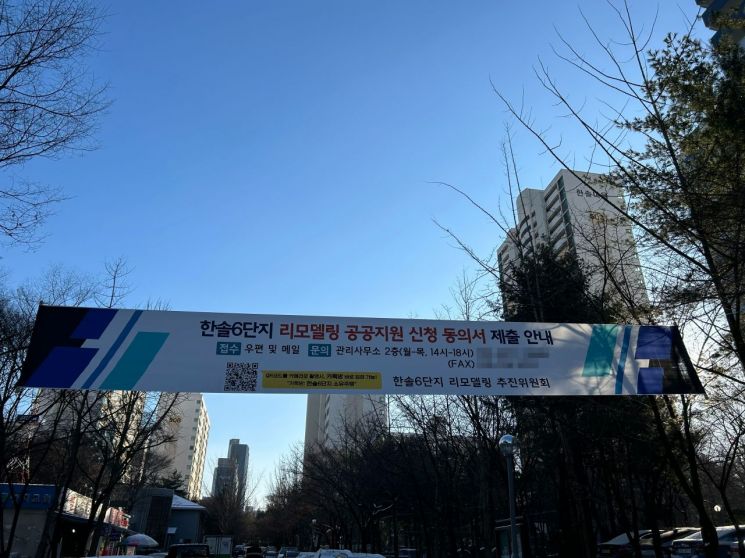 A view of Hansol Village 6 Complex in Jeongja-dong, Bundang, where a remodeling project is underway.
 Photo by Kwak Minjae
According to the real estate industry on the 20th, since the announcement of the special law’s key contents, voices among residents of first-generation new towns have emerged advocating a shift from remodeling to reconstruction. Mr. A, the head of a real estate agency near Hansol Village Complex 6 in Jeongja-dong, Bundang, said, “In the case of Hansol Village Complex 6, unlike Complex 5 where a union was established and remodeling was significantly underway, it was not at that stage yet. With the substantial easing of safety inspections and FAR regulations, there is a sense of crisis that if remodeling is pursued hastily, the complex could fall behind others that start reconstruction first, so voices for reconstruction are growing.” Hansol Village Complex 6 was selected as a public housing remodeling public support complex by Seongnam City in 2021.
Until now, first-generation new towns have pursued remodeling as a second-best option because it is less regulated than reconstruction and allows for faster project progress by keeping the existing framework and adding extensions. Moreover, there was a consensus that the business feasibility of reconstruction was low because most first-generation new town apartments have a FAR exceeding 180%. Reconstruction requires covering project costs by selling the increased number of housing units to general buyers, but since the average FAR of first-generation new towns exceeds 180%, there is no additional FAR to increase the number of housing units. For these reasons, the number of remodeling projects rapidly increased during the Moon Jae-in administration. Remodeling projects increased from 94 sites (69,085 households) in December 2021 to 131 sites (104,850 households) in June the following year, an increase of 37 sites (35,765 households).
However, the atmosphere changed with the government’s announcement of the special law on the 7th. If the FAR can be increased up to 500%, the number of general sales can be increased accordingly to cover project costs, and the easing of safety inspection standards can accelerate the process. This is why voices for reconstruction, which can yield greater profits, have grown among union members. According to the Korea Remodeling Association, as of January this year, there were 138 remodeling projects nationwide (112,144 households). Although this is 7 more than the 131 sites in June of the same year, right after the launch of the Yoon Seok-yeol administration, the rate of increase has sharply declined.
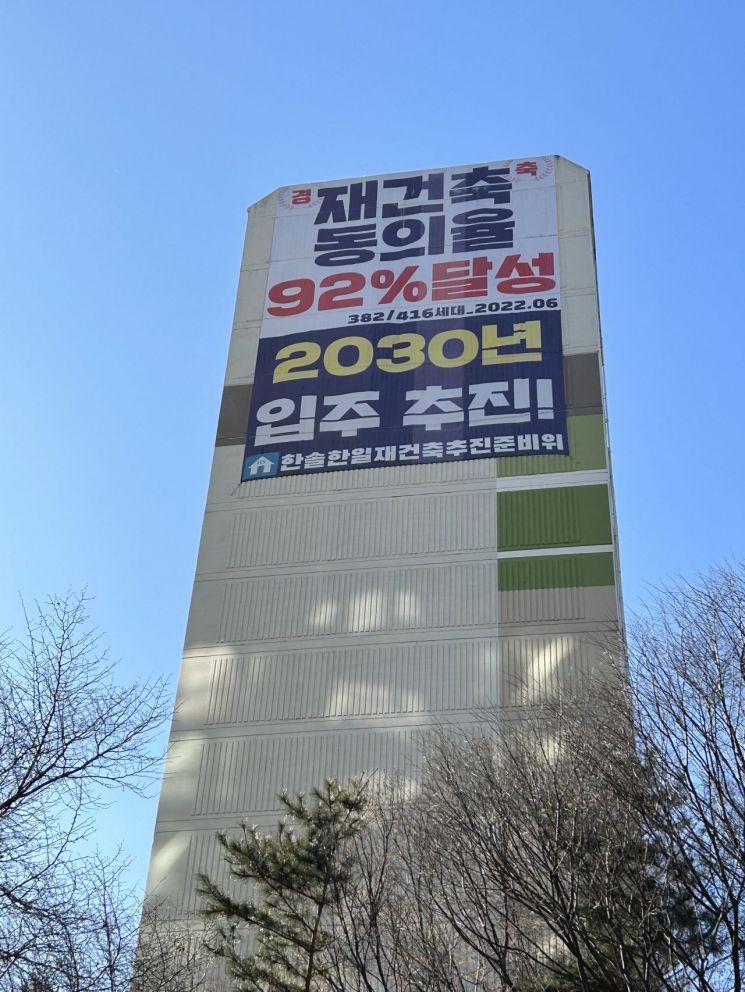 In various parts of the aging complexes in Jeongja-dong, Bundang, there were signs of movements pushing for reconstruction.
 [Photo by Kwak Minjae]
As the situation rapidly changes, opposition to remodeling has also appeared in Gangseon Village Complex 14 in Ilsan Seo-gu, Goyang City, where the first remodeling union was established last year. According to the redevelopment industry, after the announcement of the first-generation new town special law, some residents of this complex have been demanding reconstruction and collecting “remodeling opposition consent forms.” Mr. B, the head of a real estate agency near this complex, said, “After the government’s special law announcement, the situation changed drastically, and it seems residents believe reconstruction is more beneficial than remodeling. Voices are growing that even if the remodeling union is canceled, reconstruction should be pursued.”
Concerns among union members about the burden of contributions for remodeling projects are also a background for the growing voices for reconstruction. Remodeling has fewer general sales units, so as construction costs increase, union members’ contributions also increase accordingly. Due to the housing market downturn and the sharp rise in raw material costs, labor costs, and interest rates, construction costs have surged, increasing the likelihood that union members will have to pay higher contributions.
Lee Dong-hoon, Policy and Legal Affairs Committee Chair of the Korea Remodeling Association, said, “From the residents’ perspective, if the contributions they have to pay increase by 10-20% in perceived terms, they may feel burdened. To establish a remodeling union, more than two-thirds of union members’ consent is required, and even when conditions were favorable, it took up to six months, so it was not easy. Now, with the market shrinking, pursuing remodeling does not seem easy.”
However, since the Reconstruction Excess Profit Recovery System (재초환), a major obstacle to reconstruction projects, still remains, the calculations for complexes pursuing remodeling projects are expected to become even more complicated. Unlike remodeling projects, the government imposes taxes on excess profits from reconstruction projects, calculated by subtracting construction and development costs and average housing price increases from the increased housing prices. Professor Park Hap-soo, adjunct professor at Konkuk University Graduate School of Real Estate, said, “From a business feasibility perspective, reconstruction is indeed better than remodeling, but if the existing 재초환 is applied as is, project delays are likely, so complexes pursuing redevelopment projects are expected to remain cautious for the time being.”
© The Asia Business Daily(www.asiae.co.kr). All rights reserved.
![Clutching a Stolen Dior Bag, Saying "I Hate Being Poor but Real"... The Grotesque Con of a "Human Knockoff" [Slate]](https://cwcontent.asiae.co.kr/asiaresize/183/2026021902243444107_1771435474.jpg)

















