Old Cars Galloper and Grandeur Priced Above Release Price
Domestic Old Car Market Worth 500 Billion Won
Popular Among MZ Generation as a Means of Self-Expression
Challenges to Address Include Environmental Regulations and Insurance Issues
[Asia Economy Reporter Su-yeon Woo] The Hyundai Pony is the first independently produced model of a Korean-made car. Until the Pony was launched, Korea was merely a contract factory that produced cars by directly licensing American technology. Although Ford produced cars in Korea, it did not teach any core technologies. However, with the launch of the Pony, Korea rose as an independent automobile manufacturing country. The lacking technology was supplemented through a technical partnership with Japan's Mitsubishi. When the Pony, equipped with an engine developed by Hyundai, climbed up Namsan, the employees cheered.
It has already been 48 years since Hyundai started mass production of the Pony in 1975. (This also means that 'heritage cars' that have left a mark on the history of Korean automobiles have begun to emerge domestically.) Old cars are not simply old vehicles. They refer to historically significant cars that have changed the entire industry flow or hold meaning for the brand itself. They must be rare and meaningful. Internationally, old cars are sometimes defined by fuel delivery methods (carburetor or electronic fuel injection) or production year. However, since there is no clear system yet in Korea, cars over roughly 20 years old are generally categorized as old cars.
On the 16th, a restored 1994 Hyundai Galloper (300,000 km) equipped with a V6 3.0 engine was listed for 26 million KRW on the used car trading platform Encar.com. In January, the same model with 20,000 km was sold for 23 million KRW. The launch price of the Galloper 3.0 in 1991 was 18.2 million KRW. As a consumable product, cars depreciate over time. However, this Galloper’s price has actually increased. It has gained intangible value beyond being a simple car.
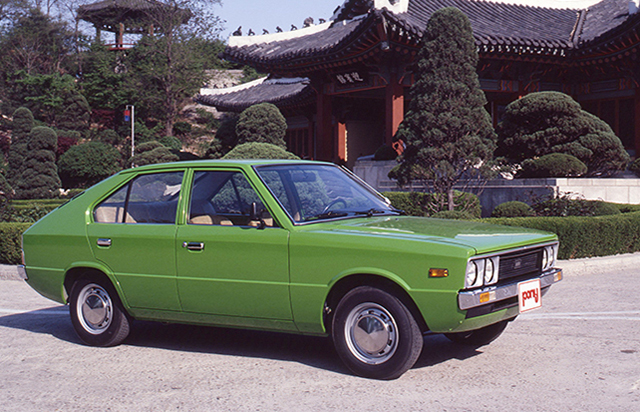
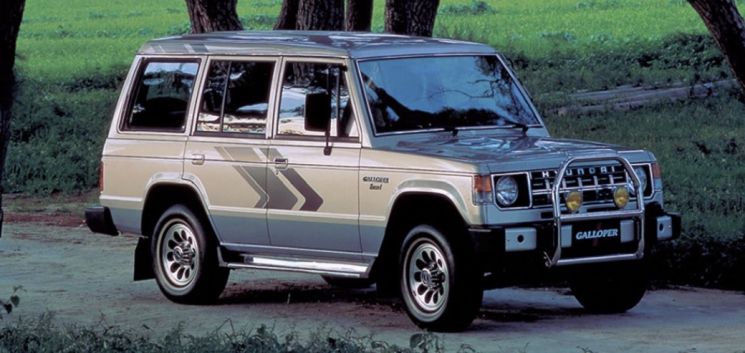
Galloper, Kak Grandeur, Pony 2 Pickup... In High Demand Among Enthusiasts
The Hyundai Galloper, first-generation Grandeur (commonly called Kak Grandeur), and Pony 2 Pickup are highly sought-after models among domestic old car enthusiasts. First, the Galloper is popular among campers due to its spacious interior. Although the Galloper was originally a 6-seater, its interior was so spacious that a 7-seater license was even considered. Another popular feature is its use of a frame body, which is rare in today’s SUVs. A frame body is a structure where the body is mounted on a ladder-shaped frame. Since the body and frame are separate, restoration work is much easier.
The Galloper also holds historical significance as Hyundai’s first SUV. It was the first project undertaken by Honorary Chairman Chung Mong-koo when he was in charge of the automobile division. During the Hyundai Precision & Industries (now Hyundai Mobis) era, Chairman Chung, with full support from the founding chairman Chung Ju-yung, initiated the development project for a four-wheel-drive SUV. This coincided with the increase in leisure activities among the public during the Seoul Olympics, leading to explosive growth in the four-wheel-drive SUV market. In its first year of release in 1991, the Galloper caused a stir in the market. The following year, it captured a 52% share of the domestic four-wheel-drive SUV market.
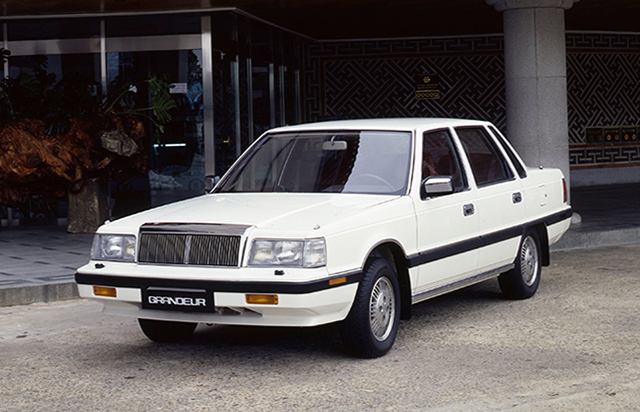
The first-generation Grandeur, known as 'Kak Grandeur,' is also a bestseller in the domestic old car market. Released in 1986, the first-generation Grandeur was the most expensive domestic luxury car. The launch price of the first-generation Grandeur 3.0 was 28.9 million KRW. At that time in 1987, the sale price of an 18-pyeong apartment in Banpo Jugong was around 34 million KRW. The price of one car was roughly equivalent to that of a decent apartment in Seoul. The first-generation Grandeur is popular in the old car market due to its image as a luxury sedan targeting the wealthy and a symbol of success. Well-maintained 'Kak Grandeur' models are currently listed in the old car market for about 10 million KRW. Its clean, dignified design emphasizing straight lines is highly appreciated. The seventh-generation new Grandeur, released at the end of last year, also inherits the design of the 'Kak Grandeur' because many consumers feel nostalgic about the first-generation Grandeur’s design.
"A Means to Express Individuality" MZ Generation Enthusiastic
Recently, among the MZ generation, the culture of driving old cars is spreading like a trend. In the past, old cars were a collecting culture shared among 'older gentlemen' as a form of nostalgia. However, the younger generation perceives old cars as 'Newtro'?a reinterpretation of past culture they have never experienced before.
For the MZ generation, expressing their individuality is important. One of the means of expression is through cars. Young people who think 'I don’t want to drive the same car as everyone else' choose old cars. They are willing to endure the effort of repairing and maintaining the car for the sake of individuality. Also, well-maintained domestic old cars can be found for around 10 million KRW. Due to the low price entry barrier, more MZ generation individuals are considering old cars as their first vehicle.
Experts advise that when trading old cars, the priority is to find vehicles with well-preserved bodies. Engines, internal parts, and interiors are consumables and can be replaced with new ones, but the frame cannot be repaired once damaged. Additionally, it is recommended to use vehicle accident history inquiry services to carefully check maintenance and accident records, as well as flood damage. Since many old car transactions occur between individuals, it is important to select vehicles cautiously.
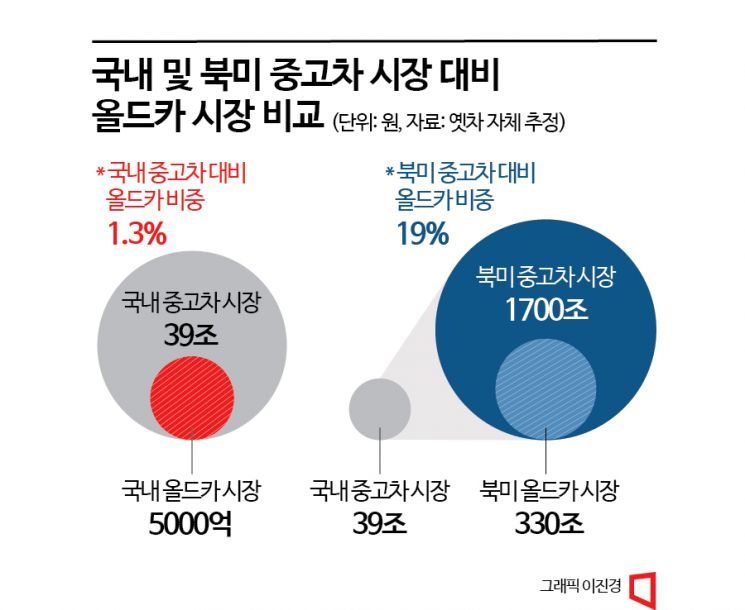
The domestic old car market size is estimated at around 500 billion KRW by the classic car platform startup Yetcha. This is about 1.3% of the domestic used car market (39 trillion KRW), still a negligible scale. In advanced automobile manufacturing countries such as the United States, Japan, and Germany, the old car market is already separated, and auction markets are active. Environmental regulations have also been revised early on.
In contrast, the domestic old car market is still integrated into the used car market without clear standards or regulations. As the market grows, many issues need to be addressed, including environmental regulations and customized insurance. Won Myung-won, CEO of the startup Yetcha, said, "Even if we want to exhibit classic cars, environmental regulations prevent them from being driven inside the four gates of Seoul," adding, "We expect regulatory improvements appropriate to the market size as it grows."
© The Asia Business Daily(www.asiae.co.kr). All rights reserved.



















