Presiding over the Emergency Economic and Livelihood Meeting... Emphasizing Relief on High Interest Rates, Heating, and Communication Costs
President Yoon: "Focus on Managing Spending Burdens in Livelihood Areas"
Reiterates "Banks Are Public Goods" and Calls for "Voluntary Participation in Sharing Pain"
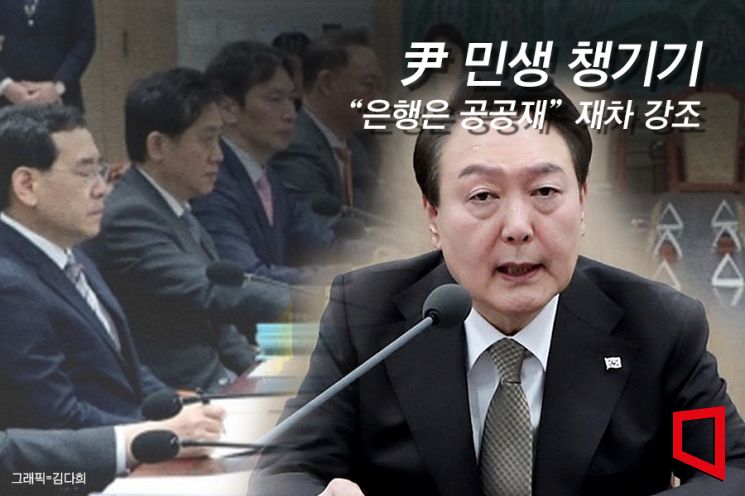
[Asia Economy Reporter Baek Kyunghwan] President Yoon Suk-yeol announced on the 15th, "Public utility fees managed by the government will be operated with a freeze policy in the first half of the year." This includes energy fees, communication costs, and financial costs, which President Yoon identified as 'public goods.' Two days after instructing financial authorities to prepare related measures in response to the public's suffering from high bank interest rates, he appeared before the entire nation and also urged the private sector to make efforts to stabilize prices. This move is interpreted as an intention to directly address various living expenses issues and soothe the anxiety of ordinary citizens, as well as to regain approval ratings that fell due to controversy over interference in the party convention.
On the morning of the same day, President Yoon presided over the 13th Emergency Economic and Livelihood Meeting held at the Yongsan Presidential Office building via live broadcast, stating, "We will focus on discussing measures to reduce the expenditure burden and strengthen support for vulnerable groups in four major livelihood areas directly related to people's lives: public utility fees, energy fees, communication costs, and financial costs," revealing the government's policy direction.
This meeting was convened to discuss measures to stabilize livelihoods in key areas such as public utility fees, energy fees, communication costs, and easing interest rate burdens. Although the detailed meeting was held privately, considering the growing public anxiety over living expenses and criticism from both inside and outside that government measures were not being prepared quickly, the president's opening remarks were broadcast live.
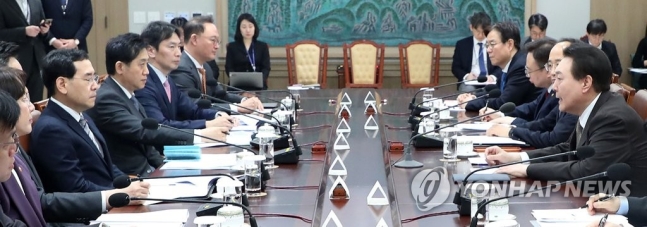 President Yoon Suk-yeol is speaking at the 13th Emergency Economic and Livelihood Meeting held on the morning of the 15th at the Yongsan Presidential Office building in Seoul.
 [Photo by Yonhap News]
On that day, President Yoon emphasized, "Public utility fees managed by the central government, such as roads, railways, and postal services, will be operated with a freeze policy as much as possible in the first half of the year." To this end, he asked local governments to also work together to stabilize local public utility fees as a part of livelihood support. This policy aims to reduce the burden on ordinary citizens by adjusting the timing of public utility fee increases, and he also indicated the intention to partially reflect this policy in private sectors such as finance and telecommunications.
The repeated mention of the financial sector as a 'public good' is in the same context. Earlier, in last month's Financial Services Commission briefing, President Yoon said, "Banks are a public good system more important than national defense." The current government's logic is that companies without owners and with dispersed ownership, which contributed to the public interest, should have minimal government management involvement but should work together to establish fair and transparent governance. On this day, President Yoon added, "The financial and telecommunications sectors have strong public good characteristics and are government-licensed businesses maintaining oligopolistic conditions. Since they greatly affect the difficult household finances of ordinary citizens, I believe that alongside government efforts to improve systems, the industry should voluntarily participate in sharing the burden to stabilize prices."
Accordingly, at the meeting, Kim Joo-hyun, chairman of the Financial Services Commission, reported to President Yoon on measures to ease the burden of high-interest rates and support vulnerable borrowers. Both the Financial Services Commission and the Financial Supervisory Service expressed willingness to review the banks' performance-based compensation systems. The day before, Lee Bok-hyun, governor of the Financial Supervisory Service, announced a related review, stating, "In a situation where the public's difficulties are increasing due to high interest rates and economic slowdown, banks are paying large performance bonuses based on record-high interest income, but efforts to coexist with the public are insufficient."
Discussions also focused intensively on easing the burden of living expenses such as energy fees and communication costs. Lee Chang-yang, Minister of Trade, Industry and Energy, proposed measures to reduce public utility fees such as heating and electricity costs, while Lee Jong-ho, Minister of Science and ICT, presented plans to reduce communication costs. Regarding heating costs, the presidential office and government currently prioritize support for heating costs for low-income households but are also considering expanding support to the middle class. This is based on the judgment that the middle class is also facing difficulties due to the sharp rise in energy prices. However, they are reviewing how far financial support can go and whether there are other alternatives. The same applies to communication costs. President Yoon mentioning communication costs after interest rates and heating costs reflects the intention to reduce the living expense burden on ordinary citizens. The government reports that although communication expenses have significantly increased in household trends, the actual communication-related costs felt or borne by ordinary citizens are much higher.
In the political sphere, it is expected that President Yoon's 'livelihood care' will continue. This is to focus on the livelihood economy while distancing from the noise surrounding the People Power Party convention and President Yoon's wife, Kim Geon-hee, and to regain approval ratings that have turned downward. A presidential office official said, "The president and government’s will to visit the field, directly listen to the voices of the people, and reflect them in policies will continue."
© The Asia Business Daily(www.asiae.co.kr). All rights reserved.


















