[Asia Economy Reporter Haeyoung Kwon] American automaker Ford has halted production of its electric pickup truck, the F-150 Lightning, due to battery defects. This has caused setbacks in Ford's plans to expand electric pickup truck production.
On the 14th (local time), Ford announced that the Detroit plant producing this model has been shut down since last week. A Ford spokesperson explained, "A potential battery defect was discovered during the quality inspection process before vehicle shipment," adding, "Production and shipment are suspended during the investigation period."
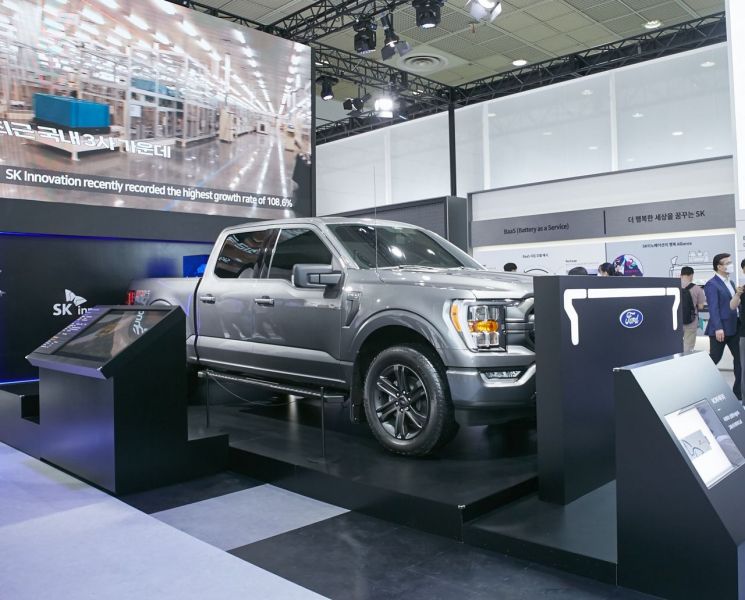
The F-150 Lightning is the electric vehicle model of the popular F-150 pickup truck in the United States. Ford began production of the F-150 Lightning in April and has been accelerating plant operations to meet order demand.
Currently, in the U.S. electric pickup truck market, Ford's F-150 Lightning is fiercely competing with Rivian Automotive's 'R1T' and General Motors (GM)'s 'GMC Hummer.' Ford reported selling 15,600 units of the F-150 Lightning in 2022 and currently has 200,000 pending orders. Jim Farley, Ford's CEO, has also emphasized that the company will surpass Tesla's sales volume in the U.S. market within the next few years.
The U.S. economic media outlet CNBC pointed out, "Automakers typically face battery defects and recalls, but battery issues are particularly concerning." Since automakers are investing billions of dollars solely in the battery sector, a single defect can cause significant losses. Safety concerns are also critical. Two years ago, GM recalled the Chevrolet Bolt electric vehicle due to battery defects. The recall affected about 60,000 units in the U.S. and approximately 10,000 units in Korea, totaling 70,000 vehicles.
This battery defect is likely to cause unavoidable setbacks in Ford's plans to accelerate the transition to electric vehicles. CEO Farley has stressed the importance of becoming a leader in the early electric pickup truck market. Especially since Ford was late to transition to electric vehicles after insisting on internal combustion engine vehicles, the company has been pushing strongly for electrification. On the 13th, Ford announced plans to invest $3.5 billion (approximately 4.5 trillion KRW) in partnership with Chinese electric vehicle battery maker CATL to establish a battery factory in Michigan, USA. On the same day, Ford revealed plans to cut 3,800 jobs across Europe, including Germany and the UK, citing this as part of the electric vehicle transition.
Currently, the F-150 Lightning is equipped entirely with NCM9 batteries produced at SK On's Georgia Plant 1. NCM9 is a high-performance high-nickel battery with a nickel content of about 90%. While a higher nickel content increases driving range, it has the drawback of reduced safety. SK On has compensated for this by using Z-folding technology, which wraps the separator inside the battery in a zigzag (z) shape. SK On, through its U.S. subsidiary SK Battery America (SKBA), has invested a total of $2.6 billion and operates battery plants 1 and 2 exclusively in Georgia. Plant 1, with a production capacity of 9.8 gigawatt-hours (GWh), began construction in 2019 and started mass production last year.
The Wall Street Journal (WSJ) pointed out, "Traditional automakers are entering competition with startups to develop and sell electric vehicles," but "many companies are experiencing production difficulties due to supply chain instability."
© The Asia Business Daily(www.asiae.co.kr). All rights reserved.

















