Member of the Chinese Academy of Social Sciences and President of the World Economic Association
"Fixed Asset Investment Will Drive Growth"
"Expansionary Monetary Policy Needed, Including Reserve Requirement Ratio Cut"
[Asia Economy Beijing=Special Correspondent Kim Hyun-jung] As the Chinese government prepares to announce this year’s economic growth target at the upcoming Two Sessions (National People's Congress and Chinese People's Political Consultative Conference) next month, there is a forecast that the figure could reach 6%.
According to the state-run Global Times (GT) on the 14th, Yu Yongding, a member of the Chinese Academy of Social Sciences, a think tank directly under the State Council, said in an interview with GT, "To boost confidence in economic policy, the Chinese government may set this year’s GDP growth target at 6%." Yu, who previously served as a member of the Monetary Policy Committee of the People’s Bank of China and currently serves as president of the Chinese World Economy Society, is regarded as one of the most authoritative economists in China.
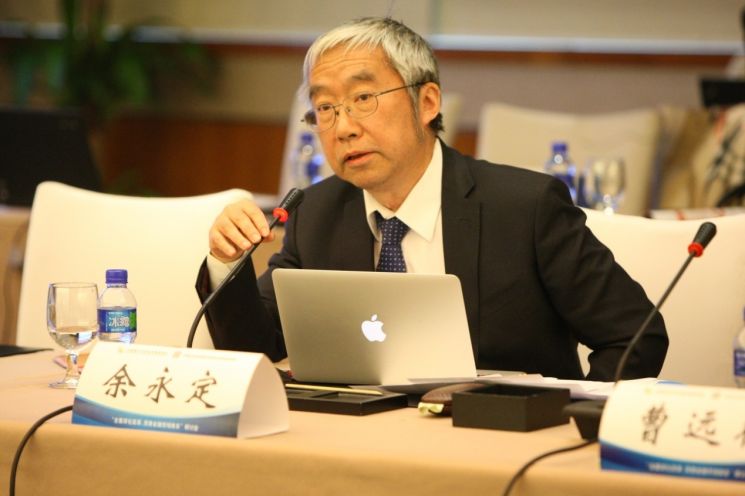 Member Wei Yongding of the Chinese Academy of Social Sciences, a think tank directly under the State Council of China (Photo by Baidu)
He said, "The Chinese economy is highly likely to rebound strongly this year, based on the low base effect from last year’s 3% GDP growth rate and China’s expansionary macro policies to stimulate the economy," adding, "If there is no black swan (unexpected crisis), China’s economic growth rate will exceed 5% this year."
Above all, he predicted that fixed asset (infrastructure) investment will drive growth this year. He stated, "Fixed asset investment will be the key driver of China’s GDP growth this year," and added, "Among them, manufacturing investment will be determined by market forces, and real estate investment, which fell 10% last year, will regain a stable foundation this year." Regarding consumption, despite government measures such as coupon issuance, he believed the increase would be limited without improvement in household income from economic growth. He said, "Consumption may temporarily rebound due to pent-up demand, but it will not be sustained unless income expectations improve," reminding that the contribution of consumption to GDP growth decreased from 65.4% in 2021 to 32.8% last year.
Addressing concerns that government-led infrastructure investment is excessive, he said, "The pandemic (COVID-19) showed that China’s public health infrastructure is still insufficient," diagnosing, "The per capita infrastructure gap between China and advanced countries is enormous in other sectors as well." He foresaw uncertainty in China’s export sector this year. He emphasized, "Due to the bleak global economic outlook, exports are unlikely to be a strong driver of the economy," and added, "China needs to further adjust its export policies to improve the efficiency of cross-border resource allocation."
He also expressed the view that China must tolerate a rise in the fiscal deficit ratio to GDP while implementing expansionary macro policies. He stressed, "China does not need to strictly adhere to the doctrine of keeping the fiscal deficit ratio below 3% of GDP," and said, "It may need to significantly increase government bond issuance, and strengthening cooperation between the government and the central bank is important in this process."
As an important expansionary monetary policy tool, he pointed to lowering the reserve requirement ratio (weighted average 7.8%) of Chinese financial institutions. Yu argued, "There is room to lower the policy rate further when necessary," and said, "Monetary policy should play an active role in preventing liquidity shortages from causing bankruptcies as small and medium-sized enterprises restore supply chains and resume normal operations." However, he cautioned, "We must also learn from past lessons," explaining, "Credit expansion should not be forced on companies and households by commercial banks at the expense of profitability and risk in a non-market-oriented manner."
He expected inflationary pressures this year. Yu forecasted, "Due to the severe impact on China’s production capacity over the past three years, repairing supply chains and resolving bottlenecks may take longer than expected," adding, "Supply-demand imbalances could lead to increased inflation for a certain period this year." Furthermore, he said, "De-globalization, Sino-US trade disputes, global supply chain disruptions, and rising food and energy prices due to the Russia-Ukraine conflict will cause import inflationary pressures on China," and added, "The possibility of further depreciation of the yuan and the resulting pressures cannot be ruled out."
© The Asia Business Daily(www.asiae.co.kr). All rights reserved.

















