Dispatches Increase by 12.8% Compared to Previous Year
[Asia Economy Reporter Kiho Sung] The National Fire Agency announced on the 15th that last year, it responded to a total of 1,199,183 rescue operations, handled 640,099 cases, and rescued 113,156 people. This averages to 3,285 dispatches per day, 1,753 rescue sites, and 310 people rescued daily. In terms of rescue cases handled, this means that 1 out of every 80 people in the country received help from rescue teams based on the national population statistics.
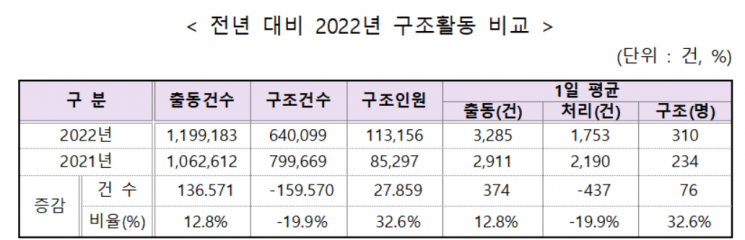
Compared to the previous year (2021), rescue dispatches increased by 12.8% (1,199,183 times), and the number of people rescued also rose by 32.6% (113,156 people).
Dispatches to apartment complexes, roads, and single-family homes accounted for nearly half (49.64%) of all dispatches, indicating that rescue activities were concentrated in residential facilities and traffic-related locations. The number of people rescued was also highest at residential facilities and traffic accident sites, which is interpreted as a result of an increase in residential safety accidents (such as entrapment, elevators, unlocking devices) and road-related traffic accidents (involving electric vehicles, bicycles, kickboards, agricultural machinery, etc.).
By season, 445,101 cases (37.12%) occurred in summer, when there is a high flow of leisure population, and 306,404 cases (25.55%) in autumn, accounting for 62.67% (751,505 cases) of total dispatches. The main activities also differed according to seasonal characteristics.
In spring, the main dispatches were for fires and traffic accidents; in summer, for beehive removal and water-related accidents; in autumn, for mountain accidents and location confirmation; and in winter, when heating device use increases, for electrical and gas accidents and unlocking devices.
Accordingly, the National Fire Agency plans to strengthen safety campaign promotions tailored to seasonal and type-specific characteristics and prepare customized life-saving measures through cooperation with local governments and related organizations.
Another notable point is that the number of beehive removal cases decreased sharply by 45.6% compared to the previous year. This is believed to be largely due to climate change causing repeated abnormal low and high temperatures in spring, shortening the bees' active period. Additionally, the operation of the ‘Bee Sting Accident Forecast System’ also showed its effectiveness.
By region, out of the total 1,199,183 cases, Gyeonggi-do recorded 292,897 cases (24.4%), Seoul 213,383 cases (17.8%), and Gyeongnam 83,172 cases (6.9%), with the Seoul metropolitan area (Seoul, Gyeonggi, Incheon) accounting for 46.23% of nationwide dispatches. The number of dispatches per population was highest in Gangwon (1 case per 20 people), Gyeongnam (1 case per 27 people), and Jeonnam (1 case per 27 people).
In Gangwon and Gyeongnam, many dispatches were related to road locations such as traffic accidents. This appears to be linked to the increase in outdoor activities coinciding with the easing of COVID-19 quarantine guidelines, leading to more traffic accidents involving visitors.
Lee Il, Director of the 119 Response Bureau at the National Fire Agency, stated, “Since the easing of COVID-19 quarantine guidelines in April last year, outdoor activities have increased, resulting in more traffic accidents and outdoor safety incidents on roads, fields, mountains, rivers, and seas. We will work to minimize casualties by strengthening traffic safety rule promotions in cooperation with local governments and related organizations, implementing tailored prevention policies by accident type, and enhancing the professional capabilities of rescue personnel.”
© The Asia Business Daily(www.asiae.co.kr). All rights reserved.
![Clutching a Stolen Dior Bag, Saying "I Hate Being Poor but Real"... The Grotesque Con of a "Human Knockoff" [Slate]](https://cwcontent.asiae.co.kr/asiaresize/183/2026021902243444107_1771435474.jpg)
















