De Facto Suspension of Legislative Consultations... Medical Community Moves Toward Struggle
[Asia Economy Reporter Lee Gwan-joo] The aftermath of the National Assembly plenary session’s direct referral of the 'Nursing Act' bill, led by the major opposition party, is intensifying. The medical-government consultative body, which was discussing essential medical support measures, was suspended in less than a month. Discussions on the formal legalization of non-face-to-face medical treatment, temporarily permitted during the COVID-19 pandemic, have also inevitably faced setbacks.
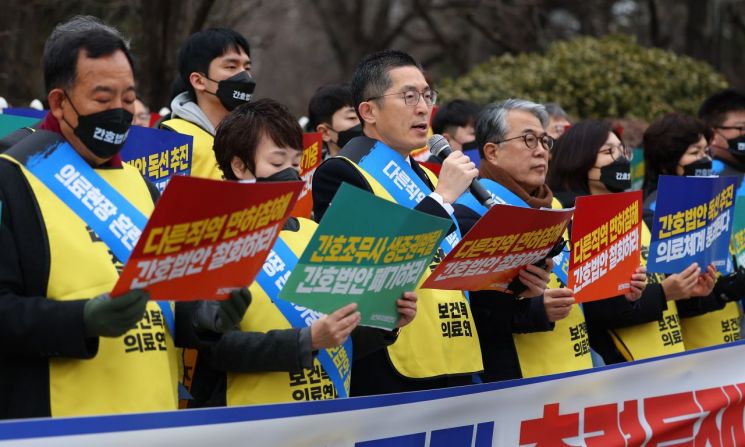 On the 13th, at the Nurses Act Forced Passage Condemnation Declaration Ceremony held by the Health and Welfare Medical Solidarity, Lee Pil-su, President of the Korean Medical Association, is reading the declaration of struggle.
 [Photo by Yonhap News]
According to the medical community on the 15th, the 3rd meeting of the 'Medical Issues Consultative Body' between the Ministry of Health and Welfare and the Korean Medical Association, originally scheduled for the 16th, was canceled. The Medical Issues Consultative Body was established to discuss urgent medical issues that the government and medical community need to resolve. The medical-government consultative body was launched through an agreement in September 2020 but was temporarily suspended in February 2021 due to the COVID-19 outbreak, and was reactivated last month on the 26th after two years. However, as the Nursing Act bill, which the medical community strongly opposed, was directly referred to the National Assembly plenary session, the consultative body was suspended again in less than a month. A Korean Medical Association official said, "At present, it seems difficult to revitalize the consultative body."
The suspension of the medical-government consultative body is expected to become an obstacle to the activation of essential medical support measures, such as addressing the shortage of residents in essential medical departments like pediatrics and adolescent medicine, and resolving regional medical disparities. There was a strong expectation inside and outside the medical community for the resumption of the consultative body, given the noble cause of saving essential medical care and the fact that the current Korean Medical Association leadership, centered on President Lee Pil-soo, has been emphasizing dialogue and compromise to the extent of being classified as 'moderates.' The government’s lukewarm response to the Nursing Act bill also reflected its concern not to break this atmosphere of medical-government relations. Park Min-soo, the 2nd Vice Minister of Health and Welfare, said, "If the Nursing Act passes amid severe conflicts between professional groups, it would be difficult for the executive branch."
Along with this, setbacks have become inevitable in discussions on the legalization of non-face-to-face medical treatment. As it marks three years since non-face-to-face medical treatment was temporarily permitted in February 2020 due to COVID-19, discussions for its formal introduction have been underway, and one of the main agenda items of the medical-government consultative body was the legalization of non-face-to-face medical treatment. Recently, the Ministry of Health and Welfare and the Korean Medical Association reached an agreement on the principles of non-face-to-face medical treatment, including ▲ face-to-face treatment as the principle, using non-face-to-face treatment as an auxiliary means ▲ operation focused on returning patients ▲ implementation mainly at clinic-level medical institutions, with dedicated non-face-to-face medical institutions prohibited.
However, with the suspension of the consultative body before discussing detailed implementation plans, the government’s proposed timeline for legalizing non-face-to-face medical treatment (June) is likely to be delayed. The platform industry, which has been striving to promote the legalization of non-face-to-face medical treatment, also expressed regret. An industry official said, "Medical professionals who provide medical services lead non-face-to-face treatment," adding, "Since the medical community has proactively changed its stance on non-face-to-face treatment, which it had opposed until now, opening the path to legalization, we need to watch future developments closely."
The medical community is expected to continue opposing the enactment of the Nursing Act for the time being. The Korean Medical Association plans to hold an extraordinary general assembly on the 18th to declare a struggle against the Democratic Party of Korea and to handle agenda items such as forming an emergency countermeasure committee related to the Nursing Act. The Health and Medical Solidarity, which includes 13 professional organizations including the Korean Medical Association, will also hold a '4 Million People’s Rally to Block the Nursing Act' in Yeouido, Seoul, on the 26th.
© The Asia Business Daily(www.asiae.co.kr). All rights reserved.

















