April 14 National Assembly Planning and Finance Committee
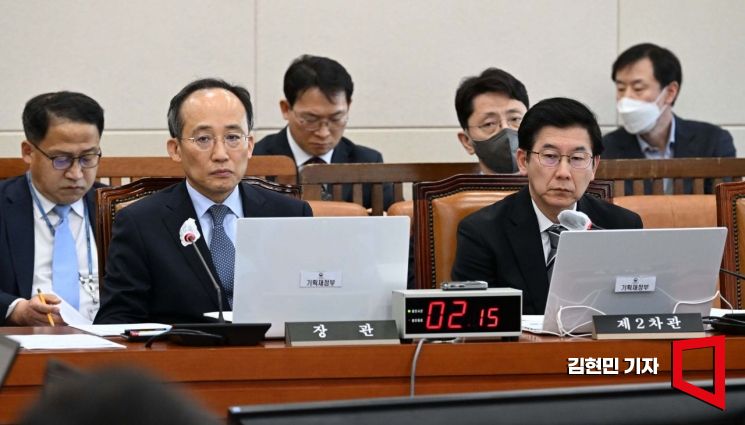 Deputy Prime Minister and Minister of Economy and Finance Choo Kyung-ho and Second Vice Minister of Economy and Finance Choi Sang-dae are attending the 1st plenary meeting of the Planning and Finance Committee held at the National Assembly in Yeouido, Seoul on the 14th. Photo by Hyunmin Kim kimhyun81@
[Asia Economy Sejong=Reporter Song Seung-seop] Ruling and opposition lawmakers criticized the government's policy to expand tax credits for semiconductor investments, emphasizing that increased investment and profit return must be guaranteed. They pointed out that tax benefits should not only serve the profits of some large corporations but must be used in ways that align with national interests.
At the Planning and Finance Committee meeting held at the National Assembly on the 14th, lawmakers from both parties repeatedly criticized the government's additional tax support plan for semiconductor facility investments by large corporations (Amendment to the Restriction of Special Taxation Act), calling for clear policy effects. At the end of last year, the National Assembly, through bipartisan agreement, raised the tax credit rate for large corporations' semiconductor facility investments from 6% to 8%. However, after President Yoon Seok-yeol instructed to expand the credit rate, the government proposed an amendment to increase benefits to 15% for large and medium-sized enterprises and 25% for small and medium-sized enterprises.
Yang Kyung-sook, a member of the Democratic Party of Korea, said to Deputy Prime Minister and Minister of Economy and Finance Choo Kyung-ho, "You came to the office to explain the Restriction of Special Taxation Act before the Planning and Finance Committee, but the materials have not changed," adding, "Most companies receiving tax credits are large corporations, and we need to know how much they earn to review the bill." Yu Dong-su, also from the Democratic Party, said, "We need to see the tax adjustment statements to understand how investment tax credits and R&D will be affected," and added, "If difficult, at least for R&D investment, we need to see how companies receive investment tax credits to judge whether the government proposal is reasonable or not."
Jang Hye-young, a member of the Justice Party, criticized, "It is estimated that Samsung Electronics receives 1.7 trillion won and SK Hynix 400 billion won in tax credits annually. If the credit rate is raised to 15%, Samsung Electronics' amount will increase to 3.2 trillion won and Hynix's to 800 billion won," adding, "Submitting a 15% proposal within a week before even evaluating the effect of the 8% tax credit undermines the authority of the National Assembly and the Ministry of Economy and Finance."
Similar voices came from the ruling party as well. Kim Young-sun of the People Power Party said, "If semiconductor tax credits are given, the public should be informed about what parts are supported and what disadvantages exist, but bureaucrats only know this on paper," and questioned, "Semiconductor company employees are currently fighting for bonuses; are those companies enduring the current difficulties?" He advised, "At least a minimum mechanism must be created to ensure returns to national interests."
Deputy Prime Minister Choo Kyung-ho expressed the position that the passage of the amendment is necessary since semiconductors are a national key industry. He said, "There is bipartisan agreement on the importance of the semiconductor industry," and added, "The opposition party has also promoted policies with awareness of the technological importance and national support needs of strategic industries."
Choo further explained, "Countries are engaged in ultra-gap competition, and whether through fiscal or tax support, each country is competitively advancing," adding, "Although we said we support at a fairly high level, considering their swift actions, there was recognition that we cannot maintain a competitive edge." He appealed, "Large-scale investments must be continuously made, and the structure that creates wealth and circulates it by paying substantial taxes should be strengthened."
Regarding the disruption caused by the Ministry of Economy and Finance's mistake in implementing the Hometown Love Donation policy, Deputy Prime Minister Choo expressed regret. He said, "We failed to carefully manage the implementation timing of the Hometown Love Donation, which was set for 2025," and apologized, "I sincerely apologize for not thoroughly organizing it."
© The Asia Business Daily(www.asiae.co.kr). All rights reserved.
![Clutching a Stolen Dior Bag, Saying "I Hate Being Poor but Real"... The Grotesque Con of a "Human Knockoff" [Slate]](https://cwcontent.asiae.co.kr/asiaresize/183/2026021902243444107_1771435474.jpg)
















