[Asia Economy Yeongnam Reporting Headquarters Reporter Koo Dae-seon] Daegu City announced on the 13th that it will invest 1 billion KRW this year to create smart gardens in 34 locations including industrial complex resident companies, public facilities, social welfare facilities, and medical facilities.
Smart gardens are a new type of indoor garden that applies an IoT control system to idle spaces such as meeting rooms and lounges within multi-use facilities to manage plant growth through automatic watering, growth regulation, and lighting control.
They are also attracting attention as year-round green rest spaces with various functions such as purifying the air by absorbing fine dust and maintaining indoor temperature and humidity at a constant level.
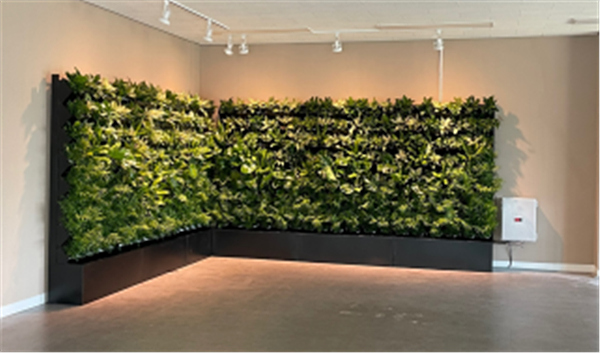 Smart garden created in the office of J-Tech, a company located in Seongseo Industrial Complex, Dalseong-gun, Daegu.
Since 2020, the project has been promoted with national funding secured from the Korea Forest Service, and so far, 4.5 billion KRW has been used to create 45 smart gardens, continuously expanding garden spaces in daily life.
The creation of smart gardens is a Korea Forest Service public project targeting multi-use facilities such as resident companies in industrial complexes, public facilities, medical institutions, as well as educational counseling facilities and social welfare facilities.
This year, smart gardens will be created in resident companies within industrial complexes (21 locations including Seodaegu Industrial Complex, Seongseo Industrial Complex, National Industrial Complex), public facilities (10 locations including Dong-gu Office, Eoul Art Center, Suseong-gu Lifelong Learning Center), and medical institutions (1 location: Asia Union Clinic). In particular, the target will be expanded to social welfare facilities (2 locations: Han Family Nursing Home, Hwawon Nursing Home) where plant healing effects can be expected.
Daegu City is currently accepting applications from institutions or companies wishing to create smart gardens next year.
According to a recent effectiveness verification study on smart garden use by Hankyong National University, the creation of smart gardens reduced users' cerebral blood flow by more than twice (153%), relieving fatigue, and also lowered blood pressure, alleviating physical tension and stress.
Furthermore, the study analyzed that the sympathetic nervous system decreased while the parasympathetic nervous system increased, resulting in more than a 50% reduction in fatigue and depression, and more than a 100% increase in motivation and vitality, demonstrating various positive effects.
Ji Hyung-jae, Director of the Environment and Water Resources Bureau of Daegu City, said, “Smart gardens utilizing small indoor spaces will provide a unique rest and healing space for workers and users in harsh environments,” and added, “We will make further efforts in the creation and management of these gardens so that citizens can easily enjoy various garden cultures in their daily lives.”
© The Asia Business Daily(www.asiae.co.kr). All rights reserved.
![Clutching a Stolen Dior Bag, Saying "I Hate Being Poor but Real"... The Grotesque Con of a "Human Knockoff" [Slate]](https://cwcontent.asiae.co.kr/asiaresize/183/2026021902243444107_1771435474.jpg)
















