Interview with Kim Deokhwan, Manager of Seoul Western Branch, Ministry of Employment and Labor
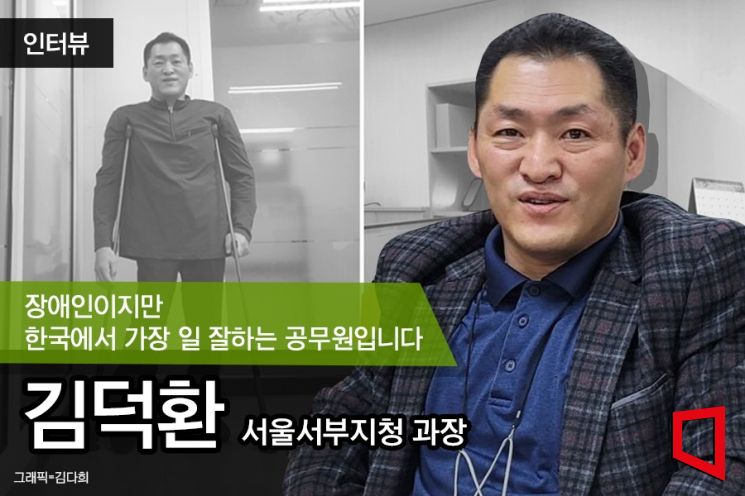
[Asia Economy Reporter Choi Seoyoon] Labor inspectors are called 3D jobs among public officials. However, there was a public official who defied his superior because he was not assigned as a labor inspector. "Do you look down on me because I use crutches? Why don’t you ask me if I want to do it?" This is the very person who shouted at his superior decades ago, Kim Deokhwan, head of the Labor Improvement Guidance Division 3 at the Seoul Western Branch of the Ministry of Employment and Labor. In August last year, just six months after he came to the Western Branch, the number of delayed cases not processed within the period decreased from 45 to 11.
He is a person with a severe disability, diagnosed with level 2 physical disability (scoliosis). When he was just starting to walk after crawling, he suddenly had a fever and went to the hospital, where he was diagnosed with polio. He cannot use his right leg.
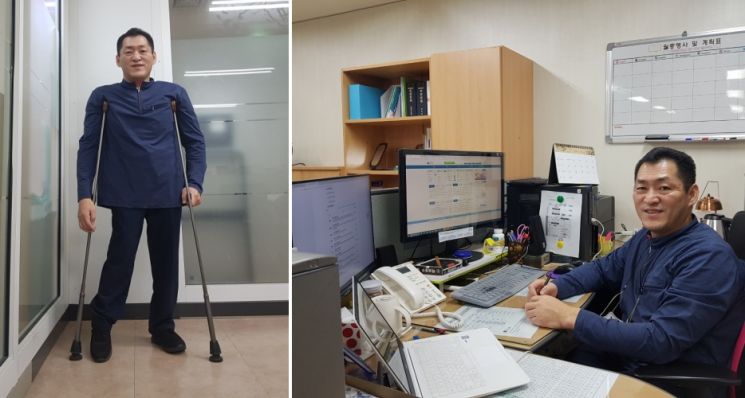 Kim Deok-hwan, Manager of the Labor Improvement Guidance Division 3, Seoul Western Branch Office, Ministry of Employment and Labor
Although physically challenged, his performance surpasses that of regular labor inspectors. As of 2016, just before his promotion to section chief, he returned unpaid wages totaling 453 million won to an average of 177 people annually over five years. This is twice the number of people handled by regular labor inspectors and four times the amount of money.
Because of his excellent performance, he has received more than seven awards. In 2016, he received the ‘Korea Public Official Award,’ given to only about 80 out of one million public officials. He also received the Labor Inspector of the Year Award in 2013, the Labor Office Director’s Commendation in 2011, the Model Public Official Award and Labor Office Director’s Commendation in 2009, the Labor Office Director’s Commendation in 2008, and the Labor Administration Meritorious Service Commendation in 2001. He received the S grade, awarded to the top 10% of public officials based on performance, six times. The S grade grants 172.5% of the annual salary as a performance bonus. Recognizing his achievements, he was promoted to a grade 5 section chief in 2016, the first severe disabled person to do so.
-What was the reason you wanted to become a labor inspector?
△They are special judicial police who catch unscrupulous employers. It was my dream. In the past, the inspection division was so feared that no one dared to enter. There was a time when labor inspectors were recruited separately. The field where they catch bad bosses is like a battlefield every day. That’s why labor inspectors are called the flower of the Ministry of Employment and Labor. When the IMF crisis hit in 1998, many inspectors quit. They had to fill the positions again, so they asked other department staff if they wanted to be inspectors. Everyone said no because the work was hard. I heard this story much later. I raised my voice at my superior (section chief), asking why they didn’t ask me. They probably thought how someone with a disability like me could be a labor inspector. In the end, I was the only one assigned.
-What do you consider important when handling cases?
△How angry would you be if your family didn’t get paid? I treat it like my own business. Some people come and cry out loud. It’s a matter of livelihood. From the complainant’s perspective, the hardest thing is not knowing how long it will take to get the money. It’s frustrating. The most important thing is to resolve it quickly. People who haven’t received the money they deserve shed tears, and the only way to heal that is through this method. I worked ‘Monday through Sunday.’ I developed alopecia areata in five places. I even went to work on holidays. On the morning of Chuseok, I was putting on my shoes to go to work after breakfast, and I felt sorry for myself. I didn’t go out that day. (laughs)
If workers do not receive wages within 14 days from the retirement date, they can report the workplace to the Labor Office. When a petition requesting relief for damages is filed with the Labor Office, the labor inspector summons both the worker and the employer to investigate the facts. Labor inspectors have judicial authority and can handcuff and arrest employers who refuse to cooperate. If unscrupulous employers refuse to pay wages in a defiant manner, the case proceeds to criminal prosecution.
-There must be cases that don’t go well, right?
△I become an employee of that company. I have them talk about how they get ready in the morning, where they transfer subways, when they arrive at the office, and what they do all day, then I close my eyes and listen quietly. Then it unfolds like a video in my mind. I imagine who they ate with and how the seating arrangement was. If a day is too short, I do this for a week. Even though they are upset about not getting paid, why do we ask complainants to bring evidence? I go to the site with them. We look for evidence together. I study what to say to the unscrupulous boss so that they can’t make a sound.
-Do you remember any unscrupulous bosses?
△Bosses who cunningly abuse the law. Usually, new employees don’t check their working hours one by one when they join. For a while, they were told to leave by 6 p.m., but suddenly they were forced to work overtime continuously, different from the job posting. When they looked at the contract, it said they had to work until 8 p.m. It was a comprehensive wage system that included overtime and holiday pay in the salary, but the new employee didn’t know that and signed a contract agreeing to overtime work. Even if they already signed, if the contract terms are unfair, they can be invalidated. However, proving that ‘free labor’ is unfair is not easy.
-It must have been hard dealing with workers who are enraged or complain about unfairness because they didn’t get paid, right?
△It’s human nature. When complainants curse and shout, I offer them a cup of coffee. Then they take a breath. In the past, I even gave cigarettes while investigating. It’s about easing their minds. Some people just vent and leave. They thank me for listening. I also dislike going to government offices because they are stiff. Even the unscrupulous bosses who are questioned by me leave with a smile. I say, “Consider today as tuition paid; I won’t ask you to buy me a drink, just pay the fine. Don’t come again.”
Because the work is hard, many inspectors work negligently. Some are even sued for dereliction of duty for not processing complaints for a year. Civic groups have even released a ‘Labor Inspector Power Harassment Report.’ According to statistics from the Ministry of Employment and Labor provided to Rep. Ahn Hoyoung of the Democratic Party by Workplace Power Harassment 119, only 3 out of 10 requests for labor inspection were actually accepted (as of 2021). The number of cases per labor inspector decreased by 49% over the past five years, but the average processing time only decreased by 4%. This reflects a complacent public service culture where doing the job half-heartedly does not risk dismissal.
Kim, now a section chief whose main duties involve approvals after leaving the field, is still busy. He is devoted to taking care of juniors. Without being asked, he creates manuals sharing his know-how on points to be careful about when dealing with employers and workers, and how to handle cases when both sides have conflicting claims. He still has the habit of handling other jurisdictional complaints when he finishes his own.
-What has changed since you became a section chief?
△My main job became teaching inexperienced MZ generation juniors my problem-solving methods. I tell them to learn and memorize my know-how. Once, I heard a fight between an employer and a worker all the way to my office. I immediately wrote an email to the responsible inspector on how to handle it. Sometimes, I play the role of labor inspector and juniors play the complainant in role-playing. When inspectors think from the complainant’s perspective, questions arise and they can organize what to ask further. When there is a stuck case, I say, “Don’t worry. I’ll take care of everything, just bring it to me.” I only know inspection work. I want to share all my experiences and trial and errors with juniors. Maybe it’s my selfishness, but I want the staff to feel comfortable. Some might think, ‘Does he care that much?’ but we are in the same department and should think of each other as family and take care of one another.
Kim was appointed as a grade 9 public official right after graduating high school. He started 7 to 9 years earlier than his peers. Most of his peers have retired. He is 54 years old this year, with about six years left until retirement.
-Do you have anything you want to do after retirement?
△Most of us become labor attorneys after quitting. If you work as a grade 5 or higher for more than five years and complete certain training, you get a certificate. I also have the certificate, but I’m not confident in sales, so I want to help juniors instead. I want to go around each branch and help unblock stuck cases. I think it would be so refreshing to provide answers with the know-how I have. Like unclogging a blocked drain.
© The Asia Business Daily(www.asiae.co.kr). All rights reserved.



















