[Asia Economy Sejong=Reporter Dongwoo Lee] As the 'heating bill bomb' statement approaches in half a month, attention is focused on the government's plan to expand support for the middle class. The government and political circles expect another heating cost crisis this month following last month and believe that the support scope should be extended to the middle class, but the Ministry of Economy and Finance, the fiscal authority, draws a line on additional support.
According to political and government sources on the 12th, the ruling party and government plan to finalize urban gas support measures for the middle class by the end of this month when the February heating bills are delivered to each household. Earlier, due to the surge in heating costs, the government has been supporting vulnerable groups such as basic livelihood security recipients and near-poor households with incomes below 50% of the median income with up to 592,000 KRW for urban gas bills from December last year to March this year, and also provided similar heating cost benefits to 84,000 vulnerable households using district heating. To this end, the government invested 180 billion KRW, including 100 billion KRW from contingency funds and 80 billion KRW from the existing budget.
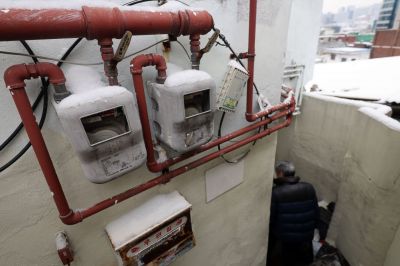 Snow Accumulated on a Gas Meter
 (Seoul=Yonhap News) Photo by Park Dong-joo = On the 26th, snow accumulated on a gas meter in the shantytown of Dongja-dong, Yongsan-gu, Seoul.
The government has decided to expand energy voucher support and gas bill discounts to reduce the burden on vulnerable groups caused by the "heating cost bomb." 2023.1.26 pdj6635@yna.co.kr (End) <Copyright(c) Yonhap News Agency, unauthorized reproduction and redistribution prohibited>
The issue is how to secure finances if heating cost support is expanded to the middle class. On the 7th, President Yoon Suk-yeol instructed to consider support for the middle class, but the Ministry of Economy and Finance anticipated significant fiscal pressure. According to an analysis by the Korea Development Institute (KDI) of the Statistics Korea's Household Financial Welfare Survey, the proportion of the middle class with disposable income between 50% and 150% of the median income was 61.1% in 2021. This means 6 out of 10 people are middle class. If heating costs are supported for all middle-class households as per KDI's analysis, the cost is expected to reach trillions of won. This is why the Democratic Party of Korea demands a supplementary budget of about 7.2 trillion KRW for energy support.
However, the Ministry of Economy and Finance and the Ministry of Trade, Industry and Energy hold the position that directly supporting heating costs for the middle class or preparing a supplementary budget is difficult. Deputy Prime Minister and Minister of Economy and Finance Choo Kyung-ho said, "Raising gas prices and then supporting them with fiscal funds is like a short-sighted approach," adding, "It would be better to directly compensate for the deficits of public enterprises or, overall, move towards energy saving and efficiency." Minister of Trade, Industry and Energy Lee Chang-yang also drew a line, saying, "Considering national fiscal soundness and budget conditions, careful review is necessary."
The variable is the concern that this month's heating bill could be a so-called 'nuclear bomb' level, exceeding expectations. This is because, before confirming last December's heating bill bomb and amid continuous cold waves last month, gas usage in each household is presumed to have already reached a considerable level. If this month's heating bill exceeds expectations, related ministries are expected to have no choice but to strengthen support for the middle class.
The Ministry of Economy and Finance is also leaving some possibility open for middle-class support. Instead of direct budget input, indirect support such as cost reductions is a likely option. Deputy Prime Minister Choo said, "We are considering how to gradually absorb the burden on the middle class over time," but added, "It will require a somewhat different level of review compared to the current method of supporting heating costs for vulnerable groups."
Considering the public utility fee hikes scheduled one after another in the first half of the year, the calculation for heating cost support becomes more complicated. If additional budget input due to the expansion of heating cost support and the variable of public utility fee hikes combine, high inflation could be prolonged. Government authorities judge that the consumer price inflation rate may record the low 5% range this month following 5.2% in January due to the impact of public utility fee hikes. If high inflation in the 5% range solidifies for a considerable period, the burden on low-income households is expected to increase.
In fact, Seoul City raised the basic fare for medium-sized taxis by 1,000 KRW from 3,800 KRW to 4,800 KRW starting this month, and in March, Gyeonggi Province is also pushing to reduce the basic distance for medium-sized taxis from 2.0 km to 1.6 km and raise the basic fare by 1,000 KRW, similar to Seoul City. In April, Seoul City is also considering raising subway and bus fares by 300 to 400 KRW.
© The Asia Business Daily(www.asiae.co.kr). All rights reserved.
![Clutching a Stolen Dior Bag, Saying "I Hate Being Poor but Real"... The Grotesque Con of a "Human Knockoff" [Slate]](https://cwcontent.asiae.co.kr/asiaresize/183/2026021902243444107_1771435474.jpg)

















