Ministry of Education Announces New Semester Quarantine Operation Plans for Kindergarten, Elementary, Middle, and Special Schools
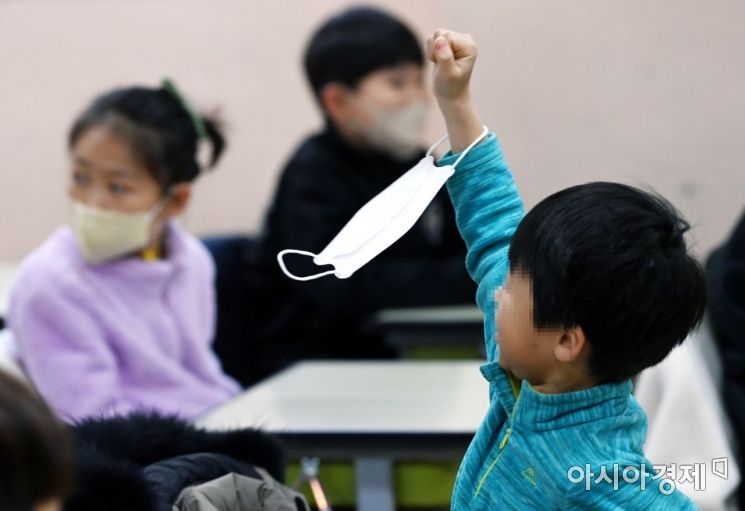 On the 30th, when the indoor mask-wearing mandate was lifted, students wearing masks and those without masks attended class together at Gwangjang Elementary School in Gwangjang-dong, Gwangjin-gu, Seoul. One student raised their hand in response to the teacher's question, "Who wants to take off their mask?" Photo by Huh Younghan younghan@
[Asia Economy Reporter Yoo Byung-don] From now on, the temperature checks that were conducted every time students went to school will be discontinued, and the partitions in the cafeteria will also be removed.
On the 10th, the Ministry of Education announced the "2023 New Semester Infectious Disease Prevention Operation Plan for Kindergarten, Elementary, Middle, High, and Special Schools," which aims to reduce the burden of quarantine measures on students and schools while moving closer to a full recovery of daily life for the new semester.
First, the mandatory fever screening (temperature measurement) for all students and staff attending school will be eliminated. Schools may conduct temperature checks autonomously, such as measuring the temperatures of classmates only when a confirmed case occurs.
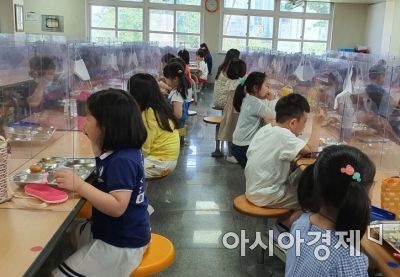
The obligation to install and operate partitions in the cafeteria will also be abolished, but schools may install them autonomously depending on their individual circumstances.
Registration on the self-diagnosis app is recommended only if there are "infection risk factors," such as symptoms like fever or cough, a positive rapid antigen test, or if the individual is awaiting PCR test results due to a confirmed case in a cohabiting family member.
If infection risk factors are registered on the app, the absence will be recognized as an excused absence without the need to separately notify the school. However, when returning to school, proof such as a test result confirmation or medical certificate must be submitted. There had been criticism that participation in the self-diagnosis app placed a heavy burden on students and staff while its effectiveness was low.
With the lifting of the indoor mask-wearing mandate, mask-wearing indoors at school will be voluntary. However, masks must be worn according to regulations in certain situations, such as when riding school transportation (mandatory) or when exhibiting suspicious symptoms (recommended).
Separately, basic measures such as ventilation during classes, disinfection of cafeterias, temporary observation rooms for symptomatic individuals, and rapid antigen testing of symptomatic classmates when a confirmed case occurs will be maintained.
The Ministry of Education has designated the two weeks from March 2, the first day of school, to March 16 as the "Special School Quarantine Support Period" and plans to support the implementation of the new guidelines in the field. Additionally, up to 58,000 dedicated quarantine personnel and supplies such as masks and hand sanitizers will be provided to reduce the quarantine burden on schools.
Lee Ju-ho, Deputy Prime Minister for Social Affairs and Minister of Education, stated, "Over the past three years, negative effects such as lack of social skills, decline in basic academic skills, and increased depression among students have accumulated due to COVID-19, making it necessary to restore educational activities. The Ministry of Education and local education offices will do their best to ensure that students can study in a safe environment."
© The Asia Business Daily(www.asiae.co.kr). All rights reserved.


















