Romanian President Scheduled to Visit South Korea This Month
Advantages of Korean Defense Industry: Fast Delivery and Cost-Effectiveness
Expectations for Second Export Contract with Poland
Hyundai Rotem Increases Defense Sector Share
[Asia Economy Reporter Han Ye-ju] Hyundai Rotem's K2 tank is expected to enter the Romanian defense market following Poland. Romania, a NATO frontline country, urgently needs to procure ground weapons due to power support to Ukraine and aging armored forces. Klaus Iohannis, the President of Romania, is scheduled to visit Korea soon to hold defense industry negotiations with the Korean government, drawing attention to whether Hyundai Rotem will be the key partner in this cooperation.
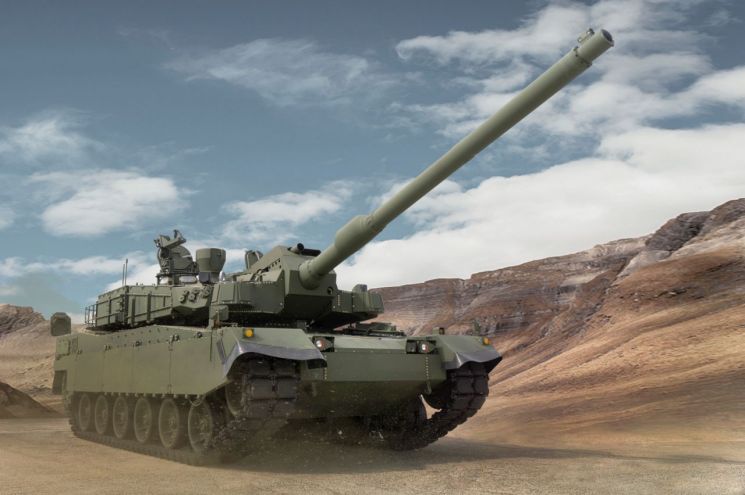
Klaus Iohannis, President of Romania, is expected to visit Korea this month. Recently, local Romanian military officials have consecutively visited Korea, showing great interest in K-weapons while touring defense companies. On the 31st of last month, Theodor Inchicash, Director General of the Romanian Armaments Directorate (Lieutenant General), and Vich Mocanu, Deputy Director of the Military Resources Office (Brigadier General), inspected Hyundai Rotem's K2 tank and wheeled armored vehicle production facilities. In December last year, Angel T?lv?r, Romanian Minister of National Defense, also visited Hyundai Rotem's site located in Changwon, Gyeongnam, Korea.
Romania has about 400 tanks, but it has donated around 60 of its strongest T-72 tanks to Ukraine, creating a need to reinforce its ground forces. It is also known to plan replacing aging tanks, armored vehicles, and infantry fighting vehicles.
In this situation, Romania is paying attention to Poland's large-scale adoption of Korean-made weapons despite not being a NATO ally. Korea is a latecomer in the defense market but maintains a mass production system due to its characteristics as a divided country and the necessity for technological development. Unlike countries such as the United States, France, Germany, and the United Kingdom, which have stopped mass production in line with global disarmament trends, Korea can deliver quickly, making it attractive. Compatibility with NATO weapon systems and affordable pricing are additional advantages. Following the Ukraine war, Romania is likely to increase its defense budget to over 3% of GDP, raising expectations for orders not only for Hyundai Rotem but also for domestic defense companies.
A second export contract for 820 K2 tanks with Poland is also anticipated. Currently, the company is negotiating detailed matters such as technology transfer, production methods, and pricing with Poland. Although the final contract may take some time, there are talks that it must be completed by September, ahead of Poland's general election this fall. Since former Soviet tanks from Eastern European countries, including Romania and Poland, have been sent to Ukraine, the demand for tanks in Europe for national security is expected to increase.
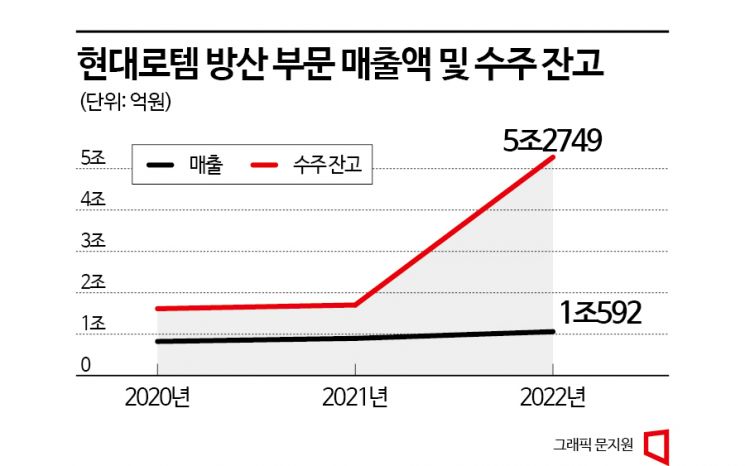
With the growth of the defense business, Hyundai Rotem's defense sector is becoming increasingly significant. As of the end of last year, Hyundai Rotem's defense division sales amounted to 1.0592 trillion KRW, accounting for 33.5% of total sales (3.1633 trillion KRW). Defense sales have shown an upward trend, with 822.5 billion KRW in 2020 and 896.5 billion KRW in 2021. Since defense export sales began to be recognized from the fourth quarter of last year, the defense sector's share is expected to grow further this year.
The order backlog is also increasing. As of the end of last year, Hyundai Rotem's total order backlog was 13.062 trillion KRW, with the defense sector accounting for 5.2749 trillion KRW. The defense sector's share of the total order backlog surged by more than 20 percentage points from 17.9% in 2020 and 16.8% in 2021 to 40.4% at the end of last year. If contracts with Romania and Poland are finalized this year, this share could increase to half.
© The Asia Business Daily(www.asiae.co.kr). All rights reserved.
![Clutching a Stolen Dior Bag, Saying "I Hate Being Poor but Real"... The Grotesque Con of a "Human Knockoff" [Slate]](https://cwcontent.asiae.co.kr/asiaresize/183/2026021902243444107_1771435474.jpg)

















