Last Year, Home Shopping Companies Faced Consecutive Performance Declines
Intensified Online-Offline Competition and Broadcasting Fee Burdens Are the Causes
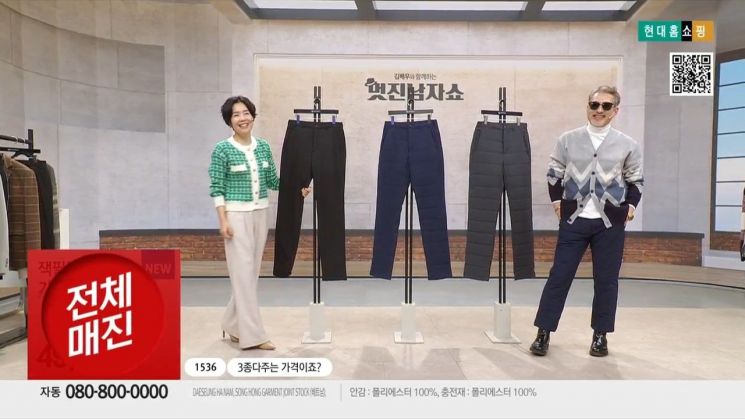 Hyundai Home Shopping 'Stylish Man Show' broadcast screen. Not directly related to the article content.
Home shopping companies are receiving disappointing performance reports for last year one after another. This is because competition is intensifying as online and offline distribution channels become increasingly diverse, coupled with the burden of transmission fees.
According to the Financial Supervisory Service's electronic disclosure system on the 10th, Hyundai Home Shopping's consolidated operating profit for last year was tentatively estimated at 111.4 billion KRW, down 20.5% from the previous year. Sales increased slightly by 0.3% to 2.1013 trillion KRW, but net profit decreased by 11.9% to 89.5 billion KRW.
The core home shopping business was sluggish. Looking at Hyundai Home Shopping alone, last year's sales were 1.1016 trillion KRW, a slight increase of 2.0% from the previous year, but operating profit fell 15.8% to 112.7 billion KRW.
Lotte Home Shopping also could not avoid poor performance. Lotte Home Shopping's operating profit last year was 78 billion KRW, down 23.5% from the previous year. Sales also decreased by 2.3% to 1.078 trillion KRW compared to 2021. After the end of social distancing, the shift to an endemic (periodic outbreak of infectious diseases) led to a return to normal external activities, and the recovery of offline purchase demand centered on clothing dealt a direct blow to the home shopping business. The shift of high-margin product purchases such as fashion and health foods to other online channels also hurt. Lotte Home Shopping plans to focus on recovering profitability through product differentiation and expanding live commerce.
CJ ENM's commerce division, CJ OnStyle, also reported poor results. Last year, CJ OnStyle's sales were 1.3553 trillion KRW, down 1.7% from the previous year, and operating profit was about 72.3 billion KRW, nearly a 40% decrease. Sales declined due to the slowdown in home shopping growth and weakened consumer sentiment, and operating profit decreased due to fixed costs such as transmission fees. This year, the plan is to strengthen channel distribution synergy through TV and live commerce and expand core product handling through differentiated marketing such as content commerce.
As competition between online and offline distribution channels intensifies and concerns about sales decline grow, transmission fees are acting as a major cause of worsening operating profits. The home shopping industry complains that the amount paid for TV transmission fees increases every year. According to the TV Home Shopping Association, transmission fees for seven domestic TV home shopping companies were 1.5497 trillion KRW in 2019, 1.675 trillion KRW in 2020, and 1.8074 trillion KRW in 2021, increasing every year. Home shopping companies argue that a reduction in transmission fees is inevitable as the number of cable TV subscribers decreases. According to the Ministry of Science and ICT, as of the end of 2021, the number of paid broadcasting subscribers (SO) was about 12.93 million, down 300,000 from the previous year.
© The Asia Business Daily(www.asiae.co.kr). All rights reserved.
![Clutching a Stolen Dior Bag, Saying "I Hate Being Poor but Real"... The Grotesque Con of a "Human Knockoff" [Slate]](https://cwcontent.asiae.co.kr/asiaresize/183/2026021902243444107_1771435474.jpg)











