Telecom Company Performance Analysis②
[Asia Economy Reporter Kang Nahum] SK Telecom, KT, and LG Uplus, the three major telecommunications companies, recorded record-high sales and the highest operating profits since 2010 last year. Each company has declared its intention to focus on non-telecom new businesses by promoting their own 'de-telecom' strategies. However, the proportion of the mobile telecommunications business remains dominant in both sales and operating profits. The increase in the number of 5G subscribers, which has become a universal communication service, brought significant profits to these telecom companies. Nevertheless, the three telecom companies are receiving criticism from consumers for focusing solely on maximizing profits while maintaining fee plans unfavorable to consumers.
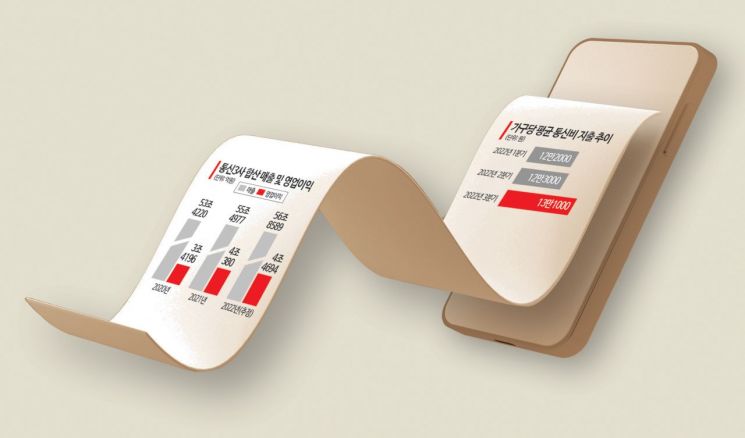
As the results of the three telecom companies for last year are being announced one after another on the 9th, SKT posted consolidated sales of 17.305 trillion KRW and operating profit of 1.6121 trillion KRW last year, continuing solid performance. Compared to the previous year, sales increased by 3.3% and operating profit by 16.2%. LG Uplus recorded sales of 13.906 trillion KRW and operating profit of 1.0813 trillion KRW last year. These figures represent increases of 0.4% and 10.4% respectively compared to the previous year, and notably, operating profit surpassed 1 trillion KRW for the first time since the company's founding. The securities industry expects KT, which announced its results on the 9th, to record sales of 25.6479 trillion KRW and operating profit of 1.776 trillion KRW, representing increases of 7.2% and 6.2% respectively compared to the previous year.
If these estimates are accurate, the total sales and operating profits of the three telecom companies last year reached 56.8589 trillion KRW and 4.4694 trillion KRW respectively. Sales are at an all-time high, and operating profits are the highest since 2010, when they recorded 4.983 trillion KRW.
The three telecom companies are setting their own de-telecom strategies aiming to transform into AI companies, but revenue from telecom business still accounts for an absolute majority of their sales.
This strong performance is mainly due to the increase in 5G subscribers. As of the end of 2022, the number of 5G lines was 13,392,940 for SK Telecom, 8,449,258 for KT, and 6,059,686 for LG Uplus. Over one year, the number of lines for the three companies increased significantly by 3,518,869 (35%), 2,076,364 (32%), and 1,446,290 (31%) respectively. Considering that the ARPU (average revenue per user) of 5G subscribers is 1.4 to 1.6 times higher than that of LTE subscribers, telecom companies' profits naturally increase. Simply put, subscriber communication fees have increased by more than 1.4 times.
Most consumers are not pleased with the telecom companies' strong performance. The burden of communication fees is increasing, but telecom companies are solely focused on profits through extreme fee policies that force consumers to either use very little or very large amounts of data. According to the '2022 Q3 Household Trend Survey' by Statistics Korea, the average monthly communication fee per household in the third quarter of last year was 131,000 KRW, an increase of 2.8% compared to the same quarter of the previous year. Expenditures on communication devices such as mobile phones (7.1%) and communication services (1.5%) both increased.
The telecom companies' fee policies are increasing consumers' burdens. When 5G service was officially commercialized in 2019, the three telecom companies divided monthly basic data provided to users into two categories: 12GB or less, or 110GB or more, and launched fee plans accordingly. Because there was no middle data tier, criticism arose that this was designed to induce users to subscribe to expensive large-capacity plans.
Most consumers are not pleased with the telecom companies' strong performance. Household communication costs are rising, but telecom companies are only focused on profits through extreme fee policies that force consumers to either use very little or very large amounts of data.
Even after four years, this criticism remains valid. In August last year, the three telecom companies launched a 5G mid-tier fee plan offering 24 to 31GB of data per month at 50,000 to 60,000 KRW. This plan was reluctantly introduced under pressure from the government and public opinion demanding communication fee reductions. Considering that the traffic per 5G subscriber is 28GB, it is still pointed out that consumer demand is not being met. Additionally, the issue of user discrimination continues as low-cost plan users pay 13.8 times more per 1GB of data than high-cost plan users.
However, telecom companies still complain that introducing additional mid-tier fee plans could trigger a significant migration of subscribers from plans of 110GB or more, which could deteriorate ARPU and profitability. Despite the continuous rise in prices increasing the living expenses burden on ordinary people, this reveals their lack of willingness to ease household communication fee burdens.
© The Asia Business Daily(www.asiae.co.kr). All rights reserved.
![Clutching a Stolen Dior Bag, Saying "I Hate Being Poor but Real"... The Grotesque Con of a "Human Knockoff" [Slate]](https://cwcontent.asiae.co.kr/asiaresize/183/2026021902243444107_1771435474.jpg)
















