Companies Capable of Legal Response Increase from 31% to 61%
SMEs "Difficulty in Response Due to Lack of Legal Understanding"
[Asia Economy Reporter Choi Seoyoon] It has been one year since the enforcement of the Serious Accidents Punishment Act (Serious Accident Punishment Act). Although the number of companies equipped with industrial safety capabilities has increased compared to the early days of the law's enforcement, it was found that 4 out of 10 companies still do not understand the law. Small and medium-sized enterprises (SMEs) unanimously expressed that policy support is urgently needed as they face the additional problem of a shortage of safety personnel.
According to a survey conducted by the Korea Chamber of Commerce and Industry on the 9th targeting 290 companies with 5 or more employees who participated in the Serious Accident Punishment Act response webinar, 45.2% of companies had established departments responsible for safety and health tasks in the corporate status survey conducted 100 days after the enforcement of the Serious Accident Punishment Act last year, but this figure significantly increased to 75.5% in the recent survey. The percentage of companies with dedicated safety personnel more than doubled from 31.6% to 66.9%.
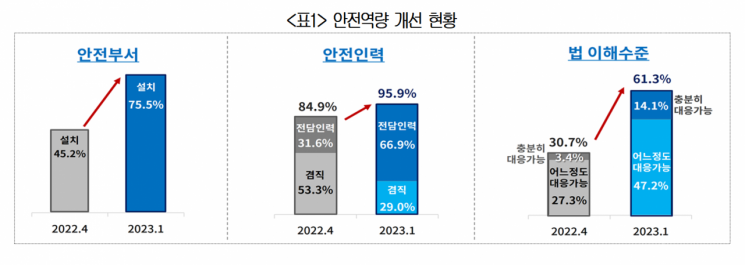 Status of Safety Capability Improvement Since the Enforcement of the Serious Accident Punishment Act [Image Source=KCCI]
The level of understanding of the law among companies has also improved. The percentage of companies that responded they understand the contents of the Serious Accident Punishment Act and are capable of responding was 61.3%, about twice the 30.7% response rate in last year's status survey. About 40% still found it difficult to understand.
It was found that 92.1% of companies are conducting risk assessments, which the government is focusing on promoting. Risk assessment involves identifying harmful and dangerous factors and establishing improvement procedures. A Korea Chamber of Commerce and Industry official said, "Companies are increasing their understanding of the law by attending related briefings and reviewing various materials in response to the enforcement of the Serious Accident Punishment Act," adding, "This also indicates that they are actively investing in building industrial safety reporting systems such as legal advice and consulting."
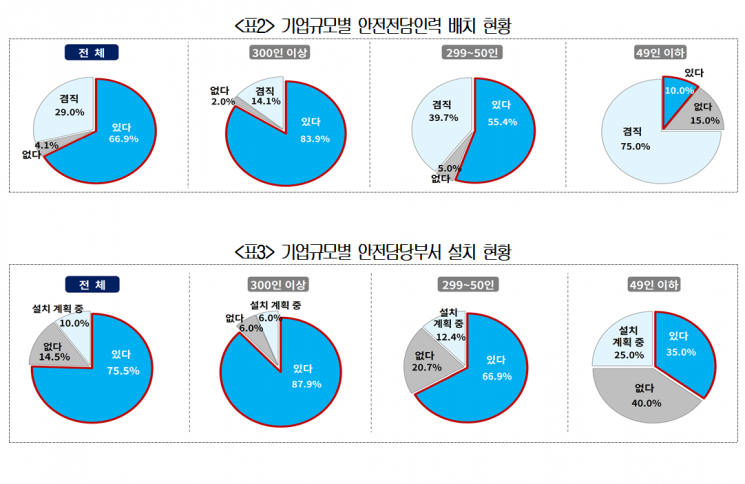
SMEs still find it difficult to comply with legal obligations. Looking at industrial safety capabilities by company size, 87.9% of large companies (300 or more employees) had established safety departments, but only 66.9% of medium-sized companies (50-299 employees) and 35.0% of small companies (5-49 employees) had done so. The percentage of companies with dedicated safety personnel was 83.9% for large companies, but only 55.4% and 10.0% for medium and small companies, respectively. In particular, 75% of small companies were found to have safety duties combined with other tasks.
Additionally, 44.6% of medium-sized companies and 80.0% of small companies responded that they still do not understand the law and have difficulty responding, while only 28.2% of large companies reported the same. A small business owner who attended the Korea Chamber of Commerce and Industry briefing said, "Safety-related laws are too vast and complex, and there are still many confusing parts about where to start," adding, "The government should actively expand policy support for SMEs lacking funds or personnel by providing free inspections and guidance on legal compliance."
Regarding provisions of the Serious Accident Punishment Act that urgently need supplementation, companies most frequently cited the establishment of exemption provisions for serious accidents without intentional or gross negligence (65.5%). This was followed by specification of safety and health assurance obligations (57.6%), clarification of regulations such as the scope of responsibility of the primary contractor (54.5%), and imposition of legal compliance obligations on workers (42.8%).
Furthermore, regarding government policy tasks, clear compliance guidelines (73.4%), distribution of industry-specific safety manuals (61.7%), and consulting support (40.7%) were identified as key policies. Other priorities included training safety personnel and supporting labor costs (39.3%) and financial and tax support for safety investments (31.4%).
Kang Seok-gu, head of the Korea Chamber of Commerce and Industry's survey division, said, "Since the law's enforcement, the number of deaths from serious accidents decreased by 44 compared to the same period last year, but 43 of these reductions occurred in workplaces with fewer than 50 employees where the law does not apply, so there was almost no decrease in workplaces with 50 or more employees," emphasizing, "Rather than strong punitive provisions, administrative supervision and preventive guidance in vulnerable areas are more effective measures to reduce serious accidents. It is urgent to amend the current punishment-centered law to a prevention-centered one."
© The Asia Business Daily(www.asiae.co.kr). All rights reserved.
![From Bar Hostess to Organ Seller to High Society... The Grotesque Con of a "Human Counterfeit" [Slate]](https://cwcontent.asiae.co.kr/asiaresize/183/2026021902243444107_1771435474.jpg)

















