Most School Meal Card Users Prefer Convenience Stores
"Reluctant to Buy Lunchboxes... Purchase Cup Noodles and Triangle Kimbap"
Experts Say "Price Adjustment and Franchise Management Needed"
[Asia Economy Reporters Jang Sehee and Choi Taewon] "Many buy a set of triangular kimbap, cup noodles, and drinks. It seems children find lunch boxes burdensome, so they rarely buy them."
On the afternoon of the 8th, Ji Mo (52), a part-time worker at a convenience store in front of an elementary school in Songpa-gu, Seoul, could not hide his sadness. The convenience store where Ji works is about 50 meters away from the elementary school. He said that about 5 to 10 children experiencing food insecurity visit the store daily.
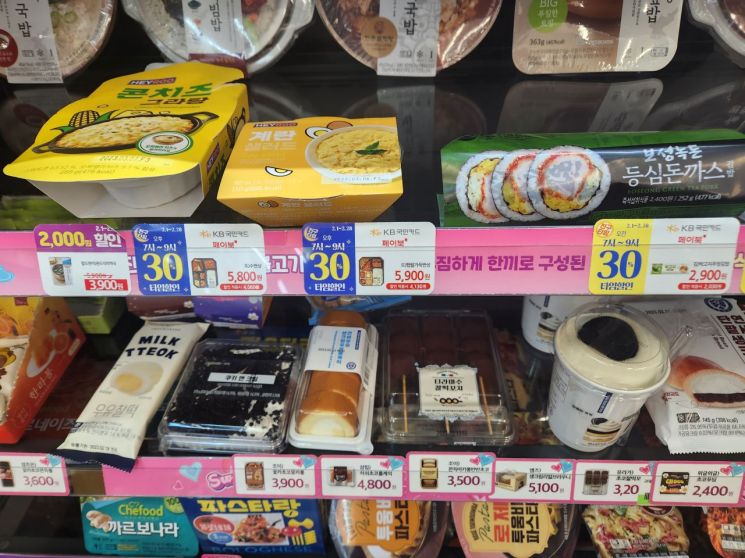 A convenience store in Hong Eun-dong, Seodaemun-gu, Seoul. The prices of bread and gimbap range from 2,000 to the high 5,000 won range.
 Photo by Tae-won Choi skking@
◆ '8,000 won per meal' Half of it spent at convenience stores = According to the '2022 January-June Child Meal Card Usage Status' received by Kang Deukgu, a member of the Democratic Party of Korea, from local governments nationwide, out of a total of 6,139,860 transactions, 41.9% (2,572,106 transactions) were used at convenience stores. In Songpa-gu as well, from August last year to January this year, the usage status by business type for meal cards was convenience stores (49%), general restaurants (34%), fast food and bakeries (8%), and others (1%). Out of a total of 75,576 transactions, Western and Japanese food accounted for only 692 and 962 transactions, respectively.
A reporter from this paper visited restaurants in Songpa-gu and Seodaemun-gu, Seoul, and found that there were almost no places where children could use the meal card (prepaid card) to eat. Un Mo (50), the owner of a pork cutlet restaurant registered as a franchise in Songpa-gu, Seoul, said, "I have never seen anyone use the meal card," adding, "The cheapest menu is 10,900 won." Kim Miyoung (41), who works at a nearby pizza place, said, "The cheapest pizza is 8,900 won, so since the card limit is 8,000 won, not many children come," adding, "About one or two children come per week." Recently, with food and dining costs rising sharply, the use of meal cards has become more restricted. The meal card limit per meal is 8,000 won, allowing up to 24,000 won per day.
Choi Kikwon (56), who runs a private bakery in Hongneung-dong, Seodaemun-gu, said, "Usually, children buy two pieces of bread and one milk or one sandwich and one milk," adding, "For bigger kids, it sometimes seems insufficient, so I sometimes give a little extra bread as a service," expressing his concern.
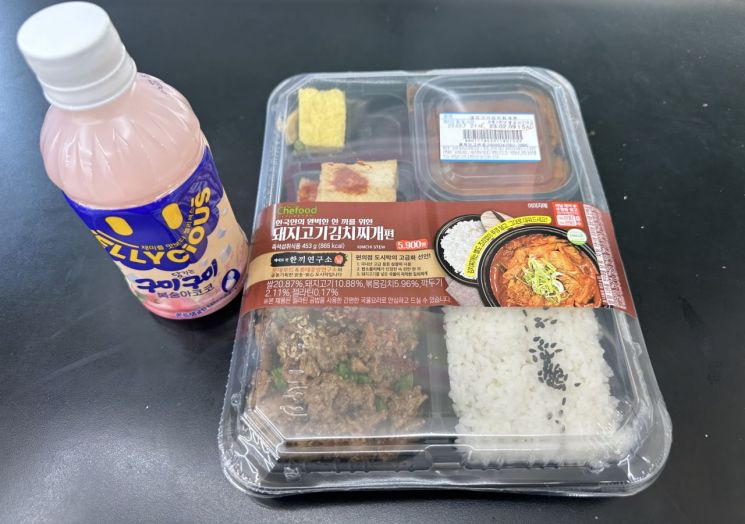 On the afternoon of the 8th, a lunchbox and a beverage purchased for a total of 7,500 won at a convenience store in Songpa-gu, Seoul. Photo by Jang Sehee jangsay@
◆ 'Unbalanced' meals worry both store owners and children = People working at convenience stores also expressed concerns about children's unbalanced meals and attitudes. Jang Yuchin (64), a convenience store owner in Hongneung-dong, Seodaemun-gu, said, "Lunch boxes cost in the high 5,000 won range, and cup rice dishes range from the high 4,000 won to mid-5,000 won range. Even if children eat just cup rice and milk, the limit is reached," adding, "Growing children need to eat enough, but they tend to choose relatively cheaper items like kimbap and bread." Kim Mo, a part-time worker in his 30s at a convenience store in Songpa-gu in the afternoon, sighed, "Children seem to find lunch boxes burdensome, so they buy kimbap, triangular kimbap, cup noodles, and snacks," adding, "Healthy meals seem practically impossible." Kim added, "The most popular item is triangular kimbap, and they usually spend between 4,000 and 6,000 won."
Kim Mo (10), whom we met in front of a convenience store, said, "Lunch boxes seem very expensive. When I come to the convenience store with friends, we usually buy snacks like ramen, triangular kimbap, and chocolate," adding, "I have to save about 2,000 won each meal so that I can go to a restaurant and buy food on other days."
◆ Strengthening management of meal card franchise stores and local governments = There were also reports that it is difficult to use the card at places like kimbap shops, pork cutlet restaurants, and Chinese restaurants. Kim Mo, in his 40s, who uses the child meal card, said, "I heard that a local Chinese restaurant accepts the meal card, so I took my child there, but we were refused."
Some restaurants do not even know they are franchise stores for meal cards or are reluctant to serve customers if only one or two people visit instead of a family group. Some restaurants have closed and cannot even be found in searches but are still included as franchise stores. A public official from a local government in Seoul said, "Franchise stores should accept the cards properly on their own, but I have heard that this is not always the case," adding, "If people do not report to the district office after being refused once, it is realistically difficult to manage all restaurants."
Experts pointed out that although the policy is for children experiencing food insecurity, the per-meal price does not reflect reality. While prices have soared, local governments only raised the unit price by about 1,000 won last year. Professor Lee Eunhee of the Department of Consumer Studies at Inha University said, "Food and dining prices rose significantly last year, but the meal card amount only increased by 1,000 won, reducing the number of places where children can comfortably go," emphasizing, "More affordable places should be recruited as franchise stores, or the meal card limit should be increased so children can use it without worry."
© The Asia Business Daily(www.asiae.co.kr). All rights reserved.
![Clutching a Stolen Dior Bag, Saying "I Hate Being Poor but Real"... The Grotesque Con of a "Human Knockoff" [Slate]](https://cwcontent.asiae.co.kr/asiaresize/183/2026021902243444107_1771435474.jpg)


















