Final Treatment at Emergency Medical Institutions
Promotion of Public Emergency Medical Information Provision
Concerns Raised Over Concentration and Insufficient Support for Vulnerable Groups
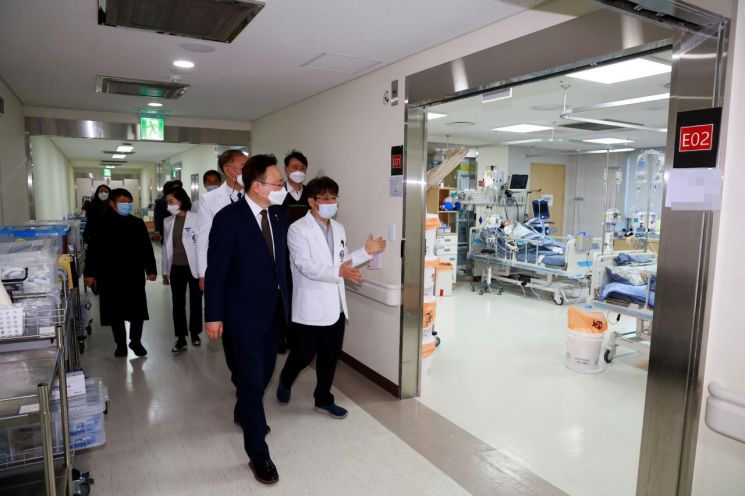 Minister of Health and Welfare Cho Kyu-hong is visiting Gangdong Kyung Hee University Hospital, one of the Seoul Regional Emergency Medical Centers, to inspect the site.
 [Photo by Ministry of Health and Welfare]
[Asia Economy Reporter Lee Gwan-joo] Experts have shown mixed reactions to the Ministry of Health and Welfare's '4th Basic Emergency Medical Plan (draft),' which centers on the reorganization of the emergency medical delivery system. While they agree with the vision of "emergency medical care responsible until final treatment," some expressed disappointment regarding the detailed implementation plans.
The Basic Emergency Medical Plan announced by the Ministry of Health and Welfare on the 8th outlines the direction for emergency medical reform to be pursued over four years until 2027. The draft plan includes a total of 16 tasks across four areas: ▲on-site and transport stages ▲hospital stage ▲specialized response by field ▲emergency medical infrastructure, aiming to expand emergency medical infrastructure and establish a regionally conclusive emergency medical system.
The most notable part of this basic plan is the change in the emergency medical delivery system. The main content is to ensure that critically ill emergency patients can receive not only basic treatment but also surgery, procedures, and hospitalization?final treatment?when they visit emergency medical institutions. To this end, the current regional emergency medical centers (40 locations) will be reorganized into severe emergency medical centers and expanded to 50?60 locations to enable treatment within one hour anywhere nationwide. Additionally, existing regional emergency medical centers will be restructured into 'emergency medical centers' that provide final treatment for suspected severe emergency patients and primary admission for severe emergency patients, while regional emergency medical institutions will be reorganized into '24-hour treatment centers' tasked with primary emergency care and final treatment of mild emergency patients, according to the government's plan.
Experts generally evaluated this direction positively but emphasized the importance of detailed content. Kim Won-young, Policy Director of the Korean Society of Emergency Medicine (Professor of Emergency Medicine at Asan Medical Center, Seoul), said, "I actively agree with a medical system responsible until final treatment," adding, "The direction is set, but details such as which patients will be treated have not been decided yet, so the society, the Ministry of Health and Welfare, and the Central Emergency Medical Center need to work together to establish the delivery system."
The most praised part of the draft plan is the information provision field for the rational use of emergency medical care. When many patients visit emergency medical institutions despite having non-emergency conditions, patients suffer from long waiting times, and medical staff may miss critical patients while attending to non-emergency cases. To prevent this, the government plans to implement a system that provides information on emergency diseases, real-time congestion levels by emergency room, and guides appropriate hospitals for use. Song Kyung-joon, Chairman of the Korean Emergency Medical Guidance Doctors Association (Professor of Emergency Medicine at Seoul National University Boramae Medical Center), said, "Providing information for the convenience of the public is truly necessary," and evaluated, "Creating a system to help decide whether to visit an emergency medical institution or an outpatient clinic is a desirable initiative."
However, supplementation of detailed content related to the reorganization of the emergency medical system is also needed. First, there is concern about patient concentration at severe emergency medical centers. Severe emergency medical centers are likely to be selected from large hospitals with actual final treatment capabilities, and these hospitals already receive many patients. Lee Sang-woon, Vice President of the Korean Medical Association, stated, "Issues such as patient concentration at severe emergency medical centers, difficulty filtering mild patients, and increased delays in transfer when problems cannot be resolved even after arrival at emergency medical centers must be addressed first," emphasizing, "Along with revising the standard guidelines for 119 ambulance teams, expanding severe emergency medical centers is necessary."
It was also pointed out that the plan lacks content on emergency medical services for vulnerable groups. Chairman Song said, "The medical window for homeless people, housing-vulnerable individuals, elderly living alone, undocumented foreigners, victims of sexual and domestic violence, and school violence victims is the emergency room," adding, "These patients require linkage with welfare services beyond emergency measures, so this aspect needs to be considered." There are also calls to include specialized hospitals in the emergency medical system and to develop plans to utilize emergency medical technicians more actively.
© The Asia Business Daily(www.asiae.co.kr). All rights reserved.
![Clutching a Stolen Dior Bag, Saying "I Hate Being Poor but Real"... The Grotesque Con of a "Human Knockoff" [Slate]](https://cwcontent.asiae.co.kr/asiaresize/183/2026021902243444107_1771435474.jpg)











