Stock Market Rally Continues After Powell's Remarks
"Dovish" Despite "Interest Rate Hike" Comments
Some on Wall Street Point Out Market Optimism
"Still Significant Liquidity... Investors Should Be Cautious"
Following recent public remarks by Jerome Powell, Chair of the U.S. Federal Reserve (Fed), the stock markets in the United States and South Korea have continued their upward rally. Although Chair Powell hinted at the possibility of further interest rate hikes, the market focused more on his comments that 'inflationary pressures are weakening,' which instead heightened expectations of a Fed 'pivot' in policy. However, some voices within Wall Street warn that market optimism may be excessive. Experts advise cautious investment decisions given the ongoing uncertainties surrounding U.S. monetary policy.
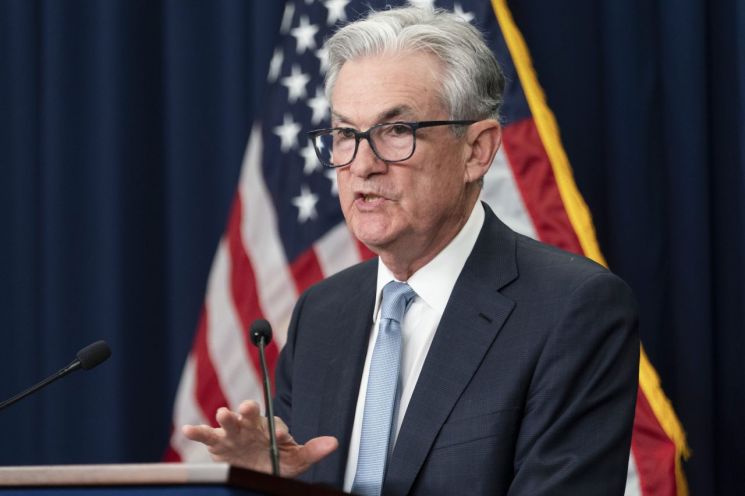
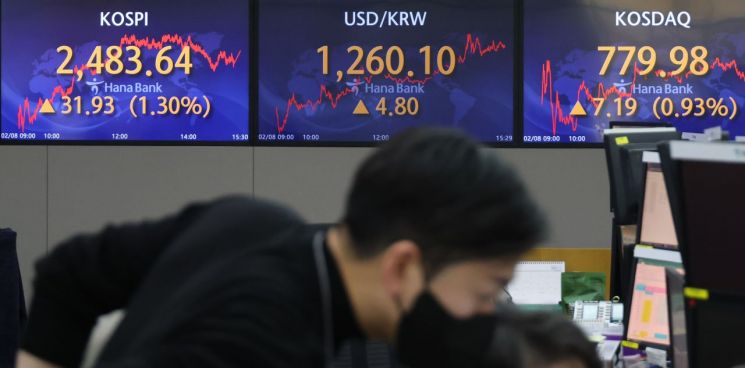
Since Chair Powell's Federal Open Market Committee (FOMC) press conference on the 2nd (Korean time) and his discussion at the Economic Club in Washington D.C. on the 7th (local time), the stock market has exhibited a 'my way rally' pattern. The KOSPI index closed at 2,483, up 1.30%, while the KOSDAQ ended at 779.98, up 0.93%. This upward trend was driven by increased buying from foreign and institutional investors. Powell's mention of 'disinflation' and the sharp rise in the Nasdaq positively influenced the domestic stock market.
In the discussion, Powell stated, "Although price declines have begun, it will take two years to tame inflation, and strong employment data make additional rate hikes inevitable." However, the market focused more on the 'price decline' than the 'rate hikes.' In fact, he also made dovish remarks such as "inflation will 'significantly' decrease this year" and "I would 'certainly' use the word disinflation," which the market welcomed as subtle shifts in Powell's stance.
Nonetheless, Powell also made hawkish comments indicating that tightening must continue for inflation to approach the 2% target, raising concerns that the market's reaction may be overly optimistic. This suggests that Powell was effectively closer to a 'madulgi' (a blend of hawkish and dovish tendencies). The U.S. economic media CNBC assessed that "Powell was hawkish, but investors were bullish," explaining that the Fed and the market's chicken game is likely to continue for some time.
Compared to last year, inflationary pressures have somewhat eased, but uncertainties remain significant, so it is advised not to hastily judge the Fed's monetary policy direction. Mohamed Afaabay, a strategist at Citigroup, told Bloomberg that stocks in the U.S., Europe, Hong Kong, and South Korea appear overvalued and could decline within the next three to four months. He said, "For stocks to show strength, the dollar needs to fall another 10% from here, but if the Fed raises rates in an unexpected way, that will be difficult."
Within Wall Street, there is also analysis suggesting that even the current disinflation trend in the U.S. may not be sustainable. Kang Hu, a TIPS trader at New York hedge fund Winshore Capital Partners, explained to MarketWatch, "We may experience disinflation for another five to six months, but beyond that, we cannot be certain what will happen." Earlier, Mohamed El-Erian, Chief Economic Advisor at global insurer Allianz, advocated a 0.50 percentage point rate hike by the Fed on the 30th of last month (local time), mentioning the "possibility of prolonged inflation."
Amid divergent forecasts on U.S. monetary policy and global geopolitical conditions, exchange rates have also become more volatile. In the Seoul foreign exchange market, the won-dollar exchange rate closed at 1,260.1 won the previous day. This is the first time since January 6 (1,268.6 won) that the exchange rate has exceeded 1,260 won at closing. After falling to 1,216.4 won on the 2nd, it rose to 1,262 won in less than a week, showing significant fluctuations. Unlike the stock market, the foreign exchange market has reinterpreted Powell's remarks as hawkish and is expecting a strong dollar trend for the time being.
The market is expected to continue fluctuating while awaiting the U.S. January Consumer Price Index (CPI) data to be released on the 14th. Professor Sung Tae-yoon of Yonsei University's Department of Economics pointed out, "Pressure for rate hikes due to inflation remains, but there is some expectation that the speed or magnitude may be somewhat adjusted, which seems to be priced into the stock market." He added, "This itself means that there is still considerable liquidity. However, caution is still needed regarding investments through loans and other means."
© The Asia Business Daily(www.asiae.co.kr). All rights reserved.
![Clutching a Stolen Dior Bag, Saying "I Hate Being Poor but Real"... The Grotesque Con of a "Human Knockoff" [Slate]](https://cwcontent.asiae.co.kr/asiaresize/183/2026021902243444107_1771435474.jpg)

















