[Asia Economy Reporter Park Sunmi] As the government is pushing to abolish the 'Safe Freight Rate System' for cargo trucks, which was a key issue in the Cargo Solidarity general strike, and reorganize it into a 'Standard Freight Rate System,' the Korea International Trade Association (KITA) pointed out that South Korea is the only country in the Organization for Economic Cooperation and Development (OECD) that enforces mandatory freight transportation charges.
On the 8th, KITA announced that, based on legal advice from three law firms including Law Firm Hwawoo, none of the 38 OECD countries enforce freight transportation charges at the central government level.
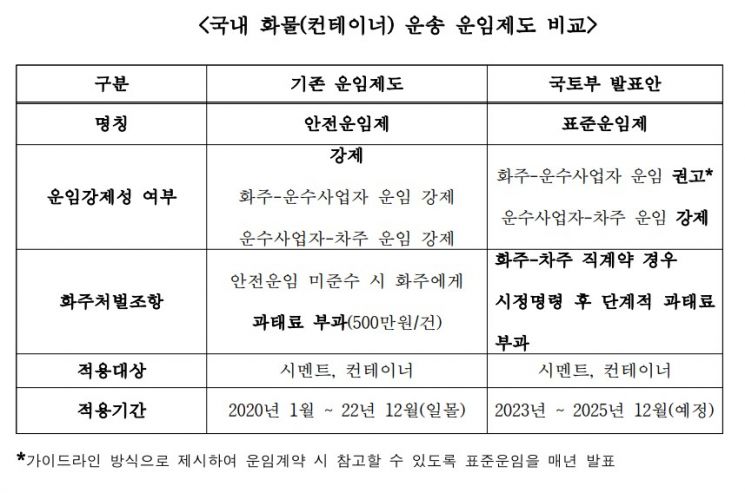
The United States and the United Kingdom leave freight rates to market autonomy without any rate system, while some advanced countries such as France and Japan operate freight rates in the form of non-binding reference rates. Certain local governments, such as British Columbia in Canada and New South Wales in Australia, regulate minimum hourly wages or standard contracts for freight workers, but none enforce freight rates. There are also no penalty provisions for shippers.
KITA stated that the government enforcing freight truck rate systems may restrict or infringe upon fundamental rights guaranteed by the constitution, such as freedom of contract, property rights, and equality rights. If the government enforces freight rates in the freight truck transportation market, freedom of contract is restricted, and the market economy order based on free competition and contracts could be distorted.
Furthermore, the government already guarantees the monopolistic position and a certain income level for freight truck owners by limiting new supply of freight trucks through the freight truck permit system and supply-demand control system for freight transport operators, which could be seen as giving excessive privileges to freight truck owners compared to other industries.
Jung Manki, Vice Chairman of KITA, said, “Despite the severe damage caused by the Safe Freight Rate System over the past three years, it is questionable whether introducing regulations not found even in major advanced countries to restrict the autonomy of our transportation market is truly the best for the future of our transportation market.” He added, “If the introduction of a Standard Freight Rate System is necessary to maintain a transitional order in the freight transportation market, it should be introduced only at the level of market recommendations.”
For the normalization of the freight transportation market, he emphasized, “The chronic multi-tiered subcontracting structure in the domestic freight transportation market caused by the total volume restriction on freight trucks and the consignment system must be improved,” and added, “Only when freedom of contract in freight transportation is guaranteed and freight transportation rates are determined by supply and demand in a market economy order can shippers, transportation companies, and truck owners all achieve a win-win outcome.”
© The Asia Business Daily(www.asiae.co.kr). All rights reserved.

















