UST Research Team Develops AI and Deep Learning-Based Technology with 95% Accuracy for Detection
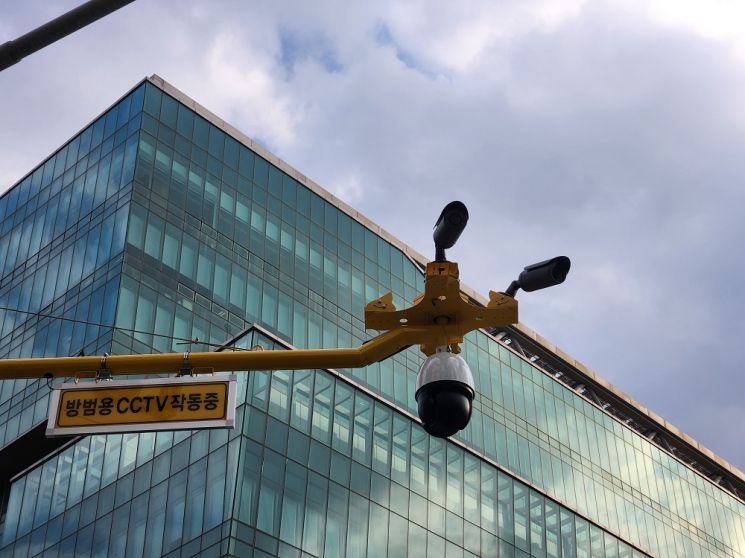
An artificial intelligence (AI) closed-circuit television (CCTV) monitoring technology that instantly recognizes traffic accidents or fights and notifies people has been developed.
On the 8th, the University of Science and Technology (UST) announced that Hyungmin Kim and Hobum Jeon, doctoral students at the Korea Electronics and Telecommunications Research Institute (ETRI) School, have developed an integrated framework technology capable of detecting and judging multiple abnormal situations simultaneously.
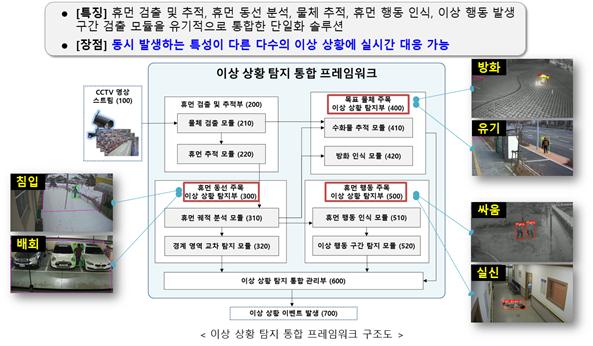
This technology is the only one in Korea to pass all seven intelligent CCTV certification areas of the Korea Internet & Security Agency (KISA), including “loitering, intrusion, falling, fighting, abandonment, arson, and marketing.” It also demonstrated a 94.66% action recognition rate in performance evaluation based on the ‘RGB+D’ dataset from Nanyang Technological University (NTU) in Singapore, the world’s largest 3D visual dataset, confirming world-class abnormal behavior detection accuracy. Notably, it can accurately detect human movements and abnormal behaviors under various external conditions such as fog, snow, and nighttime.
Due to poor monitoring conditions in Korea, where one Seoul city monitoring staff is responsible for an average of 958 CCTVs, there have even been discussions about the ineffectiveness of CCTV. This technology is expected to have a significant impact by greatly enhancing the capability to detect abnormal behaviors with fewer personnel.
Intelligent CCTV is already used for detecting seven major situations to build a social safety net. However, most existing detection methods are optimized only for single abnormal situations. They have low utility because they cannot detect and process different situations simultaneously. This new technology enables computers to actively detect complex abnormal situations and notify monitoring personnel, allowing efficient operation of monitoring centers with fewer staff.
By combining visual AI and language AI, the technology applies a ‘zero-shot learning’ technique where the computer independently combines information based on system experience to infer results. This AI technology sets and analyzes detection situations during the inference process, increasing big data construction speed, reducing costs, and improving technology application efficiency. This technique is a ‘post-deep learning’ method that classifies images using human language. It learns by comparing commonalities between visual and language information to find correct answers. The American AI company OpenAI applied this method in its image AI ‘DALL-E.’ DALL-E distinguishes images and text together, learns to generate images based on language information, and later creates new images by combining language information when new text inputs are given.
The technology can also be integrated with IoT (Internet of Things) technology, making it highly valuable in various CCTV environments for disaster prevention and security monitoring in everyday life, such as immediately alerting monitoring personnel in cases of disturbances in unmanned stores, elderly people falling alone, or pet abandonment, which have been increasing recently. In arson situations, it detects not only the ‘fire area’ based on objects but also fire scenes (smoke, flames, etc.) and human arson behaviors (pouring oil, igniting fire, etc.) simultaneously, enabling abnormal behavior detection and warnings to monitoring personnel within 10 seconds before the fire spreads significantly and during the arson stage. This is expected to greatly aid in preventing large fires and wildfires.
It can also detect overcrowding in specific spaces. When overcrowding exceeds a certain level, it can notify monitoring personnel or managers, which is expected to help prevent accidents and analyze consumer behavior patterns. For example, if customers suddenly crowd at a checkout counter in a large supermarket, additional cashiers can be deployed, or marketing strategies can be developed by analyzing customer concentrations in specific areas within the store.
As of December 31, 2019, the number of CCTV installations in public institutions in Korea was over 1.14 million and continues to increase. Among them, 51.6% are used for crime prevention, and 43.8% for facility safety and fire prevention. However, despite CCTV installations even in alleyways beyond security facilities, the shortage of monitoring center personnel often results in missing the golden time for disaster prevention. The Ministry of the Interior and Safety set the appropriate level of CCTV monitoring at a maximum of 50 cameras per monitoring staff, but in reality, the ratio is 271.88, far exceeding the standard.
Under the current monitoring conditions relying on human eyes, accident prevention is difficult, and immediate response is often not expected, making CCTV often a ‘too little, too late’ measure. This technology adds real-time preventive capabilities to existing CCTV installations as an AI platform improvement technology, providing significant value.
It can detect abnormal situations not only in real-time video but also in already recorded footage. When searching for criminal evidence among large volumes of CCTV footage, police personnel previously had to watch the entire video to find suspicious points. Using this technology, the system analyzes the footage, greatly aiding efficient criminal investigations.
Due to its high applicability in real life, there has been one research institute company technology investment, one technology transfer, two international conference paper presentations, domestic patent applications, and international patent applications under review, with further value creation expected. The video surveillance market was worth 53 trillion KRW worldwide and 3.9144 trillion KRW domestically in 2020. It is projected to reach 146 trillion KRW worldwide and 5.4672 trillion KRW domestically by 2027 (Transparency Market Research, Human ICT). The average annual growth rate from 2020 to 2025 is expected to be about 16.8%.
© The Asia Business Daily(www.asiae.co.kr). All rights reserved.


















