CEO Choi Jeonghoe Raises Concerns Over AI Technology Monopoly
Developer of Korea's First-Generation AI Chatbot 'Simsimi'
OpenAI, a Pioneer in AI Technology Open Source
Exclusive Supply to Microsoft Since 2020
"Government Must Reform Systems, Companies Should Unite Capabilities"
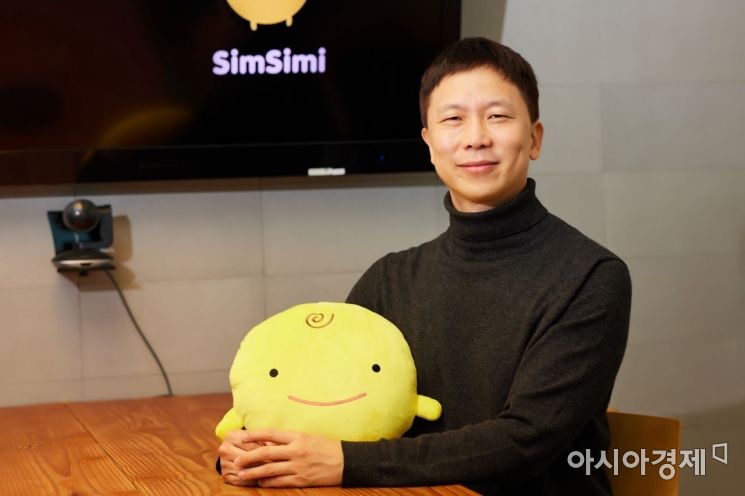
[Asia Economy Reporter Seungjin Lee] The emergence of OpenAI's ChatGPT is shaking up the artificial intelligence (AI) market. Google and Microsoft (hereafter MS) have begun a battle for AI supremacy. Meanwhile, domestic companies are said to be on the brink of collapse, overwhelmed by the AI technologies of global corporations. Choi Jeonghoe, CEO of Simsimi Corporation, a first-generation AI chatbot developer in Korea, lamented, "AI companies have been sighing deeply lately."
Choi, a Seoul National University alumnus, is the developer of Korea's first-generation AI chatbot, "Simsimi." Simsimi began service in 2002 and is currently available in 81 countries. It has accumulated over 400 million users worldwide, with approximately 300 million Korean language conversation data entries.
Choi conveyed that the recent concern among domestic AI companies is the monopoly of technology by global big tech firms. Until now, new AI technologies were based on open source. Simply put, when an AI program was created, it was made publicly available for anyone to use. Domestic small and medium AI companies utilized this information to enhance their AI capabilities and develop their own differentiation strategies. However, recently, open AI software has disappeared.
OpenAI, which released ChatGPT, is a representative example. OpenAI was established in 2015 with the goal of benefiting humanity. It pursued AI development by open-sourcing AI information and provided services based on large language models such as GPT-3. However, since October 2020, OpenAI announced that GPT-3 would be exclusively supplied through Microsoft. This move was criticized as contrary to OpenAI's previous non-profit and open-source principles.
Domestic small and medium AI companies have attempted to enhance their technology but face clear limitations. After the recent release of OpenAI's chatbot "ChatGPT," domestic companies deeply feel the technological gap. Choi explained, "Previously, we tried to refine our technology by inputting our data into publicly available AI technologies to replicate them, but now we are at a loss about what to do."
Choi believes that the technological gap between global big tech companies and domestic companies may widen further. He said, "Korea was once considered to have AI competitiveness, but since global big tech companies have blocked technology disclosure, the gap will likely widen significantly." He analyzed, "In the future, AI research and services may only be possible within the limits allowed by giant companies like Google and MS."
To narrow the AI technology gap with global big tech, Choi emphasized the need to consolidate domestic technological capabilities in one place. He also argued that the government should step in to organize related systems to advance data training, which is the core of AI technological competitiveness. He said, "In the past, various companies and research institutes gathered capital individually to build large AI models, but for various reasons, these efforts fizzled out. Now is the time to try again."
He called for the state or a specific company to take the lead as a focal point for Korean AI technology. He added, "We cannot afford to delay any longer."
He also stressed the importance of Korean language data. Unlike English, ChatGPT often fails to understand context or provides inaccurate answers when using Korean. This is due to a lack of high-quality Korean language data training.
Choi stated, "High-quality data includes novels and news articles, but there are copyright issues," and argued, "The government should step in, like with regulatory sandboxes, to enable AI companies to use such data." He added, "In overseas cases, many high-quality English-based data have resolved copyright issues, allowing global big tech companies like Google to train AI at a high level."
"While the AI craze is heating up the world, domestic small and medium AI companies may not withstand this heat and could wither away. If we fail to create an environment where grassroots AI companies can continue to grow significantly, the future of Korea's AI industry will be difficult to guarantee."
© The Asia Business Daily(www.asiae.co.kr). All rights reserved.
![Clutching a Stolen Dior Bag, Saying "I Hate Being Poor but Real"... The Grotesque Con of a "Human Knockoff" [Slate]](https://cwcontent.asiae.co.kr/asiaresize/183/2026021902243444107_1771435474.jpg)
















