Government Questioning on Economic Issues in the National Assembly on the 7th
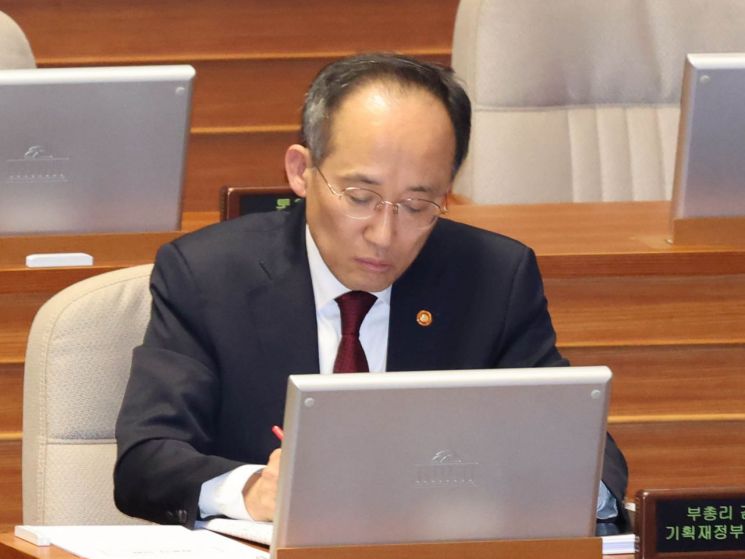 Deputy Prime Minister and Minister of Economy and Finance Choo Kyung-ho is reviewing documents during the National Assembly's economic sector questioning session held on the afternoon of the 7th.
 [Image source=Yonhap News]
[Asia Economy Sejong=Reporter Song Seung-seop] Deputy Prime Minister for Economy and Minister of Strategy and Finance Choo Kyung-ho reiterated on the 7th that "levying a windfall tax every time based on corporate profits does not align with economic principles."
Deputy Prime Minister Choo made this remark during the National Assembly's economic sector questioning session when Lee Sung-man, a member of the Democratic Party of Korea, asked whether there was any intention to impose a windfall tax on oil refiners and banks. Last year, oil refiners and banks earned huge profits due to rising raw material prices and a high-interest rate environment. As a result, opposition parties proposed collecting a windfall tax and using it to support ordinary citizens.
In response to Lee Sung-man's question, "Since oil refiners profited from price increases rather than self-help efforts, is there any intention to consider a windfall tax?" Deputy Prime Minister Choo answered, "Our views are completely different." He pointed out, "Companies make profits and incur losses depending on market conditions," adding, "If they incur losses, how should we interpret that?" This implies that since losses are not compensated, taxes cannot be levied when profits are made.
Deputy Prime Minister Choo also actively refuted criticisms that the government's fuel tax reduction measures increased the profits of oil refiners. He explained, "This was done in the previous administration as well and is not a measure for oil refiners," adding, "We have a system where companies pay more corporate tax under a progressive tax system when they earn more money."
Lee and Deputy Prime Minister Choo also clashed over the imposition regulations of charges under the Petroleum Management Act. According to Article 18 of the Petroleum Management Act, if petroleum refiners or petroleum importers/exporters earn excessive profits due to significant fluctuations in international oil prices, the Minister of Trade, Industry and Energy may impose charges. Lee said, "Since Korea does not produce a single drop of oil, it inevitably suffers from international crude oil price shocks, so legislative measures were taken to impose charges in such situations."
In response, Deputy Prime Minister Choo said, "It is practically a defunct structure," explaining, "It was a system applied when there was a difference between old import prices and domestic prices," and added, "The Petroleum Stabilization Fund, which was operated based on this, has long since disappeared." He further explained, "Currently, domestic prices are linked to import international prices."
Banks that profited from increased interest rate margins due to the base rate hike also became the subject of windfall tax controversy. Lee mentioned, "Hungary, the Czech Republic, and Spain impose windfall taxes," and noted, "The total net interest income of banks last year was 50.71 trillion won." On the other hand, Deputy Prime Minister Choo said, "There is absolutely no intention to consider a windfall tax. They should contribute according to the law and progressive tax system."
© The Asia Business Daily(www.asiae.co.kr). All rights reserved.
![Clutching a Stolen Dior Bag, Saying "I Hate Being Poor but Real"... The Grotesque Con of a "Human Knockoff" [Slate]](https://cwcontent.asiae.co.kr/asiaresize/183/2026021902243444107_1771435474.jpg)
















