Korea Research Institute of Chemical Technology
[Asia Economy Reporter Kim Bong-su] Domestic researchers have developed treatments for rheumatoid arthritis and lymphoma, representative pain diseases in an aging society.
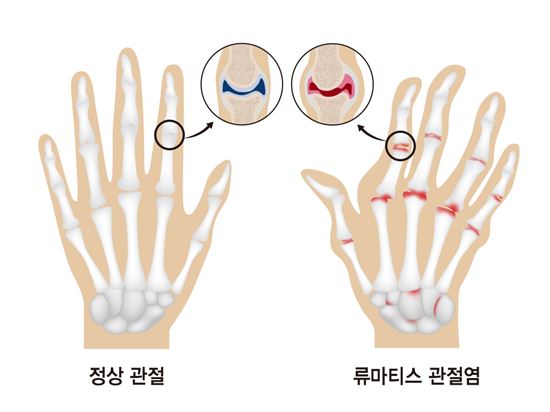 ▲If your joints feel stiff even when the weather is warm, you should suspect rheumatoid arthritis.
 [Photo by Gangdong Kyung Hee University Hospital]
The Korea Research Institute of Chemical Technology announced on the 7th that a joint research team led by Dr. Cho Hee-young and Dr. Lim Hee-jong developed a new substance that treats rheumatoid arthritis and lymphoma by inhibiting the abnormal function of the IRAK4 enzyme through research on treatments for ‘autoimmune diseases,’ where inflammation is caused by immune system malfunction and normal tissues are attacked.
The treatment mechanism for rheumatoid diseases and lymphoma developed by the research team has been transferred to the private company Future Medicine Co., Ltd. and is being developed as a treatment for autoimmune diseases and lymphoma. Rheumatoid arthritis is the most common autoimmune disease affecting nearly 1% of the global population, and drugs such as anti-inflammatory agents and biological anti-rheumatic injections are prescribed. However, most patients still suffer from side effects such as resistance development, reduced drug efficacy, and weakened immunity due to long-term drug treatment. Therefore, there is a need for a new selective rheumatoid arthritis treatment with excellent efficacy, low toxicity, and easy oral administration. Excessive inflammation is also a major carcinogenic factor, and especially for ‘ABC-DLBCL type lymphoma,’ the type of blood cancer with the worst prognosis, inhibiting the IRAK4 enzyme to reduce inflammation is known as an important treatment strategy.
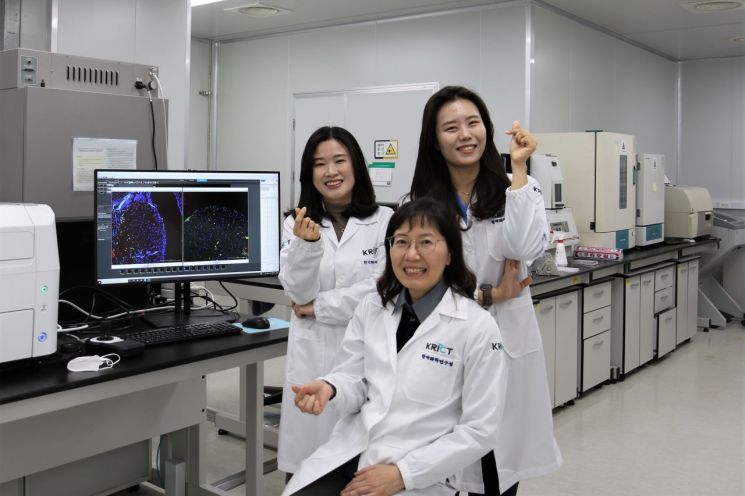 Dr. Heeyoung Cho's research team at the Korea Research Institute of Chemical Technology, who developed candidate substances for the treatment of rheumatoid arthritis and lymphoma (center: Dr. Heeyoung Cho; back row from left: Dr. Hyowon Hong, postdoctoral researcher; Saebom Yoon, student researcher). Photo by Korea Research Institute of Chemical Technology
‘Tofacitinib,’ the first orally administered rheumatoid arthritis drug developed and widely used, has recently been officially associated with risks of severe cardiovascular side effects such as heart attacks. The lymphoma drug ‘Ibrutinib’ requires combination therapy with other drugs due to resistance development during long-term use.
The research team conducted studies to find substances that can selectively block excessive inflammatory responses in the human body. By blocking the function of the enzyme ‘IRAK4,’ which exists in autoimmune disease and lymphoma cells in the body and amplifies inflammation, they developed a candidate drug called ‘KIC-0101’ that improves rheumatoid arthritis and lymphoma. When this drug was administered to an animal model of rheumatoid arthritis, arthritis symptoms were significantly improved. When combined with the existing treatment drug ‘Ibrutinib’ in lymphoma drug-resistant cells, it blocked inflammatory signal transmission and significantly reduced lymphoma size. Specifically, short-term oral administration for 10 days or long-term oral administration for 10 weeks in a collagen-induced arthritis animal model (CIA) reduced arthritis indicators such as swelling and ankle thickness by about 68-80%, and inflammation sites improved to normal levels, showing therapeutic effects. In an animal tumor model where lymphoma cells were injected subcutaneously, single or combination administration for 14 days suppressed tumor growth by more than 80%.
The results of this study were published in December last year in the international pharmacology journal 'Acta Pharmaceutica Sinica B.'
© The Asia Business Daily(www.asiae.co.kr). All rights reserved.
![Clutching a Stolen Dior Bag, Saying "I Hate Being Poor but Real"... The Grotesque Con of a "Human Knockoff" [Slate]](https://cwcontent.asiae.co.kr/asiaresize/183/2026021902243444107_1771435474.jpg)











