[Asia Economy Yeongnam Reporting Headquarters Reporter Koo Dae-sun] Gyeongbuk Province is launching the creation of a cell culture technology specialized cluster to respond to the paradigm shift in the bioindustry and future issues such as the expansion of the biopharmaceutical market, global food crisis, and carbon neutrality, and to secure future food industries.
On the 7th, Gyeongbuk Province signed a business agreement at the provincial office with 28 organizations from industry, academia, research, and government, including Pohang, Gyeongsan, Gumi cities, Uiseong County, Yeungnam University, POSTECH, Korea Food Research Institute, Gyeongbuk·Pohang TP, Ildong Foodis, Neocrema, Vision Science, Space F, and Danagreen, and announced a strategy to foster the cell culture industry.
This business agreement was made more meaningful by the participation of many representatives of mid-sized and venture companies positioned in the upstream and downstream of cell culture, such as Ildong Foodis, which has achieved good results by diversifying its business from powdered formula companies to health functional foods (protein supplements), as well as companies in materials, equipment, and cultured meat.
Cell culture is a core technology of the bioindustry necessary for proliferating and differentiating cells isolated from animal bodies, and is broadly classified into raw materials and equipment.
It is mainly used in basic research, biopharmaceuticals (vaccines, protein, immune, gene, stem cell therapies, etc.), and food and cosmetics screening, and recently has rapidly expanded into animal cell cultured foods.
Currently, the global market is led by bio-advanced countries such as the United States, Europe, and Japan, and the market is expected to expand from $17.74 billion in 2019 to $32.55 billion in 2024 (an average annual growth rate of 12.91%).
The domestic market imports more than 90% of raw materials from overseas, and the localization rate of equipment is only 16.5%, indicating a high dependence on foreign countries.
In particular, with the importance of domestic production of bio materials and components highlighted due to the COVID-19 pandemic, the government designated materials, parts, and equipment as core strategic technologies in June last year and is expanding R&D investment.
Gyeongbuk Province plans to expand and link the cell culture industry, which has been promoted mainly in Uiseong, to Gyeongsan, Pohang, and Gumi, enlarging the scale, and to maximize the industrial characteristics and strengths of the four cities and counties to form a cell culture cluster to increase synergy.
First, Uiseong will be developed into a cell culture industrial complex by leveraging its geographical advantage as a new airport-centered city and existing infrastructure.
It plans to establish commercialization infrastructure such as clean rooms and GMP for raw materials and equipment and actively attract corporate production facilities.
Gyeongsan will build an international cell culture research center centered on Yeungnam University Cell Culture Research Institute (a science and engineering focused research institute), the top domestic research institution in the cell culture field, conducting basic and fundamental research on core materials such as media (raw materials, formulas, additives) and equipment and processes.
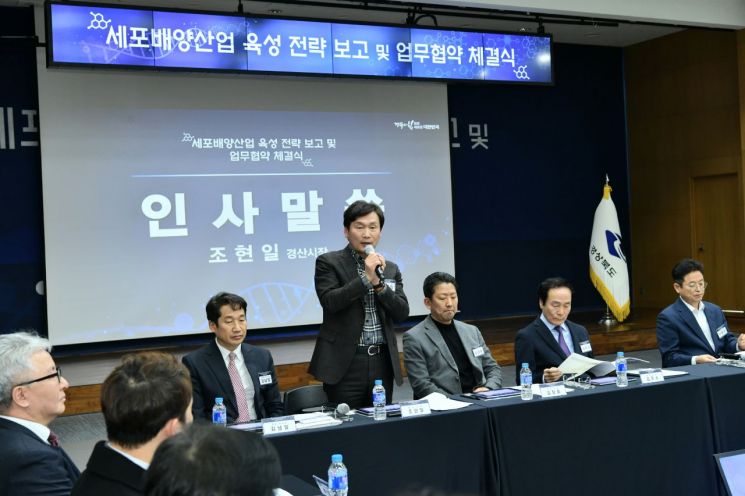 At the cell culture industry business agreement signing ceremony, Cho Hyun-il, Mayor of Gyeongsan, is giving a speech.
It will establish a cloud-based cooperative network with regional universities and research institutions such as Daegu Catholic University, Kyungpook National University, Daegu University, and the Korea Institute of Oriental Medicine, and develop natural raw materials for elderly-friendly health functional foods, medicines, and special pet food by combining in silico technology and artificial intelligence (AI), including media raw materials.
In the future, it plans to function as a hub for fostering master's and doctoral researchers and industrial personnel by establishing a convergence graduate school and introducing a professional certification system.
Pohang will utilize related research infrastructure such as POSTECH (3D bioprinting) and Pohang TP (Green Vaccine Demonstration Support Center) to build a demonstration testbed capable of technology development, pilot manufacturing, and production certification for the commercialization of cultured foods and artificial organs.
POSTECH's 3D bioprinting technology, which holds the world's best original technology, is a core technology that can overcome the cost and mass production limitations of cultured foods, supporting the commercialization of 3D printed cultured foods and artificial organs using animal cells and seafood, and nurturing it as an advanced base for ventures and startups.
Gumi, as a new airport hinterland city, will be nurtured as a future food industrial research hub linked with the establishment of the Gyeongbuk branch of the Korea Food Research Institute.
Based on the excellent original technology and expertise of the Korea Food Research Institute, a government-funded research institute under the Ministry of Science and ICT, it will support securing food safety through quality standardization applied throughout the production process from material production of cultured foods.
Governor Lee Cheol-woo of Gyeongbuk said, “The creation of the cell culture industry cluster is a meaningful project where local universities with differentiated original technologies, research institutes, companies, and local governments jointly shape the industry.” He added, “In the future, based on the technologies of universities and research institutes, we will lead related industries, and universities and Meister high schools will supply the necessary workforce to actively nurture this as a new cash cow for the region.”
© The Asia Business Daily(www.asiae.co.kr). All rights reserved.
![Clutching a Stolen Dior Bag, Saying "I Hate Being Poor but Real"... The Grotesque Con of a "Human Knockoff" [Slate]](https://cwcontent.asiae.co.kr/asiaresize/183/2026021902243444107_1771435474.jpg)

















