[Asia Economy Sejong=Reporter Dongwoo Lee] Korea Southern Power (KOSPO) is set to accelerate its hydrogen business to achieve carbon neutrality. The company aims to respond to rapidly changing management environments and create new growth engines for the future.
According to the energy industry on the 8th, KOSPO aims to reduce carbon dioxide emissions by 10% by 2028 through hydrogen co-firing power generation compared to full combustion of liquefied natural gas (LNG). Hydrogen co-firing refers to a method of producing electricity by burning hydrogen and natural gas together in a gas turbine, which is evaluated to drastically reduce carbon dioxide emissions compared to existing LNG power plants. To this end, KOSPO introduced the first domestic design capable of 30% hydrogen co-firing at the Shin Sejong Bitdream Power Plant, an LNG combined cycle power plant that began construction in Sejong City in 2021.
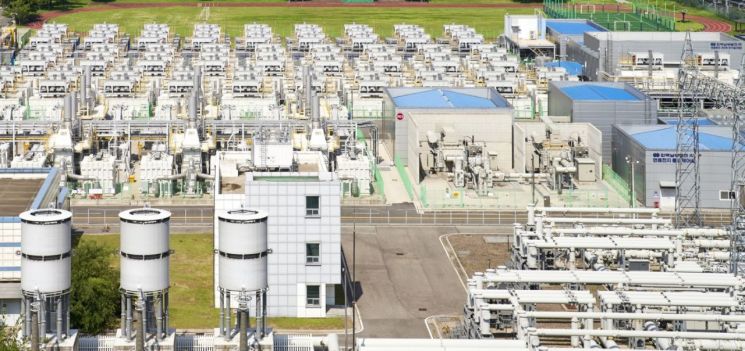 Panoramic view of the hydrogen fuel cell at Korea Southern Power's Shin-Incheon Bitdream Headquarters, developed as the world's largest single complex
Last year, KOSPO declared the 'KOSPO Hydrogen Business Promotion Strategy' at its Busan headquarters to lead the hydrogen energy market and achieve carbon neutrality by 2050. Reflecting government energy policies including amendments to the Hydrogen Act and domestic and international hydrogen-related business status, KOSPO established four strategic goals and twelve strategic tasks: ▲Innovative hydrogen power generation ▲Proactive infrastructure construction ▲Global supply chain acquisition ▲Strengthening company-wide business capabilities.
The reason KOSPO focuses on commercializing the hydrogen industry and co-firing power generation is to secure leadership in the global hydrogen market through projects such as introducing clean energy to reduce carbon emissions. This year, the company is promoting the construction of the largest green hydrogen production facility in Asia, a 12.5 MW (megawatt) renewable energy-linked plant on Jeju Island, and the country's first ammonia co-firing infrastructure project. Through these efforts, KOSPO has set a goal to produce 1.7 GW (gigawatts) of fuel cells and hydrogen-ammonia co-firing power generation by 2030.
KOSPO is also strengthening large-scale green hydrogen energy projects linked with renewable energy. Last year, the company signed a memorandum of understanding (MOU) with SK Ecoplant to enhance cooperation in green hydrogen, ammonia, and low-carbon energy businesses. This agreement was established to jointly develop overseas green hydrogen and ammonia production business models and to promote carbon capture utilization (CCU) technology cooperation and demonstration projects to lead new hydrogen businesses.
Under this agreement, both companies will strengthen cooperation to build domestic and international production infrastructure to secure a stable supply of green hydrogen and ammonia, which are expected to see increased demand for co-firing power generation. They will also develop and jointly conduct demonstration projects for a 'low-carbon energy solution model' that integrates carbon capture and liquefaction technologies with fuel cells to reduce carbon dioxide emissions by more than 70%.
KOSPO is accelerating the proactive acquisition of terminal infrastructure to ensure stable procurement of hydrogen fuel. Since it is difficult to procure large quantities of hydrogen domestically, securing a stable global supply chain in overseas markets is essential. In this regard, KOSPO is strengthening contacts with countries such as Australia, which is recently regarded as closest to producing clean hydrogen.
As a leading domestic company under 'Team KOREA,' KOSPO is also working on establishing a hydrogen supply chain through the Saudi sovereign wealth fund. KOSPO, Korea Electric Power Corporation (KEPCO), Korea National Oil Corporation, Samsung C&T Construction Division, and POSCO Holdings formed the domestic representative 'Team KOREA' and signed an MOU last year with the Saudi Public Investment Fund (PIF) to promote the development of Saudi green hydrogen and ammonia projects.
KOSPO and others will build a plant in Yanbu, on the Saudi Red Sea coast, producing approximately 2 GW and 1.2 million tons annually of green hydrogen and ammonia, which corresponds to 20% co-firing volume for coal power generation. The project cost is estimated at 6.5 billion USD, with a construction period of four years. A preliminary feasibility study is currently underway. This project is expected to secure a stable supply chain for future hydrogen and ammonia, as more than 80% of domestic hydrogen and ammonia demand will need to be procured from overseas.
Through this, KOSPO has laid the foundation for responding to climate change and achieving carbon neutrality goals by participating in the entire value chain?from development to production, distribution, and utilization?of zero-carbon energy such as green hydrogen and ammonia. It is also expected to serve as an opportunity to expand cooperation fields including new businesses, construction, and plants beyond green hydrogen and ammonia projects.
Lee Seung-woo, President of KOSPO, emphasized, "It is time to practice carbon neutrality before it is too late for humanity's survival and to overcome the global climate crisis." He added, "We will revitalize the clean hydrogen-related ecosystem such as green hydrogen production and continuously expand new energy businesses to achieve carbon neutrality by 2050."
© The Asia Business Daily(www.asiae.co.kr). All rights reserved.
![Clutching a Stolen Dior Bag, Saying "I Hate Being Poor but Real"... The Grotesque Con of a "Human Knockoff" [Slate]](https://cwcontent.asiae.co.kr/asiaresize/183/2026021902243444107_1771435474.jpg)
















