Need for a 'Megi' to Revitalize Competition in the Mobile Telecommunications Market
Potential Candidates Coupang, Kakao, etc. "No Plans to Consider"
[Asia Economy Reporter Lim Hye-seon] Will a fourth mobile carrier like Dish Network in the U.S. emerge in Korea as well?
The government is seeking a 'catfish' fourth mobile carrier to revitalize competition in the mobile telecommunications market. This is the eighth attempt. Candidate companies include Coupang, Kakao, Shinsegae, Lotte, and financial firms?companies with deep pockets capable of playing the role of a fourth mobile carrier.
However, the responses from the mentioned companies have been underwhelming. They unanimously stated, "We have not considered it." The reasons include the lack of relevance to their existing businesses and the cautious approach to entering a regulated industry. Low profitability is also a concern.
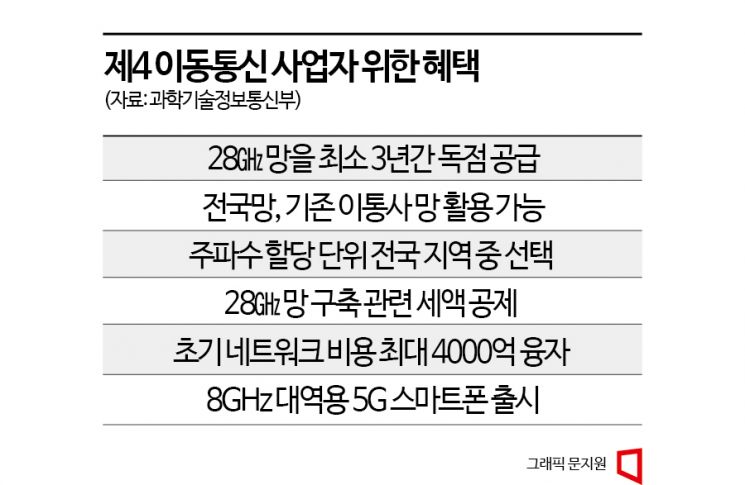
The Ministry of Science and ICT has viewed past failures as resulting from overly high standards and has lowered the entry barriers. The ministry decided to supply the 28GHz 5G frequency band and 800MHz band, reclaimed from KT and LG Uplus, to new operators at a low price for at least three years. To ensure success, the ministry reduced the burden of building new base stations from trillions of won to around 300 billion won and allowed new operators to use the existing networks of the three major carriers?SK Telecom, KT, and LG Uplus?like MVNOs, enabling nationwide service.
There is no need to build a network covering an entire specific area. Installing 28GHz base stations mainly in 100 to 300 densely populated locations such as stadiums and large shopping centers will suffice. The cost to be paid to the three major carriers for network usage will be financed up to 400 billion won through policy financial institutions. The government is also pushing for the release of 5G smartphones compatible with the 28GHz band in discussions with smartphone manufacturers. The government plans to announce the frequency allocation plan in the second quarter of this year and select a new operator in the fourth quarter.
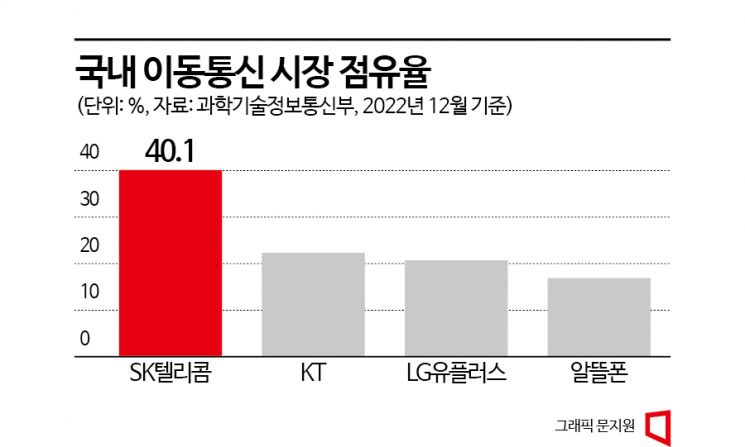
The government has proposed incentives because the need for a new operator is growing. The telecommunications market has solidified into a three-carrier system. Competition in quality and pricing among operators is gradually decreasing. The strategy is to stimulate competition in the telecommunications market through the entry of new operators alongside MVNOs. Fierce competition leads to improved service quality and lower prices. As of December last year, the market shares were SK Telecom 40.1%, KT 22.3%, LG Uplus 20.7%, and MVNOs 16.9%, chasing after them.
Since 2010, the government has conducted seven rounds of operator selection for a fourth mobile carrier but failed each time. Previous challengers such as Korea Mobile Internet (KMI), Internet Space Time (IST), Sejong Telecom, Quantum Mobile, and K Mobile all failed to meet financial capability criteria. At the time, insiders expressed dissatisfaction, saying, "There is no answer unless Samsung jumps in."
The telecommunications industry believes that it will not be easy for a new operator to enter this time either. Companies do not find the fourth mobile carrier business attractive. The risk of failure is high because it is difficult to make money relative to the scale of investment. The telecommunications business requires continuous additional investments such as maintenance along with initial capital. There is also the burden of the 28GHz frequency. While the 28GHz frequency offers high speed, it has low obstacle penetration and strong directivity, making service implementation difficult. Base stations must be densely installed, reducing investment efficiency. The consensus is that the MVNO market has a lower barrier to entry.
An industry insider explained, "Policy support provided to MVNOs is more effective than incentives for the fourth mobile carrier," adding, "The corporate atmosphere is that there is no need to compete with Goliath by taking the narrow and difficult path when an easier way exists." To solve these issues, it is analyzed that the government needs to offer more proactive support measures for the fourth mobile carrier. For example, when settling fees for network usage among carriers, the fourth mobile carrier could be allowed to use other companies' networks free of charge. The new mobile carrier plays the role of a catfish that creates tension in the telecommunications ecosystem, making the ecosystem healthier in the long term. It is pointed out that time and space must be provided for the young catfish to grow without being eaten by other creatures.
© The Asia Business Daily(www.asiae.co.kr). All rights reserved.
![Clutching a Stolen Dior Bag, Saying "I Hate Being Poor but Real"... The Grotesque Con of a "Human Knockoff" [Slate]](https://cwcontent.asiae.co.kr/asiaresize/183/2026021902243444107_1771435474.jpg)

















