Reviewing the 1st New Town Special Act
Exemption from Safety Inspections if Project Public Interest Secured
Establishing Grounds for Excess Profit Recovery to Ensure Regional Equity
[Asia Economy Reporters Minyoung Kim and Kyungjo Roh] The government announced on the 7th the "Special Act on the Maintenance and Support of Aging Planned Cities," which focuses on applying various special measures such as easing reconstruction safety inspections and increasing floor area ratios in aging new towns designated as special maintenance zones. This aims to shorten project procedures and accelerate progress by easing the first hurdle of reconstruction?the safety inspection?and increasing floor area ratios to improve project profitability, as well as integrating various permits and approvals. However, considering concerns such as a potential rental housing crisis if reconstruction projects proceed simultaneously, the government decided to promote relocation measures led by local governments. Additionally, excess profits gained from reconstruction projects will be recovered in various ways in the future.
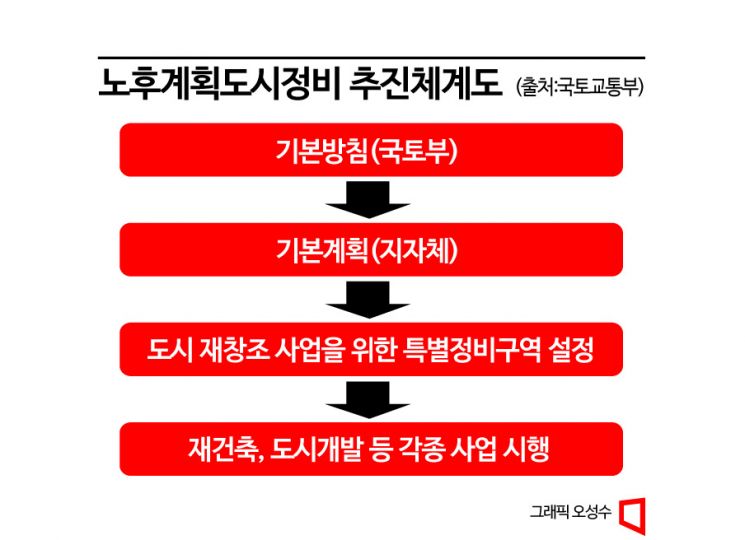
◇ Facility aging criteria changed from 30 years to 20 years after land development completion = The criteria for aging planned cities subject to the special act have been changed from the existing facility aging standard of 30 years to 20 years or more after the completion of land development projects. This is to enable systematic planning and response before the city becomes aged. In fact, the first-generation new towns (five locations) such as Bundang in Seongnam City, Ilsan in Goyang City, Jungdong in Bucheon City, Pyeongchon in Anyang City, and Sanbon in Gunpo City are large-scale residential towns with a total population of 1.17 million and 292,000 households. The construction plan was announced in April 1989, and move-in was completed by the end of 1992, about three and a half years later. However, after 30 years since completion, residents' demands for maintenance have continued due to parking difficulties, pipe corrosion, noise between floors, and aging infrastructure.
The area criterion is land of 1 million square meters or more. This corresponds to the minimum scale requiring metropolitan-level maintenance at the city unit, roughly the size of an administrative district in the Seoul metropolitan area (population about 25,000, housing about 10,000 units). However, considering cases where land districts were developed by subdivision, the enforcement ordinance will allow inclusion of aging planned cities even if a single land district does not reach 1 million square meters, provided that the combined area of two or more adjacent or contiguous land districts is 1 million square meters or more, or if adjacent aging old downtown areas forming the same living zone with the land district are included.
◇ Safety inspections also exempted = In areas designated as special maintenance zones, relaxed standards for urban and architectural regulations such as floor area ratio and building coverage ratio, as well as safety inspection regulations, will be applied, and various supports and special measures stipulated by the special act will be granted. Safety inspection standards more lenient than those stipulated in the Urban Maintenance Act can be applied, and if the public nature of the project is secured, safety inspections can be exempted, allowing immediate designation of special maintenance zones and project planning. Floor area ratio regulations will also be relaxed to a higher classification level (from type 2 to type 3 or semi-residential). Land use zones can be changed depending on local conditions.
Special maintenance zones can be designated as "minimum location regulation zones" under the National Land Planning Act to enable proximity of residence and work, high-density, and mixed-use development in aging planned cities including first-generation new towns. Additionally, for remodeling projects, considering the effect of securing additional households within special maintenance zones, the number of households can be increased beyond the current limit (within 15% increase).
◇ Simplified procedures and accelerated project speed = Integrated review procedures will be applied to maintenance projects in aging planned cities. Accordingly, various reviews, designations, and planning established under individual project laws such as the Building Act, Landscape Act, National Land Planning Act, and Metropolitan Transportation Act will be integrated into a single review.
To facilitate smooth project promotion, special maintenance zones will basically be set within the scope where a single project implementer (such as a union) can carry out the project. For example, if four apartment complexes are developed as a complex and self-sufficient facilities are secured, the four complexes will be designated as one special maintenance zone. If multiple project implementers are unavoidable, a general project manager system will be introduced from the initial stage of special maintenance zone designation to manage all project stages and support the implementers.
A basic framework for relocation measures to prevent rental housing crises caused by large-scale relocations has also been established. The obligation to establish relocation measures, which had been the responsibility of project implementers, will be led by local governments with government support. The government and local governments will designate "relocation measure project implementers," who will be responsible for creating relocation complexes and supplying cyclical housing.
◇ Basis for recovering excess profits established = To ensure fairness between regions, a basis for recovering excess profits will be established. In particular, various forms of contributions such as public sale housing, infrastructure, living SOC, and contribution fees will be possible in addition to public rental housing.
However, there are concerns that recovering excess profits from reconstruction may overlap with burden-sharing fees and potentially undermine project feasibility. Eunhyung Lee, a research fellow at the Korea Institute of Construction Policy, said, "It is necessary to consider that obstacles to new town redevelopment projects, such as discussions on recovering excess reconstruction profits, still remain," adding, "If these issues persist, they may undermine the policy effects of the special act."
The main contents of the special act will be finalized after collecting final opinions at a meeting between the Minister of Land, Infrastructure and Transport and the heads of first-generation new town local governments on the 9th, and will then be proposed after going through the National Assembly consultation process.
© The Asia Business Daily(www.asiae.co.kr). All rights reserved.

















