Riemann Muffin Seoul, Kim Taeksang & Helen Pasijian Two-Person Exhibition
Pasijian Presents 'Gu' Sculpture & Kim Taeksang's 'Sumbit' Series
[Asia Economy Reporter Kim Heeyoon] "Light is not something to be drawn, but to be absorbed and emitted. Like a farmer cultivating crops, the artwork is entrusted to nature?water, gravity, time, wind?while my role is to oversee these works like a conductor, embodying the 'aesthetics of care.'"
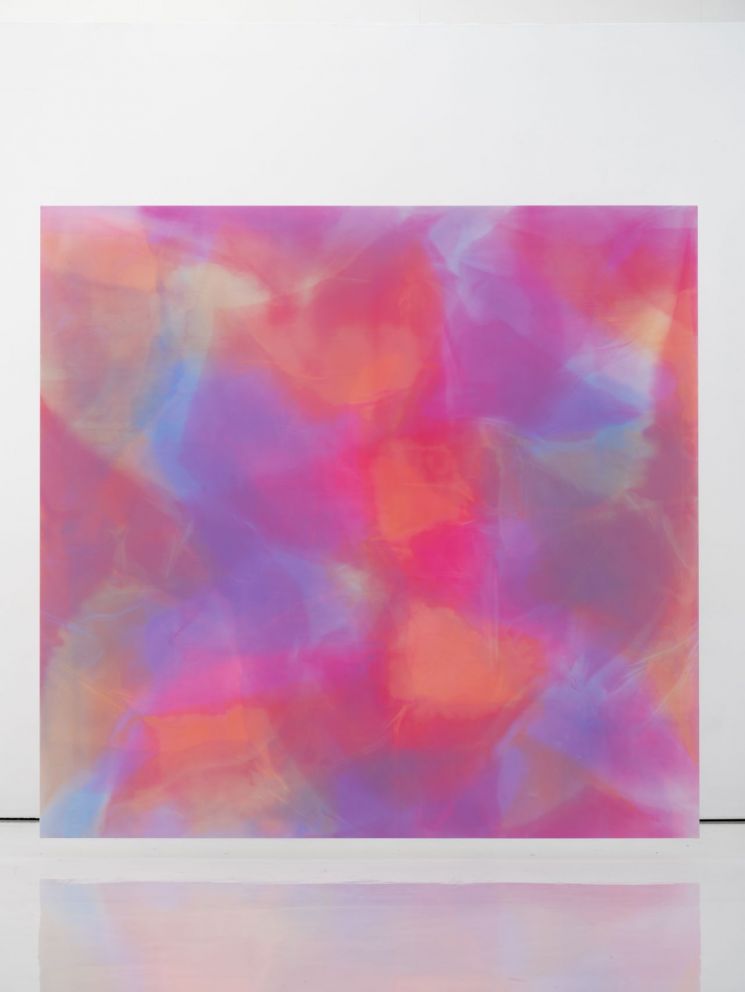 Taeksang Kim, Resonance-23-3, 2023, Water, acrylic on canvas, 176 x 183 cm [Photo by Liman Muffin Seoul]
Kim Taeksang (65), an artist who has devoted himself to light, introduced his artistic world during a two-person exhibition talk with Helen Pashgian (89), who is active in California, USA, saying, "My work is the pattern of life."
Lehmann Maupin Seoul announced on the 7th that it will hold "Reflections and Refractions," an exhibition showcasing works by Helen Pashgian and Kim Taeksang together until March 11. The exhibition three-dimensionally highlights the distinct intersection between the Western Light and Space movement, realized in terms of material and concept by two artists working in completely different regions and backgrounds, and the Eastern Post-Monochrome painting movement.
Helen Pashgian is a pioneer of the Light and Space movement, a sub-art movement of Minimalism that developed in California, USA, in the 1960s. She explores the relationship between the aesthetics and perception of atmospheric and celestial elements. Pashgian’s works, which innovatively apply industrial materials such as epoxy, plastic, and resin, are characterized by translucent surfaces that filter light while appearing to hold it within.
Emma Sohn, Senior Director of Lehmann Maupin Seoul, explained, "Pashgian began her work captivated by the strong reflection of sunlight on a California lake during her childhood, while Kim Taeksang was inspired to start painting by the sparkling pebbles in a stream in Gangwon-do. This exhibition shows how two artists from different cultural backgrounds explore light and space in their own ways."
Pashgian regards her works as 'presence' within a space that does not reveal everything at once. A characteristic feature is that continuous movement is generated as viewers circle around the sculptures to observe changes.
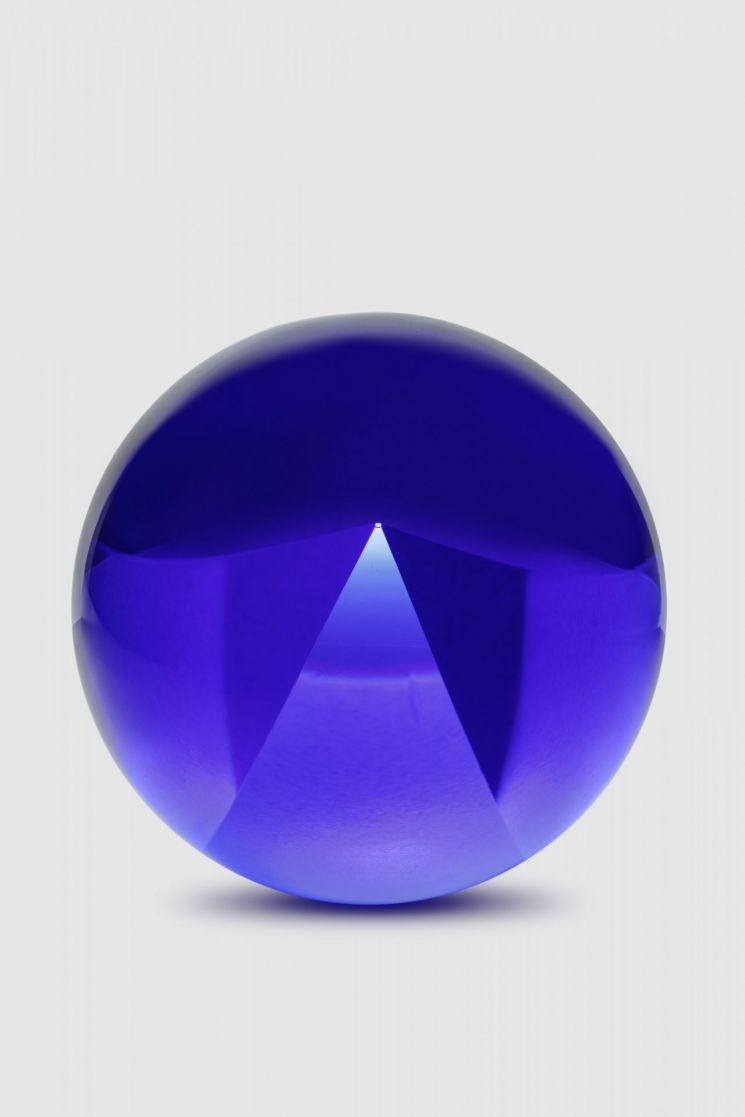
In this exhibition, Pashgian presents her representative series "Spheres." When light permeates the brightly colored spherical sculptures containing floating forms inside, interactions among light, reflective surfaces, and internally cast shapes create distortions, illusions, refractions, and prisms. As a result, the sculptures seem to simultaneously approach and retreat, appear and disappear, and come closer and then move away again.
Pashgian’s wall installations made of cast epoxy also attract attention. The shapes within each work, reminiscent of faintly emitted light or reflected camera flashes, shine more distinctly in contrast to the surrounding dark reflective surfaces. Through her works, the artist presents her perception of the visual effects that occur when light enters water, visualizing points in the space where light and water meet and moments that are difficult to capture.
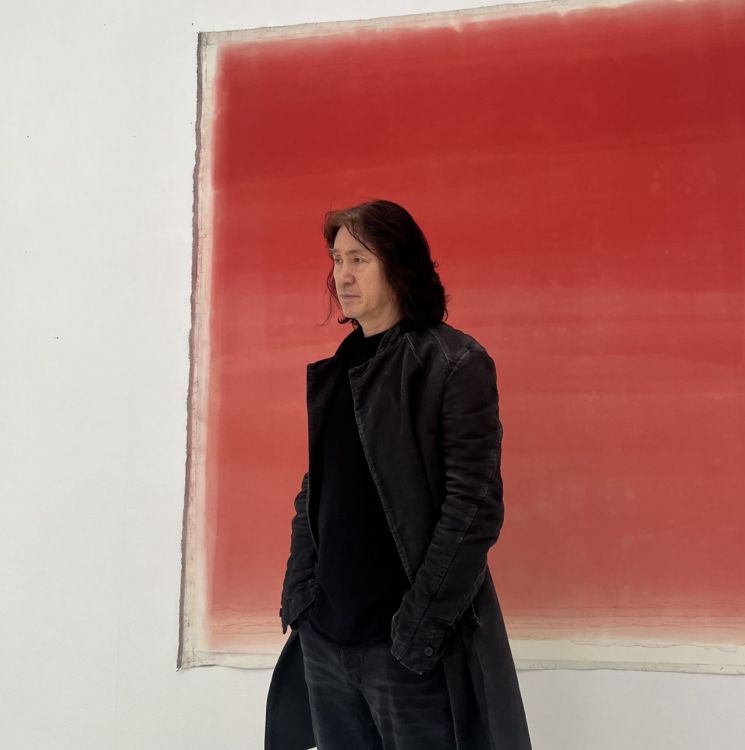 Taeksang Kim, 2023 Courtesy of the artist and Leeahn Gallery, Seoul/ Daegu
 Photo by Liman Muffin Seoul
The multicolored paintings by Kim Taeksang exhibited together create an independent environment in themselves. Like Pashgian’s works, Kim’s "Breathing Light" series is also inspired by the reflective elements of water and the resulting characteristics of light.
In this exhibition, Kim Taeksang presents many new works featuring canvases that seem to hold water and light. His translucent paintings fill the surface with multiple gradations of color instead of traditional painting elements such as form, depiction, or narrative. The artist perceives his work as a spatial structure constructed from natural elements like water, light, and time, based on a high degree of intentionality and singular chance.
After dedicating 20 years to nurturing students as a professor, Kim retired and said with a smile, "Only then did my suppressed nature finally come out in my work," adding, "My concentration and work intensity per unit time have changed." His work is an ongoing process of mimicking and creating tension between chance and intentionality.
He pours a solution of acrylic pigment dissolved in water onto canvas fabric and waits for the diluted particles to settle on the canvas surface over time. Once a single color layer is absorbed into the canvas, he drains the remaining water and dries the canvas. Kim repeats this process dozens or hundreds of times. The multiple layers applied in this process simultaneously reveal and fade each other. He explains that while he intervenes in the work, he also leaves open various possibilities led by natural processes on the canvas.
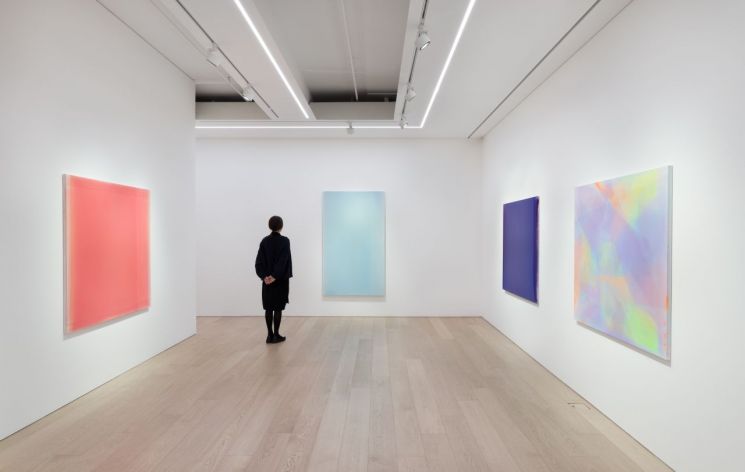
Both artists demonstrate a unique ability to transform a deep understanding of light properties such as diffraction, refraction, and scattering into spatial objects and environments. Their works turn the exhibition space into a poetic experience based on mutual communication, where light crosses boundaries while traversing the boundaries of time, space, and culture. Visitors can feel interconnected emotions within this space.
Kim Taeksang, recognized as a major artist of Korean Post-Monochrome painting, has works held in domestic and international private and public collections, including the National Museum of Modern and Contemporary Art, Leeum Museum of Art, and Kumho Museum of Art in Seoul. He served as a professor in the Department of Visual Arts at Cheongju University from 1991 to 2020. Pashgian’s works are held in prestigious public and private institutions worldwide, including the Andrew Dickson White Museum at Cornell University in Ithaca, New York; the Los Angeles County Museum of Art; the San Francisco Museum of Modern Art; and the Santa Barbara Museum of Art in California. The exhibition runs until March 11 at Lehmann Maupin Seoul in Hannam-dong, Yongsan-gu, Seoul.
© The Asia Business Daily(www.asiae.co.kr). All rights reserved.



















