Nikolai II's Coronation Attended by Min Yeonghwan
Seventeen Artworks Offered to Win Favor but Failed
'Heukchil Najon Icheungnong' and Jang Seung-eop's 'Gosainmuldo' Among Two Pieces
Exhibition Realized with Restoration Support from Overseas Korean Cultural Heritage Foundation
On May 26, 1896, the world's eyes were focused on Moscow. Major figures from around the world attended the coronation of Russian Emperor Nikolai II. China sent Li Hongzhang (1823?1901), the de facto ruler, and Japan sent Yamagata Aritomo (1838?1922), who served twice as Prime Minister of the Meiji government. Joseon dispatched Min Yeong-hwan (1861?1905) as its representative. After the signing of the Eulsa Treaty in 1905, he was a patriotic martyr who soothed the sorrow of a fallen nation with his death. He met with Russian Foreign Minister Lobanov to request the conclusion of a military and economic alliance. King Gojong (1852?1919) had a special mission to check China and Japan. The proposal was not accepted. It only resulted in a promise to send about ten Russian officers and soldiers to train the Joseon army. There was no leverage for negotiation as King Gojong had fled into the Russian legation.
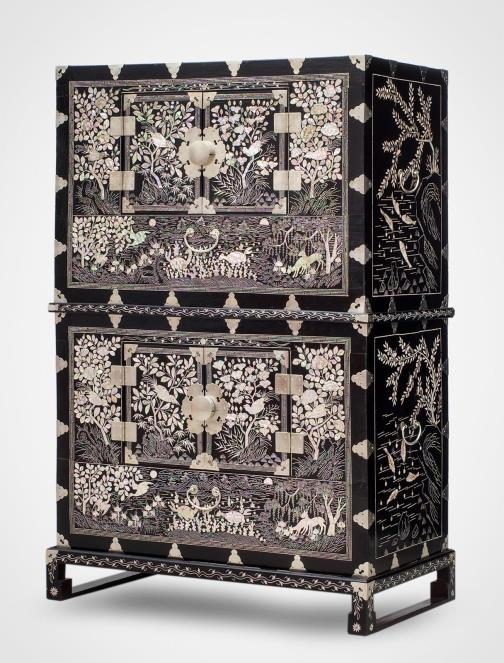
Typically, alliances are formed between countries of similar national power. If a weak country forms an alliance and a conflict arises, it may bear the brunt alone. King Gojong, who was like a candle flickering in the wind, was not in a position to be selective. Above all, protection by the Russian garrison was desperately needed. To win favor, he tried to present seventeen pieces of artwork showcasing the essence of Joseon crafts and art. These included the 'Heukchil Najeon Icheungnong' (Black Lacquered Mother-of-Pearl Two-Tiered Chest), 'Bal (簾)', and 'Deungmeseok (登每席)'. They are currently divided between the Kremlin Museum in Moscow and the State Museum of Oriental Art.
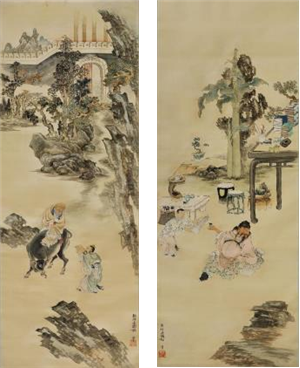
Five of the artworks belonging to the former category will be unveiled after 127 years. This will be through a special exhibition titled "Korea and the Armory, The History of the Last Emperor’s Coronation Gifts" held at the Kremlin Museum on the 9th. The Overseas Korean Cultural Heritage Foundation supported the restoration budget for the 'Heukchil Najeon Icheungnong' in 2020, and it was included in the exhibition list alongside Russian royal weapons and jewels. The exhibition features the 'Heukchil Najeon Icheungnong', two works by Jang Seung-eop (1843?1897) titled 'Gosainmuldo', and two 'Baekdong Hyangro' (white copper incense burners). This is the first time the actual gifts King Gojong presented to Nikolai II have been publicly displayed. Until now, only their names were known through the diary of Yun Chi-ho, who accompanied Min Yeong-hwan to the coronation.
The most eye-catching exhibit is the 'Heukchil Najeon Icheungnong'. It is presumed to have been made by the most outstanding mother-of-pearl craftsman of the time under King Gojong’s special order. The lower part of the chest is adorned with mother-of-pearl depictions of the Ten Longevity Symbols (십장생) to wish for Emperor Nikolai II’s long life and health. The piece employs the 'kkeun-eumjil' technique (a method of cutting mother-of-pearl into thin thread-like strips to create patterns), which became popular after the introduction of the Japanese 'saw' in 1920. Kwak Dong-gu, Senior Officer of Support and Utilization at the Overseas Korean Cultural Heritage Foundation, evaluated it as "reflecting this technique far ahead of its time by about 30 years, holding a very important position in the history of crafts."
Jang Seung-eop’s two 'Gosainmuldo' paintings are titled 'Noja Chulgwando (Laozi Leaving the Pass)' and 'Chwitaebaekdo (Drunken Li Bai)'. These large-scale works, each over 174 cm in size, have never been reported in academic circles. The former depicts a scene where Laozi, riding a green ox, converses with Yin Xi before leaving Hangu Pass. Yin Xi asks Laozi about the Dao (Way), and Laozi answers; this dialogue is compiled in the book 'Dao De Jing'. The latter shows Li Bai, dressed in official robes, passed out drunk. Each work bears the national title 'Joseon (朝鮮)' before the signature 'Ow?n Jang Seung-eop (吾園 張承業)'. Senior Officer Kwak explained, "This is a rare case first confirmed among Jang Seung-eop’s works, showing that they were created as diplomatic gifts."
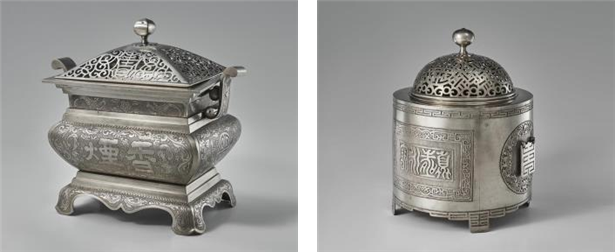
The 'Baekdong Hyangro' (white copper incense burners) are divided into square and round shapes. They symbolize heaven and earth respectively, referring to the concept of Cheonwon Jibang (天圓地方), meaning "Heaven is round, Earth is square," which well expresses the coronation’s purpose of representing the emperor’s reign. Especially notable is the harmonious fusion of straight and graceful curved lines in the openwork (透彫) pattern structure based on auspicious characters, a design rarely seen in ordinary crafts. The square incense burner’s body (노신, the main body of the incense burner or brazier) is inscribed with 'Hyangyeon (香煙)', meaning "fragrant smoke rises," while the round incense burner’s body bears 'Jinsuyeongbo (眞壽永寶)', meaning "truth, longevity, and eternal treasure." All inscriptions are phrases wishing for the success of the coronation.
© The Asia Business Daily(www.asiae.co.kr). All rights reserved.
![Clutching a Stolen Dior Bag, Saying "I Hate Being Poor but Real"... The Grotesque Con of a "Human Knockoff" [Slate]](https://cwcontent.asiae.co.kr/asiaresize/183/2026021902243444107_1771435474.jpg)


















