Foreigners and Institutions Increase 'Selling'
Decline Centered on Large Caps like Samsung Electronics and SK Hynix
Naver and Kakao Down Due to US Tech Stock Decline Impact
[Asia Economy Reporter Yoonju Hwang] On the 6th, the KOSPI and KOSDAQ closed lower. The KOSPI's decline widened in the afternoon as foreigners and institutions increased their selling pressure. Major market capitalization stocks such as semiconductors and batteries all turned downward, eventually pushing the index down to the 2430 level.
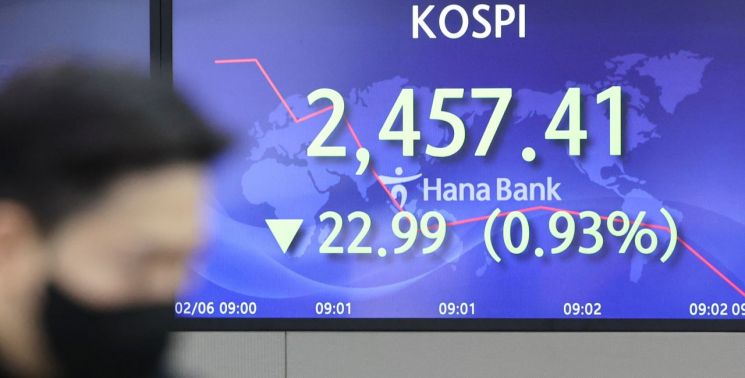
On this day, the KOSPI closed at 2438.19, down 1.70% (42.21 points) from the previous trading day. The KOSPI opened at 2461.82, down 0.75% (18.58 points), but the selling pressure from foreigners intensified, expanding the decline.
Foreigners and institutions net sold 313.9 billion KRW and 506.3 billion KRW, respectively. Although individuals net bought 790.8 billion KRW, it was insufficient to lift the index. In the futures market, foreigners and institutions bought 11 billion KRW and 11.6 billion KRW, respectively. This contrasts with their net purchases of 118 billion KRW and 156.8 billion KRW in the morning futures market.
All of the top 10 stocks by market capitalization closed lower. The decline was particularly notable among semiconductor and technology stocks. Samsung Electronics, the largest by market cap, ended at 61,600 KRW, down 3.45%. SK Hynix also closed down 3.36% at 89,100 KRW. Naver and Kakao fell 3.58% and 2.98%, respectively. LG Energy Solution and LG Chem dropped 1.87% and 2.37%, respectively.
By sector, the declines were led by Electronics -2.71%, Services -2.15%, Large-cap stocks -2.05%, Securities -1.97%, and Construction -1.93%. On the other hand, Paper & Wood +0.86%, Small-cap stocks +0.42%, and Food & Beverage +0.13% rose.
The KOSDAQ closed at 761.33, down 0.71% (5.46 points) from the previous day. It opened at 763.66, down 0.41% (3.13 points), but like the KOSPI, the decline slightly widened.
Again, the index fell due to combined selling pressure from foreigners and institutions. Foreigners and individuals net sold 23.9 billion KRW and 110.4 billion KRW, respectively. However, individuals alone net bought 160 billion KRW.
The top 10 stocks by market cap showed mixed trends. Unlike the KOSPI, battery stocks showed strength. EcoPro BM rose 4.03%, L&F 0.47%, and EcoPro surged 6.25%. Osstem Implant also rose slightly by 0.27%. Like the KOSPI, technology stocks struggled and fell. Kakao Games and Pearl Abyss closed down 3.34% and 4.33%, respectively.
By sector, Broadcasting Services -2.89%, Digital Content -2.08%, Telecommunications Equipment -1.97%, and Computer Services -1.81% declined.
Lee Kyung-min, a researcher at Daishin Securities, commented, "The decline in the KOSPI was led by expanded losses among large-cap stocks such as Samsung Electronics and SK Hynix at the top of the market capitalization rankings. Last week's US employment surprise led to a sharp rise in US Treasury yields and a shift to dollar strength, causing renewed volatility in the financial markets."
© The Asia Business Daily(www.asiae.co.kr). All rights reserved.

















