[Asia Economy Yeongnam Reporting Headquarters Reporter Koo Dae-seon] On the 6th, the Gyeongbuk Office of Education held a future education district business agreement ceremony with Mungyeong City, Cheongsong County, and Chilgok County, selected through a basic local government contest.
The Gyeongbuk Future Education District refers to areas designated by an agreement between the Gyeongbuk Office of Education and basic local governments to build a regional education community through active communication and cooperation between schools and local communities, and to realize warm Gyeongbuk education.
This project started in 2020 with five locations (Uiseong, Sangju, Yecheon, Andong, Gyeongju) and has been operated since then, confirming the possibility of restoring local communities through education. It is gaining attention as a future education initiative to prepare for the crisis of local extinction, regional population decline, and a sharp decrease in school-age population.
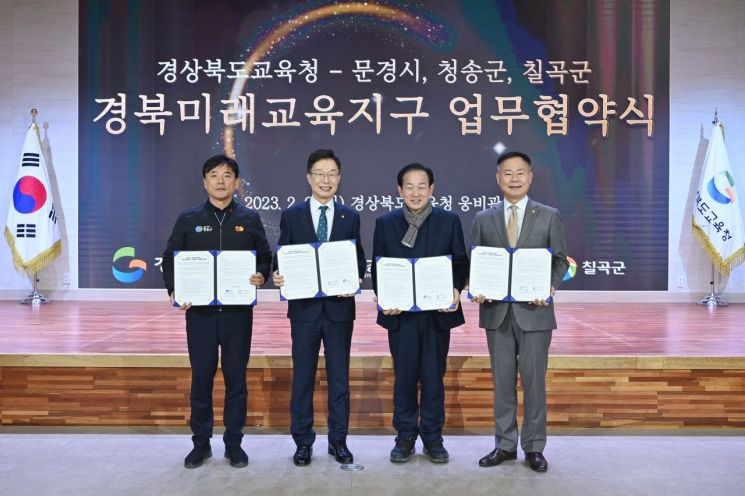 Gyeongbuk Office of Education signed a business agreement for the Gyeongbuk Future Education District with Mungyeong City, Cheongsong County, and Chilgok County. (From left in the photo: Yoon Kyung-hee, Cheongsong County Governor; Lim Jong-sik, Superintendent of Gyeongbuk Office of Education; Shin Hyun-guk, Mayor of Mungyeong; Kim Jae-wook, Chilgok County Governor)
Since a major reason for regional population outflow is considered to be the lack of quality jobs and excellent education, childcare, and care environments, this project is expected to alleviate educational disparities such as the burden of private education costs caused by gaps in the local educational environment and childcare issues necessary for local residents. It is also expected to reduce the burden of after-school childcare for parents engaged in livelihoods such as dual-income families.
By operating village education courses linked with the local community, producing village textbooks and localized teaching materials, and running regionally specialized programs reflecting local characteristics, this project fosters local pride. Through cooperation between the Office of Education and basic local governments to create a regional education ecosystem, it can play a significant role in preventing regional population outflow and creating a sustainable local community.
This project, operated over four years with an annual contribution of 200 million KRW each from the Gyeongbuk Office of Education and basic local governments, can be extended through mutual agreement between the two institutions. The Gyeongbuk Office of Education plans to continuously expand the project by designating an additional 3 to 5 locations annually and eventually extend it throughout the entire Gyeongbuk province.
Lim Jong-sik, Superintendent of Gyeongbuk Office of Education, said, “In a situation where the decline in the school-age population is severe, we will increase interest in childcare and education for children together with the local community and continue to cooperate with basic local governments to expand the operation of future education districts.”
© The Asia Business Daily(www.asiae.co.kr). All rights reserved.

















