North Korea Reconvenes Plenary Meeting After Two Months... "Unprecedented"
Worst Since the "Arduous March"... Large-Scale Starvation Deaths Also Reported
[Asia Economy Reporter Jang Hee-jun] North Korea has decided to convene a Party plenary meeting again just two months after the last one. As reports of mass starvation emerge from various regions and the Workers' Party takes an unusual step, there is speculation that North Korea's food crisis has reached an 'urgent level.'
According to security authorities on the 7th, the 13th Political Bureau meeting of the 8th Central Committee of the Workers' Party of Korea was held on the 5th at the Party Central Committee headquarters. At this meeting, a resolution to convene an expanded plenary meeting of the 8th Central Committee of the Party at the end of this month was adopted unanimously. Considering that plenary meetings are usually held once or twice a year, holding another plenary meeting just two months after the end of last year is unusual.
In particular, the resolution stated that the plenary meeting of the Central Committee would be convened "to summarize last year's struggle to realize the new era rural revolution program and to discuss the immediate farming issues and agricultural development goals." The background for convening the meeting is that "establishing a proper development strategy for agriculture and devising necessary measures for the current farming are extremely important and urgent critical tasks."
North Korea, Worst since the 'Arduous March'...Reports of Large-Scale Starvation
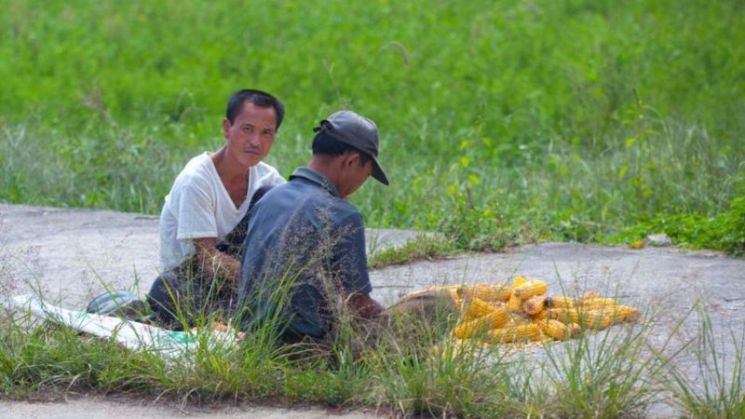 In September 2012, North Korean farmers in Kaesong are sorting harvested corn in the field. [Image source=Getty Images]
As North Korea itself acknowledged the situation as 'urgent,' the fact that it reconvened a plenary meeting focused solely on the agricultural sector within two months is interpreted as evidence that the food crisis has reached its limit.
In fact, according to the Rural Development Administration's announcement in December last year, North Korea's food crop production last year was 4.51 million tons, down 180,000 tons from the previous year. Despite this, North Korea wasted its budget on an unprecedented number of missile launches last year, so supply instability is expected to continue this year as well. Even if grain is imported from abroad at usual levels, it is generally estimated that there will be a shortage of more than 800,000 tons compared to demand. Earlier, the United Nations Food and Agriculture Organization (FAO) also re-designated North Korea as a 'country in need of external food assistance' in its crop outlook and food situation quarterly report released in July last year.
In particular, intelligence authorities are reported to have obtained information that numerous starvation deaths are occurring in various regions, including Hamgyong Province. Hamgyong is one of the most underdeveloped border areas in North Korea, and it is said that after the COVID-19 pandemic, lockdowns intensified, causing problems in procuring food from the outskirts. There are even reports that in Kaesong, considered a 'wealthy area,' dozens of people starve to death daily, and combined with harsh winter damage, people suffering extreme hardship are attempting extreme measures.
According to sources, Chairman Kim Jong-un received a special report on the situation in Kaesong and dispatched senior officials to the area in mid-last month. As the chaos worsened, he sent his close aides again to the site at the end of last month. An intelligence official said, "Complaints are already emerging among mid-level cadres that the situation is worse than during the Arduous March."
The U.S.-based North Korea specialist media 38 North also analyzed data on North Korea's food prices and stock levels last month and diagnosed that the food shortage crisis is the worst since the 1990s famine. The large price gap between rice and its substitute, corn, is interpreted as a sign that the food supply chain has collapsed. During the 1990s famine, known as the 'Arduous March,' it is estimated that up to one million residents lost their lives in North Korea.
"Evidence that the situation has reached an urgent level"... Ministry of Unification "Monitoring the situation"
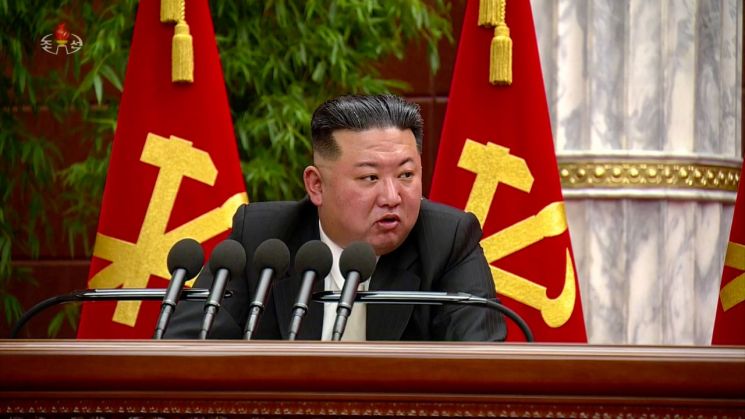
Professor Park Won-gon of Ewha Womans University’s Department of North Korean Studies said, "It is very unusual for North Korea to hold another plenary meeting focused solely on agriculture just two months after the last one, which suggests that there is something urgent going on." He added, "If they are holding a plenary meeting after just two months, it could indicate that revolutionary measures are needed to resolve the food crisis."
There is also a view that the Party leadership is showing a willingness to focus more on the people's livelihood issues. Hong Min, head of the North Korea Research Division at the Korea Institute for National Unification, interpreted, "It seems they are actively sending a message that from the beginning of the year, they will pay attention to the people's livelihood issues, especially agriculture, and establish concrete plans."
The Ministry of Unification stated that it will monitor North Korea's movements. Ministry of Unification spokesperson Koo Byung-sam said, "While it is not unprecedented for North Korea to hold a plenary meeting again two months after the last one at the end of last year, it is somewhat unusual. Especially since the agenda is solely related to agriculture, we are closely watching the food situation and internal developments."
When asked about the connection to Minister Kwon Young-se's recent remarks on 'threshold' or 'possibility of public unrest' during a radio broadcast, the spokesperson said, "The minister's remarks were made in the context of a discussion, suggesting that North Korea might come to the dialogue table 'under such circumstances.' I understand that he did not specifically mention North Korea's food situation."
© The Asia Business Daily(www.asiae.co.kr). All rights reserved.
![Clutching a Stolen Dior Bag, Saying "I Hate Being Poor but Real"... The Grotesque Con of a "Human Knockoff" [Slate]](https://cwcontent.asiae.co.kr/asiaresize/183/2026021902243444107_1771435474.jpg)

















