Population per Korean lawmaker: 170,000
Among OECD countries, relatively few lawmakers
[Asia Economy Reporter Kang Juhee] As elections approach, a cautious discussion often emerges in the political sphere. There is a proposal to increase the fixed number of National Assembly members, currently set at 300 (253 constituency seats and 47 proportional representation seats). The argument is that expanding the number of members is the only solution to reduce wasted votes, a problem inherent in the current single-member district system, and to strengthen proportionality in the legislature.
Leading the charge ahead of the 2024 general election is National Assembly Speaker Kim Jinpyo. On the 1st, Kim appeared on CBS Radio and said that the National Assembly is internally reviewing a plan to increase the number of members by about 30 or 50, while freezing personnel expenses. He also explained, "Compared to other countries, the number of National Assembly members in our country is relatively small."
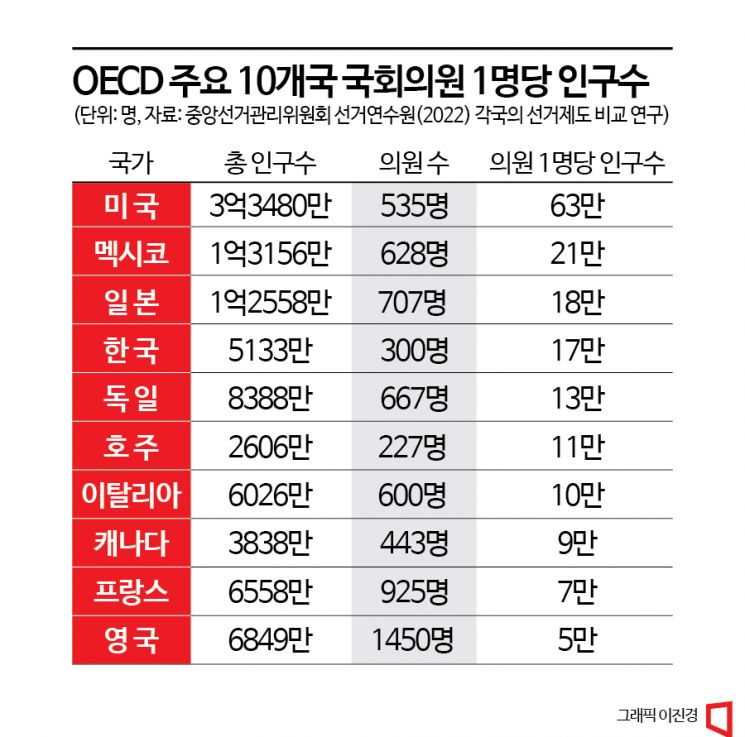
Looking solely at the Organisation for Economic Co-operation and Development (OECD), Kim’s statement is largely accurate. According to the "2022 Comparative Table of Electoral Systems" published by the National Election Commission’s Election Training Institute, considering South Korea’s current population (about 51 million), one member represents approximately 170,000 citizens.
Examining OECD countries with similar population sizes to South Korea, France (population 65.58 million) has a total of 925 members, with one member representing 70,000 people. The United Kingdom (population 68.49 million) has 1,450 members, with one member representing 50,000 people, and Italy (population 60.26 million) has 600 members, with one member representing 100,000 people.
South Korea ranks among countries with relatively fewer members per population alongside the United States, Mexico, and Japan. The United States has the fewest members relative to its population. With a population of 334.8 million, the U.S. has 535 members, meaning one member represents a staggering 630,000 people.
Compared to the U.S., South Korea may be seen as having more members, but a simple comparison between the two is problematic. The U.S. is a federal state with a well-developed state-level representative system, making its political structure and circumstances different from South Korea’s.
Although calls to expand the number of members persist when compared to other countries, public opinion is not favorable. Negative perceptions have taken root regarding various privileges granted to members and the increased costs associated with expanding the number of members. During the 2020 21st general election, Sim Sangjung, then chair of the Political Reform Special Committee, faced heavy criticism after raising the issue of increasing the number of members.
The National Assembly is aware of this public sentiment. Speaker Kim Jinpyo said, "Increasing the number of members is directly related to the public’s political trust in the National Assembly. In that respect, the conditions for increasing the number are very difficult."
However, Kim added, "Conservative figures are being elected in Honam, and progressive figures are being elected in Yeongnam, so the diverse political opinions of each region should be reflected in central politics. That is not happening now," and further explained, "To solve this problem, the most realistic current method is to increase the number of members, and there is a consensus on that."
© The Asia Business Daily(www.asiae.co.kr). All rights reserved.
![Clutching a Stolen Dior Bag, Saying "I Hate Being Poor but Real"... The Grotesque Con of a "Human Knockoff" [Slate]](https://cwcontent.asiae.co.kr/asiaresize/183/2026021902243444107_1771435474.jpg)

















