Ministry of Economy and Finance: "Local Governments Have Authority to Adjust Subway Fares"
Seoul City Proposes Amendments to Elderly Welfare Act and PSO Legislation
[Asia Economy Reporter Park Hyun-joo] Seoul City is facing increasing concerns over raising the age for free subway rides.
Seoul City views the main cause of subway deficits as free rides for senior citizens and argues that if the national government compensates for part of the losses, the fare increase could be minimized. However, the Ministry of Economy and Finance insists that subways are the exclusive responsibility of local governments, so all loss compensation should be borne by the local governments, blocking central government support.
Seoul City considers free subway rides as a national duty under the law. Article 26 of the Senior Welfare Act stipulates that those aged 65 and over can use transportation and public facilities free of charge or at a discount. Therefore, if a local government independently changes the age criteria, it would be illegal, and only if the National Assembly amends the law can the free ride age be raised. Furthermore, since free rides for seniors are universal welfare applied nationwide through legislation, the central government has a responsibility to partially compensate for the losses.
Another reason cited is the polluter pays principle under Article 32 of the Railroad Industry Development Act. Costs arising from providing public services should be borne by the party causing them, so the state should also be responsible for subway losses. In fact, Korea Railroad Corporation (KORAIL) receives Public Service Obligation (PSO) budget support from the central government. Last year, it received 379.6 billion KRW, and this year, 384.5 billion KRW.
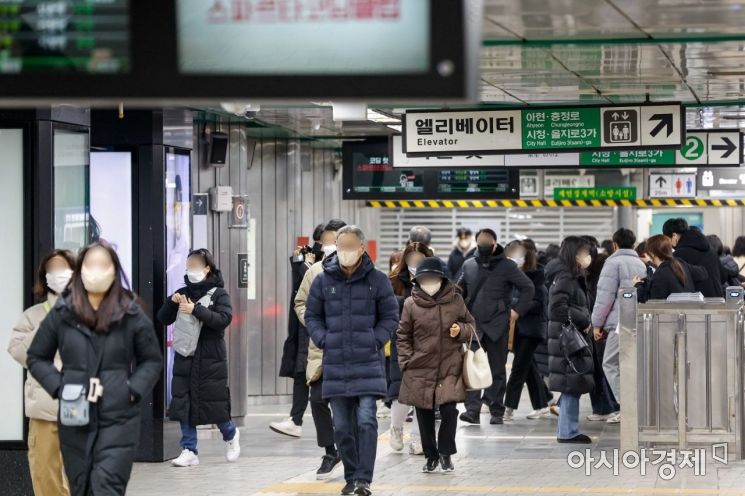 On the 30th of last month, citizens wearing masks were moving at Sinchon Station on Subway Line 2 in Seodaemun-gu, Seoul. Photo by Jinhyung Kang aymsdream@
However, the Ministry of Economy and Finance views that local government heads have the authority to adjust transportation facility fares. Article 26 of the Senior Welfare Act states that the 'state or local governments' have the authority to adjust transportation and public facility fares. The ministry argues that local governments can establish their own ordinances to adjust usage fees.
Article 31 of the Urban Railway Act also stipulates that when an urban railway operator decides or changes fares, they must report the changes to the city or provincial governor, who can then decide whether to approve them.
In fact, Daegu City is currently promoting a plan to raise the free subway ride age from 65 to 70, in line with the Senior Welfare Act. Daegu plans to prepare related ordinances and discuss the matter with the Daegu City Council.
Additionally, the Ministry of Economy and Finance argues that central government compensation for subway losses is difficult based on fairness. Injecting national funds only into Seoul’s subway would be unfair to other regions without urban rail operations and could potentially expand government responsibility to other services such as water and sewage.
Seoul City intends to resolve the issue by proposing amendments to the Senior Welfare Act and legislation on Public Service Obligation (PSO) compensation to the National Assembly.
Busan City shares the same stance. On the 6th, Busan urged the national government to support losses from free subway rides for those aged 65 and over. They argue that free subway rides for seniors are universal welfare policies implemented by government policy and law, and that there is no fairness issue arising from national funding due to the metropolitan expansion of urban rail lines.
© The Asia Business Daily(www.asiae.co.kr). All rights reserved.
![Clutching a Stolen Dior Bag, Saying "I Hate Being Poor but Real"... The Grotesque Con of a "Human Knockoff" [Slate]](https://cwcontent.asiae.co.kr/asiaresize/183/2026021902243444107_1771435474.jpg)
















