[Asia Economy (Daejeon) Reporter Jeong Il-woong] Hands are busy beneath the helicopter inside the hangar. A mechanic, having climbed up a lift, bends at the waist and tilts his head back to inspect various parts of the aircraft. Following the mechanic’s gaze, various tools are directed toward the helicopter. Behind them, two engineers continue a serious conversation. They are in the process of identifying the cause after confirming a slight fuel leak from the aircraft.
Inside the hangar, there is also a helicopter that seems to have already passed through the hands of mechanics. The aircraft is so massive that even a fully grown adult male standing next to it looks like a small child. Even without flapping its wings, the sheer size of the helicopter naturally draws exclamations. Its exterior is spotless, as if it has just been washed, but in reality, the helicopter is a wildfire-fighting helicopter that has roamed through rough flames and soot-filled wildfire sites.
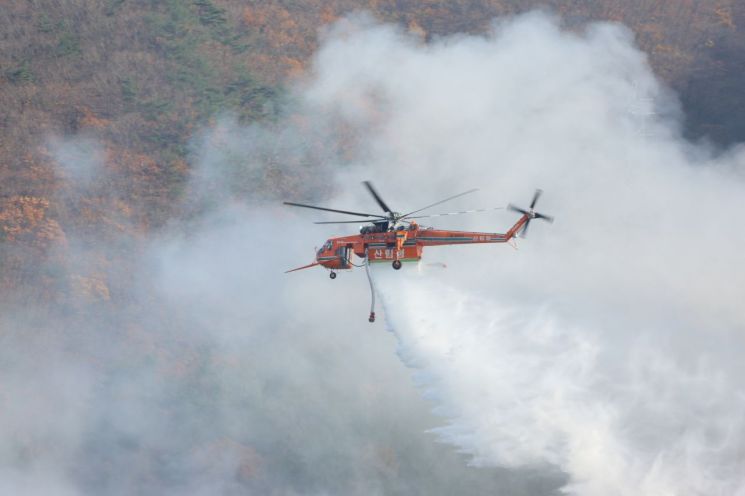 A wildfire suppression helicopter from the Korea Forest Service is cutting through the smoke while conducting firefighting operations at the wildfire site. Photo by Korea Forest Service
On the 2nd, we visited the Forest Aviation Headquarters located in Wonju, Gangwon Province. The Korea Forest Service currently operates 11 forest aviation management offices nationwide, centered on the Wonju Forest Aviation Headquarters, including branches in Iksan, Yangsan, Yeongam, Andong, Gangneung, Jincheon, Hamyang, Cheongyang, Seoul, Uljin, and Jeju.
The Wonju headquarters and the 11 management offices operate a total of 48 forest helicopters (7 extra-large, 29 large, 1 medium, and 11 small). The primary uses of these forest helicopters are wildfire suppression, aerial pest control, mountain rescue, and disaster recovery support. Among these, wildfire suppression is a key factor that increases the role of helicopters in large-scale, year-round wildfire sites.
In South Korea, where about 63% of the land is mountainous, wildfire suppression via helicopters is more effective than manpower when fires break out. The fiercer the flames, the more important the helicopter’s firefighting capability becomes. In situations where it is difficult to deploy personnel due to soaring flames, the water dispersed by helicopters acts like a lifeline, minimizing damage to the nation’s valuable forests, lives, and property.
At wildfire sites, mechanics and pilots are known as unsung heroes. This is because their invisible efforts and dedication are essential for helicopters to operate effectively in wildfire zones.
The maintenance field is the first gateway for the aircraft to be operated normally. Typically, helicopter maintenance is performed once before takeoff and once after landing, with additional maintenance required depending on operating hours. For example, extra-large helicopters undergo separate maintenance processes after 15 hours of operation, and large helicopters after 25 hours, in addition to the pre- and post-flight maintenance. Regardless of the wildfire scale, the more frequent the dispatches to the field, the busier the mechanics inevitably become.
One mechanic is assigned per helicopter, and a team leader overseeing maintenance status is included in the team. At the Wonju Aviation Headquarters, which operates 2 extra-large and 3 large helicopters, 5 mechanics and 1 team leader perform on-site duties.
Mechanics also have a set daily work schedule (8 hours per day, from 9 a.m. to 6 p.m.). However, in wildfire situations where every moment counts, it is impossible to adhere strictly to working hours. Moreover, the recent increase in wildfire frequency often erodes the free time in a mechanic’s day and life. Nevertheless, the mechanics at the Wonju headquarters unanimously say that the reason they can focus on their core duties at the site is “a sense of mission or fulfillment they hold themselves, even if others do not recognize it.”
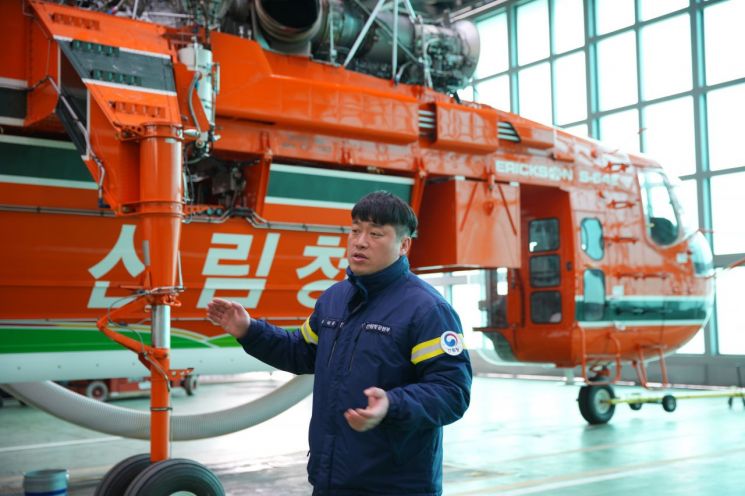 Maintenance technician Choi Seong-jun is introducing the helicopter maintenance process at the hangar of Wonju Forest Aviation Headquarters. Provided by Wonju Forest Aviation Headquarters
Choi Seong-jun (39, pictured), a mechanic at the Wonju headquarters, said, “The health of the helicopter’s body becomes the health of the mechanic,” adding, “Mechanics prioritize ensuring that helicopters deployed to wildfire sites do not encounter problems, and they never let their guard down to prevent any emergency situations.”
He further explained, “Even a minor mistake can cause confusion at wildfire suppression sites and potentially lead to casualties, so mechanics approach their maintenance work with a strong sense of responsibility.”
Since maintenance work is carried out behind the scenes, mechanics rarely receive attention even when large wildfires occur. However, as the frequency and scale of wildfires increase, the workload intensity for mechanics also rises.
Choi said, “With wildfires occurring frequently and becoming larger, the daily routine of mechanics has become more demanding. During last year’s Uljin wildfire, I stayed on-site for over ten consecutive days, battling the cold. When a large wildfire occurs, mechanics are usually dispatched to the site regardless of their affiliated institution’s jurisdiction, and they speed up maintenance in line with helicopter takeoffs and landings.”
He added, “At that time, the daily working hours, including standby time, were around 16 hours, and most of the time outside of sleeping was spent on-site. Although the working conditions in Uljin cannot be said to be ‘always’ like that, it is true that the workload has intensified with the recent increase in wildfire frequency. Nevertheless, when a helicopter I maintained rushes to the wildfire site, completes its mission, and returns safely, I feel a pride and fulfillment that others do not know,” he said with a shrug.
Challenges at wildfire sites also exist for pilots who directly operate the helicopters. Because they must fight wildfires while crossing the line between life and death, they cannot afford to relax their vigilance at any moment.
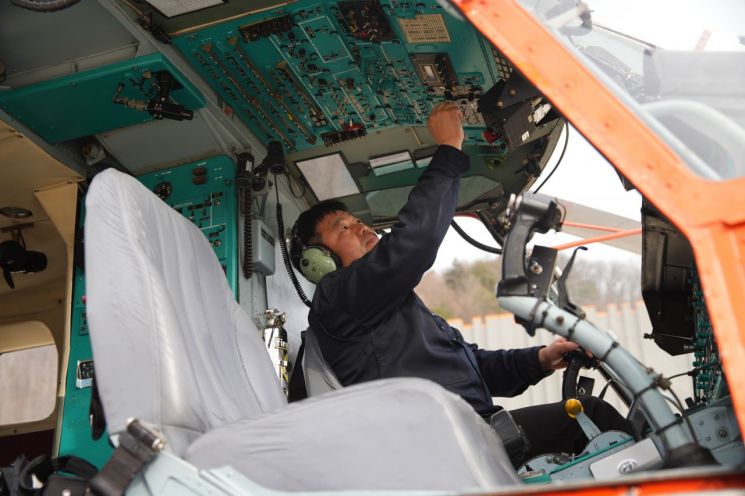 Pilot An Seong-cheol is boarding the helicopter after completing maintenance to check whether the aircraft is operating normally. Photo by Wonju Forest Aviation Headquarters
Ahn Seong-cheol (44, pictured), a pilot at the Wonju headquarters, is a veteran with 20 years of experience (including military helicopter piloting). However, even for him, wildfire sites are like walking a tightrope between life and death every moment.
Ahn said, “Everyone has an instinct to avoid danger, but when faced with fierce flames (danger), wildfire-fighting helicopter pilots answer ‘willingly’ to the question, ‘If I have to fly through the center of the flames and pour water, would I do it?’”
He added, “Besides the fierce flames, there are unexpected variables everywhere at wildfire sites. The smoke generated during firefighting and the high-voltage power lines spread like spider webs are examples. While piloting, sudden dangerous moments can occur at any time.”
He emphasized, “Nevertheless, the reason why wildfire-fighting personnel, including pilots, can bravely fight the flames on-site is the belief that ‘if not me, someone’s life and property could be threatened.’ Even if no one else recognizes it, I hope people understand that there are many who dedicate themselves to ensuring that I, my family, and neighbors can live safely,” he said with a smile.
© The Asia Business Daily(www.asiae.co.kr). All rights reserved.
!["The Woman Who Threw Herself into the Water Clutching a Stolen Dior Bag"...A Grotesque Success Story That Shakes the Korean Psyche [Slate]](https://cwcontent.asiae.co.kr/asiaresize/183/2026021902243444107_1771435474.jpg)


















