③ Singapore Global Innovation Center Set to Launch in April
Smart Factory to Secure Future Car Competitiveness
Benchmarking Hyundai Motor Group's Global Production Plants
Favorable Conditions for Talent Acquisition and New Business R&D
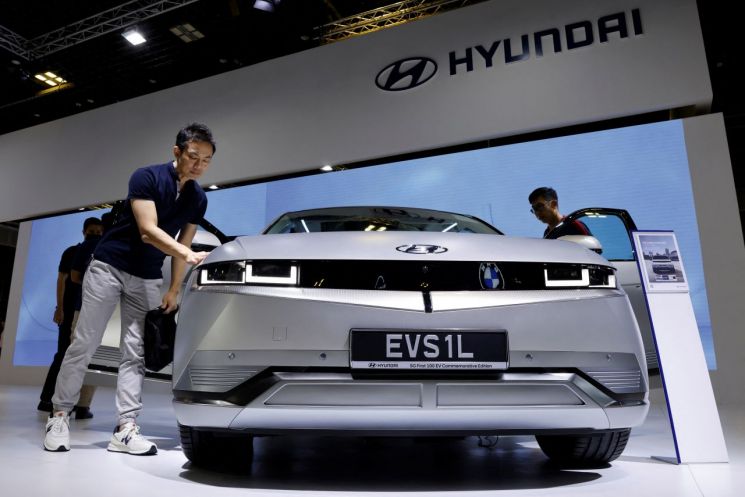 The Hyundai Ioniq 5, an exclusive electric vehicle assembled locally, was exhibited at the Singapore Motor Show held in mid-last month. Hyundai plans to put the initial batch of 100 units up for charity auction.
 [Asia Economy Reporter Choi Dae-yeol] Hyundai Motor's global innovation center (HMGICS), currently being built in Singapore, is set to open in April. What draws attention to this facility is that it encompasses the entire process of creating a new car, from development to manufacturing and sales. It also includes customer experience spaces such as a simple test driving track, exhibition, test drives, vehicle delivery, and maintenance. Such facilities are rare worldwide.
The automotive industry is a typical field where economies of scale apply. It lowers production costs by establishing large-scale mass production systems. However, the Singapore innovation center operates in a small-scale custom order format. This reflects the view that the supplier-centered mass production method of the past is not suitable for the future mobility era. The center plans to apply new attempts first across all areas that complete car companies engage in, including vehicle manufacturing, planning, and research and development.
The company's goal is to operate it as a smart factory by incorporating advanced technologies such as AI-based control systems and robotics, as well as various automated facilities. The technologies, techniques, and platforms developed here will be disseminated to Hyundai Motor Group's factories worldwide. This includes the new electric vehicle factory under construction in Georgia, USA, targeted to start operations in 2025, as well as future factories to be built in Korea.
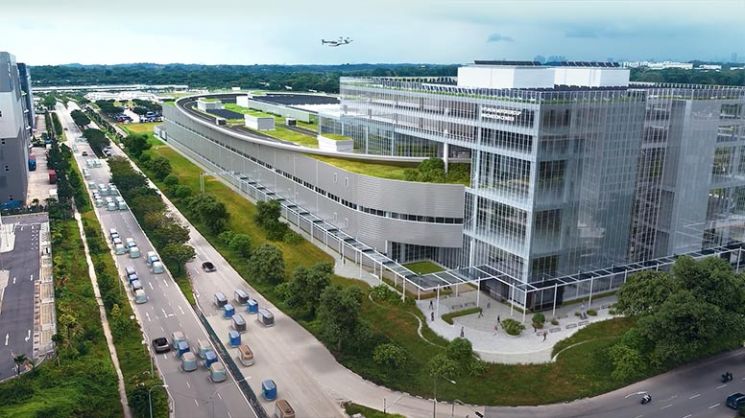
Hyundai Motor Group, headquartered in Korea, chose to create the prototype of a future factory in Singapore, a country with virtually no automotive production infrastructure, because it judged that it had an advantage over Korea in attracting global talent. Another reason for selecting Singapore is the freedom from regulations during the development of new businesses that Hyundai Motor Group has identified as future growth engines, such as Advanced Air Mobility (AAM) and autonomous driving. As a city-state, Singapore has a high acceptance of advanced information and communication technology (IT).
The HMGICS case holds significance beyond simply building another overseas factory in a specific region by a global automaker. It also shows that the criteria for deciding future complete vehicle production bases have changed from the past. Since the early 20th century, automotive factories have been dominated by the division of labor assembly system represented by Ford's conveyor belt. Later, General Motors, Toyota, and Volkswagen advanced to the global top tier of automakers with their own innovative production methods.
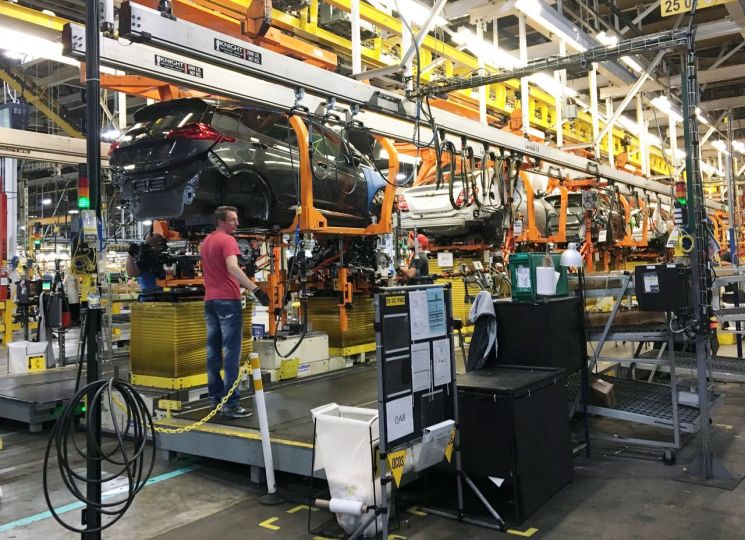
The recent automotive industry is called a period of upheaval because a completely different kind of change is underway. Not only are new power sources such as electricity and hydrogen used, but vehicles are also recognized as IT devices incorporating advanced technologies like autonomous driving and connected cars. Emphasizing Software-Defined Vehicles (SDV) is in the same context.
The industry anticipates that employment reduction in the future car era is inevitable. The role of robots is continuously increasing throughout the production process. Moreover, electrification is reducing the number of vehicle parts. Nevertheless, major automobile-producing countries are reluctant to relinquish leadership in the automotive industry because the mobility industry centered on transportation is expected to determine the fate of the entire national industry in the future.
Automobiles account for a large share of key economic indicators such as employment and exports, and the proportion of various upstream and downstream related industries in the overall economy is also significant. Considering that advanced technologies centered on automobiles are increasingly concentrated and that vehicle operation information is directly linked to a society’s security, it is clear that the state has sufficient reason to take an active role in managing this sector.
© The Asia Business Daily(www.asiae.co.kr). All rights reserved.



















