Ministry of Education and Korea Council for University Education Conduct Nationwide University Presidents Survey
[Asia Economy Reporter Yoo Byung-don] About half of four-year universities have plans to raise tuition fees in the future.
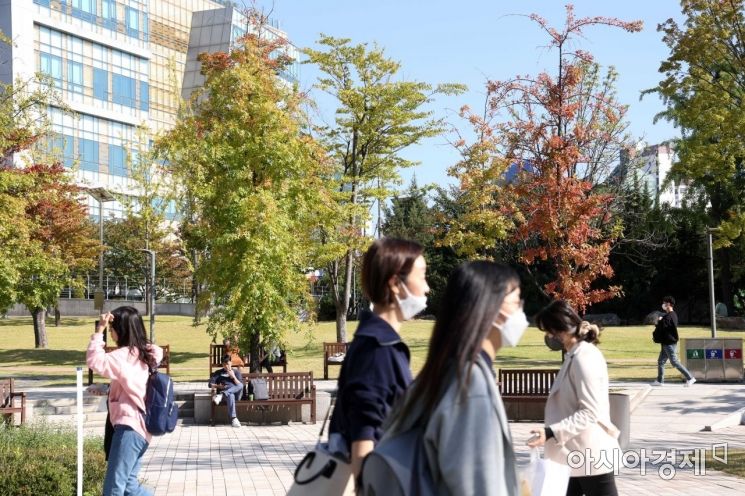 On the 12th, when the autumn weather with a large temperature difference continued, students were strolling around the campus at Yonsei University in Seodaemun-gu, Seoul. / Photo by Mun Ho-nam munonam@
According to a survey conducted on April 5th by the Ministry of Education press corps targeting presidents of four-year universities nationwide who attended the Korea Council for University Education regular general meeting, 45 out of 114 respondents (39.47%) answered that they have plans to raise tuition fees around next year.
Including universities that responded they would raise tuition fees in the first semester (10 universities) and second semester (1 university) of this year, 49.12% of the total plan to increase tuition fees in the 2023?2024 academic year.
On the other hand, responses of "will follow government policy" and "no plans to review" accounted for only 34.2% and 12.3%, respectively.
By region, non-metropolitan universities (41.67%) and by establishment type, private universities (47.30%) showed a higher proportion of considering tuition fee increases next year. Metropolitan universities (40.48%) and national/public universities (38.46%) mostly expressed opinions to follow government policy.
Among the presidents who answered that they would raise tuition fees, 45.61% said the funds would be used to secure excellent faculty and improve faculty treatment, followed by 36.84% who said it would be used for renovating aging facilities.
When asked how the College Scholastic Ability Test (CSAT) should change, 46 out of 108 respondents (42.59%) answered that it would be desirable to convert it into a qualification exam.
The second most common response was to maintain the current CSAT with 30 respondents (27.8%), followed by 16 respondents (14.8%) who said it should be abolished, and 13 respondents (12.0%) who said a written and essay-type CSAT should be introduced.
Regarding measures to reduce the side effects of the integrated CSAT, 43 out of 111 respondents (38.74%) stated that "it is still too early to discuss the outcomes."
Responses of "the liberal arts and sciences should be completely integrated" and "the difficulty level of elective subjects should be adjusted" were 34 (30.63%) and 23 (20.72%), respectively.
Regarding the number of four-year universities expected to close within the next 10 years due to the sharp decline in the school-age population, 30 respondents (27.03%) selected "31?40 universities," and 17 respondents (15.3%) answered "60 or more universities."
Regarding the Ministry of Education's consideration to change all high school grades to absolute evaluation (achievement evaluation system) along with the introduction of the high school credit system, 60 out of 113 respondents (53.10%) expressed the opinion "agree with the purpose but oppose immediate transition." Supporters were 39 (34.51%), and opponents were 14 (12.39%).
© The Asia Business Daily(www.asiae.co.kr). All rights reserved.
![Clutching a Stolen Dior Bag, Saying "I Hate Being Poor but Real"... The Grotesque Con of a "Human Knockoff" [Slate]](https://cwcontent.asiae.co.kr/asiaresize/183/2026021902243444107_1771435474.jpg)











