Kim Young-jin "Will Do Our Best to Proceed with February Extraordinary Session"
Opposition "At Least Follow Minimum Precedents for Bills"
"If Legislation Is Delayed, Everyone Will Face Confusion Going to Court"
[Asia Economy Reporter Naju-seok] The Democratic Party of Korea has expressed its intention to reach a conclusion on the so-called Yellow Envelope Act (amendment to the Trade Union Act) during the February extraordinary session of the National Assembly. As rulings regarding the business status of primary contractors have been issued by courts, there are voices urging the legislature to expedite the amendment to prevent confusion.
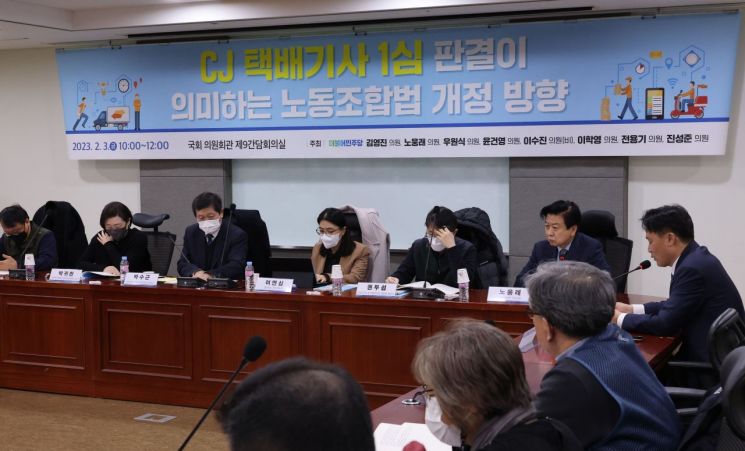
According to the Environment and Labor Committee of the National Assembly on the 4th, Kim Young-jin, the Democratic Party's secretary, said at a forum held the previous day titled "The Direction of Amendments to the Trade Union Act as Implied by the First Trial Verdict on CJ Delivery Workers," "There is accumulated discussion in the February extraordinary session, and the majority opinion is to reach a conclusion (among each party, individual lawmakers, the business sector, and labor sector). We will do our best to proceed during the February extraordinary session."
Kim said, "As the Democratic Party's secretary, I will proceed in line with that direction," adding, "We have discussed in depth the core issues such as the expansion of the scope of users in Article 2, Paragraph 2, how to realistically adjust the scope of strike actions in Article 2, Paragraph 5, and the provisions on damages in Article 3. We will reach a conclusion and proceed."
Previously, three subcommittee meetings on employment and labor were held regarding the amendment of Articles 2 and 3 of the Trade Union Act, but discussions did not progress due to the absence of the People Power Party. This forum was held based on the judgment that the first trial verdict on CJ delivery workers issued by the Seoul Administrative Court's Administrative Division 12 on the 12th of last month could be a breakthrough in the stalled issue of amending the Trade Union Act.
Within the Democratic Party, there are voices that since the court ruled that primary contractors should be regarded as users for subcontracted workers under their control or influence, the bill should at least follow the precedent.
The Seoul Administrative Court recognized the primary contractor who substantially controls working conditions as the user party in collective bargaining, noting that if this recognition is not made, the three labor rights (collective bargaining, collective action, and right to organize) may not be guaranteed. Although delivery workers contract with agencies, they can engage in collective bargaining with CJ Logistics, which can determine the actual working conditions.
In particular, the court viewed that whether the primary contractor is obligated to negotiate depends on whether they control the relevant working conditions. This is judged based on whether the workers must comply with the working conditions according to the employer's will or as set, indicating that the employer controls those conditions. If the primary contractor controls the working conditions, the subcontracted union can demand collective bargaining on areas where the primary contractor can exercise decision-making authority.
Previously, the Central Labor Relations Commission ruled in 2021 that although CJ Logistics is not the employer of the delivery workers, it has substantial and concrete control and decision-making authority over six bargaining items demanded by the delivery union, thus bearing the obligation of collective bargaining under the Trade Union Act. CJ Logistics filed for a retrial at the Administrative Court, which issued the same ruling as the Central Labor Relations Commission.
The reason for holding the forum was that since even the court recognizes the primary contractor's obligation to collective bargaining, the legislature should also discuss the amendment of the law.
Professor Park Soo-geun of Hanyang University Law School, who served as the chair of the forum and is a former chairman of the Central Labor Relations Commission, said, "It will take about three years for the first trial verdict to reach a final decision at the Supreme Court, but the result will be the same as the first trial verdict," adding, "However, if there is no legislative work, conflicts between companies and unions will occur, and labor-management relations could intensify." Since the issue concerns the infringement of the fundamental labor rights, even if it goes to the Supreme Court, the verdict will not be problematic, but if legislation is not enacted, social confusion may arise, so the National Assembly must actively engage in legislation.
Attorney Kwon Doo-seop of the Korean Confederation of Trade Unions Legal Office also said, "One might say that since there is a court precedent, all cases can just go to trial, but in reality, it takes 5 to 6 years for all trials to reach the Supreme Court," adding, "It is necessary to explicitly state this in legislation considering the precedent."
© The Asia Business Daily(www.asiae.co.kr). All rights reserved.
![Clutching a Stolen Dior Bag, Saying "I Hate Being Poor but Real"... The Grotesque Con of a "Human Knockoff" [Slate]](https://cwcontent.asiae.co.kr/asiaresize/183/2026021902243444107_1771435474.jpg)
















