Reversal and Remand of Guilty Verdict for Free Meal Organization Using Membership Fees and Donations as Expenses
"Membership Fees and Regular Donations from Organization Members Are Not Subject to the Act on Solicitation of Contributions"
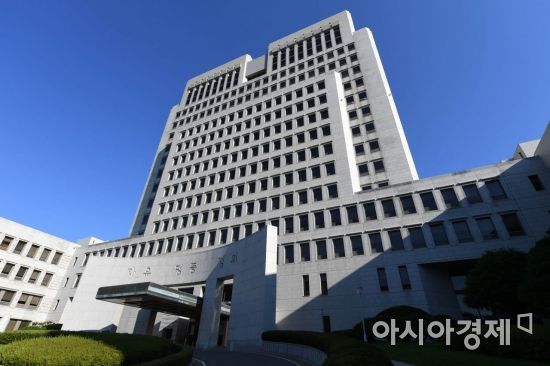
[Asia Economy Reporter Choi Seok-jin, Legal Affairs Specialist] The Supreme Court has ruled that whether a person is a 'member' of an organization exempt from punishment under the Act on the Collection and Use of Donations (Donation Act) should be determined based on the organization's internal regulations such as its articles of association.
In other words, membership fees or donations regularly paid by members who can be regarded as 'members' of the organization in light of the membership-related provisions stipulated in the articles of association of corporations or other organizations are not subject to the Donation Act.
According to the legal community on the 4th, the Supreme Court's Second Division (Presiding Justice Min Yoo-sook) on the 2nd overturned the lower court's ruling that found A Corporation and its Secretary-General B guilty of violating Article 16, Paragraph 1, Items 5 and 6 of the Donation Act, and remanded the case to the Daegu District Court.
The court stated, "Whether funds received by an organization from its members under the name of membership fees, etc., fall under the monetary items defined in Article 2, Paragraph 1, Subparagraph (a) of the Donation Act and are thus exempt from punishment under the Donation Act should be comprehensively determined based on the organization's internal regulations, considering the organization's founding purpose and operational status, membership qualifications and procedures, members' rights and obligations, and the payment and management of membership fees."
It further explained, "The lower court erred in its interpretation of Article 2, Paragraph 1, Subparagraph (a) of the Donation Act, which affected its judgment."
A Corporation, located in Seo-gu, Daegu, is a corporation established on April 3, 2013, for purposes such as promoting volunteer activities for marginalized groups and providing free meals for elderly living alone and impoverished people. It completed registration for donation collection on July 22 of the same year.
B served as the CEO of A Corporation from April 3, 2013, to October 16, 2016, and as Secretary-General from October 17, 2016. He was indicted for exceeding the allowable ratio of fundraising expenses under Article 13 of the Donation Act (violating Article 16, Paragraph 1, Item 6) and for using donations for purposes other than the fundraising objectives, such as condolence money (violating Article 16, Paragraph 1, Item 5).
Article 13 (Fundraising Expense Ratio) of the Donation Act stipulates that "a fundraiser may allocate a portion of the collected donations, within a ratio prescribed by Presidential Decree not exceeding 15%, to cover necessary costs for fundraising, management, operation, use, and reporting."
According to the Enforcement Decree of the Act on the Collection and Use of Donations, Article 18 (Application of Fundraising Expense Ratio), the allowable expense ratios based on the amount raised are: up to 15% for amounts up to 1 billion KRW, up to 13% for amounts exceeding 1 billion KRW and up to 10 billion KRW, up to 12% for amounts exceeding 10 billion KRW and up to 20 billion KRW, and up to 10% for amounts exceeding 20 billion KRW.
Accordingly, A Corporation was required to use no more than 13% of the raised amount for expenses, but the prosecution alleged that it exceeded this limit.
Violation of Article 13 of the Donation Act is punishable by imprisonment of up to three years or a fine of up to 30 million KRW under Article 16, Paragraph 1, Item 6 of the same Act.
Additionally, Article 12 (Use of Donations), Paragraph 1 of the Donation Act states that "donations collected may not be used for purposes other than fundraising expenses as stipulated in Article 13." Violation of this provision is punishable by imprisonment of up to three years or a fine of up to 30 million KRW under Article 16, Paragraph 1, Item 5.
B is accused of using approximately 1.152 billion KRW, which is 47% of about 2.433 billion KRW collected from unspecified donors between August 1, 2013, and July 31, 2014, for staff salaries, publicity expenses, and other fundraising costs, exceeding the legal limit until July 31, 2018.
He is also charged with using about 181 million KRW in donations for purposes other than fundraising, including 100,000 KRW from donations collected on July 23, 2013, for free meal services for elderly living alone and vulnerable groups and scholarship support for volunteer students, which he used as condolence money for his acquaintance C's father's funeral, over a total of 644 instances until May 31, 2018.
Furthermore, B is accused of falsely recording 12.776 billion KRW of donations as 'membership fees' in the cashbook of A Corporation from August 1, 2016, to July 30, 2017.
Article 7 (Donation Receipt Location, etc.) Paragraph 2 of the Donation Act requires fundraisers or fundraising workers to record the receipt of donations in books and issue receipts to donors. Article 16, Paragraph 2, Item 2 punishes false entries in such books with imprisonment of up to one year or a fine of up to 10 million KRW.
A Corporation was also indicted under the principle of joint liability.
In the first trial, B was found guilty of violating the Donation Act and sentenced to one year imprisonment with two years probation, and A Corporation was fined 10 million KRW.
In court, B argued that the money raised by A Corporation was collected from its members for their mutual benefit or for donation to third parties, and thus did not fall under the Donation Act.
Article 2 (Definitions) of the Donation Act defines donations in Subparagraph 1 as "money or goods acquired without consideration, regardless of the name such as welcome gifts, congratulatory gifts, or sponsorships," but excludes in the proviso: ▲money collected from members of corporations, political parties, social organizations, clans, or friendship groups according to their articles of association, regulations, or bylaws as entrance fees, lump-sum payments, membership fees, or for the mutual benefit of members (Subparagraph a), ▲money collected from believers by temples, churches, Confucian academies, or other religious organizations for their inherent activities (Subparagraph b), and ▲money collected from members for donation to members or third parties by the state, local governments, corporations, political parties, social organizations, or friendship groups (Subparagraph c).
B claimed that the money in question was entrance fees or funds collected from A Corporation members for donation to third parties, thus falling under Subparagraphs a to c of Article 2, Paragraph 1, and not subject to punishment, but this was rejected.
The court first stated, "Subparagraph a of the proviso to Article 2, Paragraph 1 of the Donation Act excludes money collected from members for their mutual benefit. Therefore, even if the defendants' claims are accepted, money received from so-called 'members' for free meal projects, which are not for members' benefit, does not fall under this provision."
It further stated, "Subparagraph c excludes money collected from members or third parties for donation purposes, but the so-called 'members' referred to by the defendants cannot be regarded as 'members' under Subparagraph c of Article 2, Paragraph 1."
The court cited that the so-called 'members' claimed by the defendants number about 200,000, but except for regularly paying money to A Corporation, they did not engage in any special activities for the organization. If these 'members' were excluded from the Donation Act as 'members' of A Corporation, it would lead to indiscriminate fundraising and improper use of funds. The articles of association classify members into regular members (those who agree with the corporation's purpose and fulfill rights and obligations), supporting members (those paying monthly fees of 5,000 KRW or more), and general members (volunteers contributing talents or efforts), requiring submission of membership applications. However, the membership applications do not state any rights as members. Also, when recruiting promotional members, A Corporation did not explain or show the articles of association regarding members' rights. Nowhere in the articles of association is there a provision allowing members to become executives or exercise executive appointment rights."
The court pointed out, "If submitting a membership application and having 'members' recorded in the articles of association were sufficient to regard applicants as members of A Corporation, it would allow organizations to evade various regulations of the Donation Act by recruiting donations from unspecified external individuals under the name 'members,' which is unreasonable."
The second trial acquitted B of false bookkeeping but upheld the first trial's judgment on other charges (exceeding fundraising expense limits and using funds for purposes other than fundraising).
However, the Supreme Court's judgment differed.
The Supreme Court reviewed the evolution of donation-related laws from the Donation Prohibition Act enacted in 1951, the Donation Regulation Act in 1995, the unconstitutional ruling in 1998, to the current Donation Act.
The court noted, "When the Donation Regulation Act was revised in 2006 to the Act on the Collection and Use of Donations, fundraising was converted to a registration system, and regulations were adjusted accordingly, resulting in the current Donation Act's purpose and structure. Initially, the Donation Act was enacted to strictly prohibit fundraising, but after several amendments aimed at ensuring legal effectiveness and protecting citizens' fundamental rights, it now aims to foster a mature donation culture and ensure proper fundraising and use."
It also cited previous Supreme Court precedents, stating, "While the Donation Act strictly regulates fundraising and use and punishes violations, it exceptionally excludes certain fundraising activities of organizations under Article 2, Paragraph 1 proviso Subparagraph a, etc., to guarantee organizational autonomy and because, considering the organization's structural characteristics, fundraising purposes, and targets, indiscriminate fundraising is unlikely, and proper use is expected."
The court reiterated, "Whether funds received by an organization from its members under the name of membership fees, etc., fall under the monetary items defined in Article 2, Paragraph 1, Subparagraph (a) of the Donation Act and are thus exempt from punishment should be comprehensively determined based on the organization's internal regulations, considering the organization's founding purpose and operational status, membership qualifications and procedures, members' rights and obligations, and the payment and management of membership fees."
It added, "Considering the organization's founding purpose and the management and use status of membership fees or donations paid by members, it is reasonable to conclude that such payments are not made indiscriminately and that proper use can be ensured. Therefore, funds paid by members of the defendant organization are excluded from the 'donations' regulated by the Donation Act."
The court based this judgment on the facts that ▲those who regularly paid money to A Corporation submitted membership applications and paid 'membership fees' or 'donations' for the stated purpose ▲A Corporation referred to them as regular or supporting members and stipulated members' rights and obligations in the articles of association ▲A Corporation completed fundraising registration under the Donation Act without violating the Act during fundraising ▲A Corporation complied with bookkeeping, disclosure of fundraising and usage details, report submission to the registration authority, and audit report submission by certified accountants without violations ▲the amount spent for purposes other than fundraising was about 0.337% of the fundraising amount during the same period, less than income from interest ▲A Corporation is subject to various strict regulations such as tax laws, reporting and disclosure obligations, external audits, supervisory inspections, and notifications to the National Tax Service, with no violations found.
Finally, the court concluded, "The lower court found B and others guilty because most of the so-called 'members' who submitted membership or supporting membership applications and paid fees were merely donors and not members of the defendant organization. This misinterpreted the legal provisions of Article 2, Paragraph 1, Subparagraph (a) of the Donation Act and affected the judgment."
A Supreme Court official explained, "Basically, contributions from internal members of an organization are not subject to the Donation Act's restrictions, but when external supporters donate to the organization, they are subject to the Act, and violations of requirements, procedures, or amount limits are punishable. Unlike the lower court's view that A Corporation's members were not actual members, the Supreme Court judged them as internal members and presented specific criteria for this determination."
He added, "When determining whether someone is an internal member or an external supporter, the organization's founding purpose, operational status, membership qualifications and procedures, members' rights and obligations, and payment and management of membership fees should be considered, with the core being the articles of association concerning the organization's internal essence. This is the first ruling to explicitly state this."
This appeal was taken up as a public interest case by the law firm Taepyungyang and the Dongcheon Foundation, which provided defense.
The Dongcheon Foundation, a public interest foundation established by the law firm Taepyungyang in 2009, stated, "Since the Donation Act was revised into its current form, registration authorities such as the Ministry of the Interior and Safety have consistently interpreted that donations received from regular supporting members or members joining according to the articles of association are fundraising from 'members' and thus not subject to registration, and fundraising expenses are limited to personnel costs of fundraising workers. Accordingly, most domestic non-profit and public interest corporations have not registered regular membership fees for fundraising and have spent costs according to relevant tax regulations."
Dongcheon explained, "If the lower court's ruling overturning the existing administrative interpretation is upheld, most domestic non-profit and public interest corporations that have complied with donation-related laws, supervisory guidance from authorities, the National Tax Service, and fundraising registration authorities would be deemed to have violated the law, and would face severe operational difficulties, including inability to properly pay staff salaries. This was the reason for selecting this case as a public interest case."
It added, "This ruling has prevented a major operational crisis for public interest organizations nationwide and is expected to have a positive impact on revitalizing public interest activities and improving legal systems for reasonable management and supervision."
© The Asia Business Daily(www.asiae.co.kr). All rights reserved.

















