Measures to Strengthen Compensation Management in Public Institutions Focused on Job Performance and Outcomes
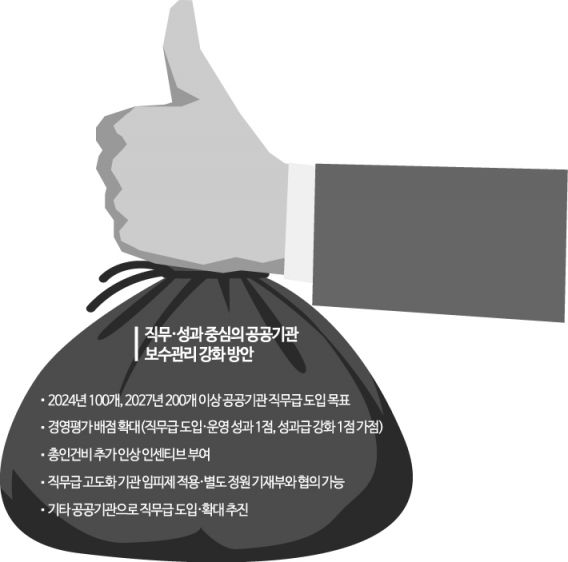
[Asia Economy Sejong=Reporter Kim Hyewon] The government will provide incentives that allow additional increases in total labor costs to institutions that excel in introducing job-based pay. Leading institutions in job-based pay will be subject to more flexible standards compared to other public institutions in terms of workforce, such as wage peak systems or new hiring.
On the 3rd, the Ministry of Economy and Finance held the 2nd Public Institution Management Committee meeting chaired by Second Vice Minister Choi Sang-dae and finalized the "Strengthening Public Institution Compensation Management Centered on Job and Performance" plan with these details.
This plan focuses on expanding the introduction of job-based pay to all public institutions, including other public institutions, linking job difficulty with compensation, and encouraging the simultaneous expansion of the proportion and differential range of performance pay within total compensation, thereby easing the seniority-based compensation system.
The government aims to introduce job-based pay to over 100 public institutions next year and more than 200 by 2027, as recently mentioned by Deputy Prime Minister and Minister of Economy and Finance Choo Kyung-ho. As of the end of 2021, only 35 public enterprises and quasi-governmental institutions have implemented job-based pay.
Starting this year, public institution management evaluations will award an additional 1 point if organizational members broadly participate in the job-based pay design process or if there are efforts or achievements in introducing and expanding job-based pay. The job-based pay scoring will increase from 2.5 points to 3.5 points. An additional 1 point will also be given if the proportion of performance pay in total compensation is increased or if the differential amount of performance pay according to evaluation grades is expanded. This creates a possibility of earning a total of 2 extra points.
Institutions with outstanding performance in introducing and operating job-based pay will receive incentives for additional increases in total labor costs. For example, they may be allowed to raise labor costs by an additional 0.1 to 0.2 percentage points. The incentive targets will be gradually expanded to include institutions newly introducing job-based pay.
The introduction of job-based pay will be extended to other public institutions. A Ministry of Economy and Finance official explained, "Currently, the Ministry evaluates the performance of job-based pay introduction through management evaluations of public enterprises and quasi-governmental institutions, but from this year, we will recommend applying the Ministry’s management evaluation indicators to other public institutions evaluated by their respective ministries so that their job-based pay introduction performance can also be included." Other public institutions with excellent management evaluation results from their respective ministries will also be eligible for incentives for additional increases in total labor costs.
However, the process of achieving the government's goals is expected to be challenging. Since each institution has unique characteristics and labor-management agreements are required, severe difficulties are anticipated during the phased implementation. The Ministry of Economy and Finance stated, "To address the lack of interest and understanding among members, we will simultaneously pursue various consensus-building measures to increase the acceptability of the system reform." Workshops, customized consulting, online and offline briefings, and the publication and distribution of best practice casebooks are being prepared.
On the same day, the government also decided to reform the integrated public institution disclosure (ALIO) system. The existing five major categories will be reorganized into four by newly adding "ESG (Environment, Social, Governance) Operation" and excluding "General Status" and "Information Disclosure." The current 10 middle categories will be subdivided into 15. Disclosure items related to national tasks, such as "male and female turnover rates" and "self-assessment results of welfare benefits," have also been added. This revision will be applied to public institutions starting April 1.
Additionally, to secure the audit period for accounting auditors, the submission deadline for public institutions’ financial statements will be extended from the end of February to March 15, and the submission date of financial statements to the National Assembly will be moved forward from August 20 to July 30, thereby extending the National Assembly’s review period by a total of 21 days. The Board of Audit and Inspection plans to expand the scope of institutions subject to financial statement audits to include those that establish mid- to long-term financial management plans by designation. In this case, the number of target institutions is expected to increase from the current 25 to 41.
© The Asia Business Daily(www.asiae.co.kr). All rights reserved.
![Clutching a Stolen Dior Bag, Saying "I Hate Being Poor but Real"... The Grotesque Con of a "Human Knockoff" [Slate]](https://cwcontent.asiae.co.kr/asiaresize/183/2026021902243444107_1771435474.jpg)











