Long-standing Efforts to Improve Corruption Perception Index Unrecognized "Cause of Failure in Achieving Fair Rule of Law"
Jeon Hyun-hee, Chairperson of the Anti-Corruption and Civil Rights Commission, Evaluates "Continuous Rise Over the Past 6 Years, Significant Meaning"
[Asia Economy Reporter Kim Jong-hwa] "There is still not a fully positive perception of the Republic of Korea."
Jeon Hyun-hee, Chairperson of the Anti-Corruption and Civil Rights Commission, described the perception of Korea's corruption level as evaluated by global assessment organizations and evaluation consultants in this way.
According to the '2022 Corruption Perceptions Index (CPI)' released recently by Transparency International (TI), Korea's national integrity score was 63 points, ranking 31st out of 180 countries. Korea's score rose from 54 points (51st) in 2017, 57 points (45th) in 2018, 59 points (39th) in 2019, and 61 points (33rd) in 2020, then increased to 62 points (32nd) in 2021 and 63 points (31st) last year, showing a somewhat gradual upward trend.
Denmark took first place with 90 points, Finland and New Zealand tied for second with 87 points, Norway was fourth with 84 points, Singapore and Sweden tied for fifth with 83 points, Hong Kong ranked 12th with 76 points, Japan 18th with 73 points, and Taiwan 25th with 68 points. Somalia ranked last at 180th with 12 points, Syria and South Sudan tied for 178th with 13 points, and Venezuela was 177th with 14 points.
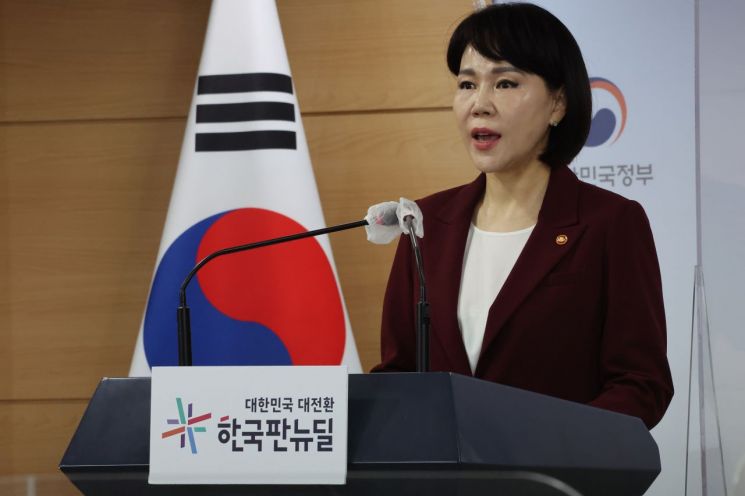 Chairperson Jeon Hyun-hee of the Anti-Corruption and Civil Rights Commission briefing on the "Performance and Implementation Status of Recommendations for Improving Corruption Impact Assessments" at the Government Seoul Office Building in May last year.
 [Photo by Yonhap News]
Korea has established anti-corruption systems over a long period, including the enactment of the Anti-Corruption and Civil Rights Commission Act in 2008, the Whistleblower Protection Act in 2011, the Improper Solicitation and Graft Act in 2016, the Public Finance Recovery Act in 2020, and the Conflict of Interest Prevention Act in 2022, but the results have been unsatisfactory. The government's initial target was to be within the top 20. Prime Minister Han Duck-soo announced at the first national agenda review meeting held last month that the Yoon Seok-yeol administration aims to achieve a national integrity ranking within the top 20.
Despite the Korean government's long-standing efforts, some in society point to the lack of speed in improving the corruption index, citing "failure to realize fair rule of law, extraterritorial elitism and moral insensitivity among politicians and businesspeople, and the absence of the spirit of noblesse oblige."
Regarding this, Chairperson Jeon explained, "The government continues to make anti-corruption efforts at the national level, and the people are making great efforts in unison, but global evaluation organizations and consultants still do not have a fully positive perception of the Republic of Korea." She added, "The recent real estate speculation scandal involving employees of Korea Land and Housing Corporation (LH) has become widely known internationally, and there are serious evaluations of corruption suspicions in the political and public sectors as well as in the private sector." Although the government and citizens are making efforts, the world has yet to recognize these efforts, and the LH employees' real estate speculation scandal negatively affected the corruption index evaluation.
Chairperson Jeon also noted, "It is significant that the upward trend has continued consecutively for the past six years since the implementation of the Improper Solicitation and Graft Act."
The Corruption Perceptions Index (CPI) is an index published annually by Transparency International in Germany that measures the perceived level of public and government sector corruption in countries. Also called the 'corruption index,' it is measured on a scale of 0 to 100, with higher scores indicating lower levels of corruption.
Transparency International defines corruption as "the abuse of power for private gain." The CPI evaluates a country's corruption level based on the corruption of public officials and politicians. The CPI is used alongside the Democracy Index published by The Economist in the UK and the Press Freedom Index published by Reporters Without Borders (RSF) in France as one of the three major indicators assessing a country's corruption, democracy, and press freedom.
According to the Seoul City University Anti-Corruption System Research Institute, a 1-point increase in the CPI corresponds to a 25% increase in Gross National Product (GNP) per capita, and the Korean Association for Public Administration states that it corresponds to a $4,713 increase in per capita national income, highlighting its importance domestically.
Kwon Woo-duk, senior researcher at the Anti-Corruption System Research Institute, explained the reason why Korea's efforts to improve corruption are not recognized internationally: "Although institutional arrangements have been made, it will take time to achieve results." He added, "Since the Conflict of Interest Prevention Act was implemented last year and existing practices have been improved, there is ample possibility for new evaluations and improvements."
© The Asia Business Daily(www.asiae.co.kr). All rights reserved.
![Clutching a Stolen Dior Bag, Saying "I Hate Being Poor but Real"... The Grotesque Con of a "Human Knockoff" [Slate]](https://cwcontent.asiae.co.kr/asiaresize/183/2026021902243444107_1771435474.jpg)
















