[Asia Economy Reporter Lee Gwan-ju] The first weekend since the indoor mask-wearing mandate was changed to a recommendation is approaching. However, confusion is arising in various places, especially in medical institutions, public transportation, and infection-vulnerable facilities where the mask-wearing mandate is still in effect during the initial implementation phase. The quarantine authorities basically leave indoor mask-wearing to individual discretion except for facilities where the mandate is maintained, but strongly recommend mask-wearing in '3밀' (closed spaces, crowded places, close-contact settings) environments and for high-risk groups such as seniors aged 60 and above.
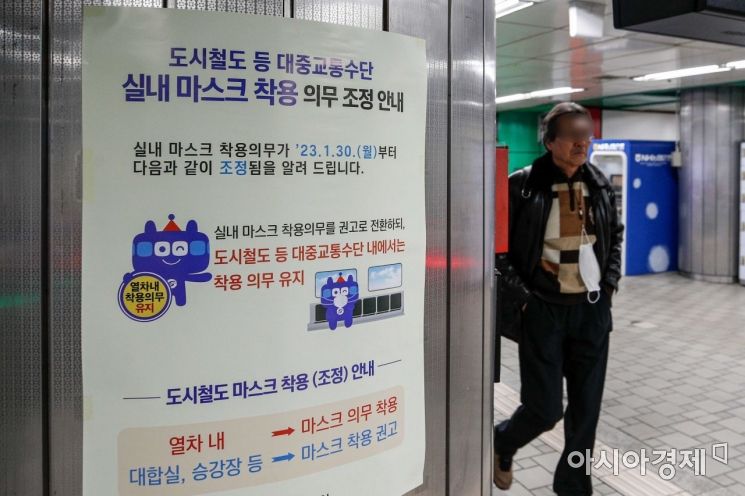 An indoor mask-wearing mandate adjustment notice for public transportation is posted at Sinchon Station on Subway Line 2 in Seodaemun-gu, Seoul. Photo by Jinhyung Kang aymsdream@
Medical institutions include hospitals, clinics, pharmacies, local health centers, and health sub-centers or health clinics. Users of these facilities are basically required to wear masks, but exceptions allowing no mask-wearing are permitted depending on the facility environment and whether patients or guardians are present. For example, in office buildings, research buildings, dormitories, etc., used only by medical staff or employees of medical institutions without patients or guardians entering, masks do not need to be worn.
Funeral halls that are separated by a different building or occupy an entire floor also do not have a mask-wearing mandate. For inpatients, masks are not required when they are alone in a single room or with a resident caregiver or guardian, but masks must be worn if they are with outsiders even in a single room or in multi-bed rooms. One of the most confusing parts is pharmacies in large marts; if the space is separated, masks must be worn. However, if using the pharmacy is possible from the common aisle of the mart without entering the pharmacy, there is no mask-wearing obligation.
The mask-wearing mandate remains in effect when using public transportation. This includes buses, subways, trains, taxis, airplanes, and commuter or school transportation. The quarantine authorities explained, "Public transportation is an essential facility used universally by COVID-19 high-risk groups and infection-vulnerable populations. Since it is inevitably a confined and narrow space where people stay for a considerable time and have a high possibility of contact with unspecified many, the mask mandate is maintained." However, the indoor mask-wearing mandate applies only while 'on board,' so masks do not need to be worn while waiting at terminals, railway station platforms, bus stops, or taxi stands. In other words, it means that masks should be worn the moment one boards the public transportation vehicle.
Infection-vulnerable facilities include nursing hospitals, long-term care institutions with residential facilities, psychiatric medical institutions with closed wards, psychiatric nursing facilities, residential-type psychiatric rehabilitation facilities with more than 10 residents, and residential-type facilities for the disabled. Like medical institutions, these facilities do not require masks in separated spaces where residents or inpatients do not need to enter. When residents or inpatients are with cohabitants such as roommates or resident caregivers or guardians in private spaces like bedrooms or wards, masks are not required, but masks must be worn when facility workers, visitors, or other outsiders are present.
Additionally, even in facilities where mask-wearing is mandatory, masks can be temporarily removed for official events such as inauguration ceremonies, agreement ceremonies, or awards ceremonies when taking photos of the event participants. Also, those exempted before the indoor mask mandate adjustment, such as infants under 24 months, people with brain lesions or developmental disabilities who find it difficult to put on or take off masks without assistance, and those with medical opinions stating difficulty breathing when wearing masks due to respiratory diseases, are excluded from fines. Children and adolescents under 14 years old are subject to fines, but according to the 'Act on the Regulation of Violations of Order,' which governs the imposition and collection of fines, fines are not actually imposed.
In all other facilities, masks do not need to be worn indoors without any particular restrictions. Even in meetings or seminars where many people gather, if they are not restricted facilities, there is no mask-wearing mandate. The same applies to elevators. However, the quarantine authorities emphasize that only the 'mandate' such as fines for not wearing masks has been lifted, and mask-wearing is still strongly recommended in environments where infectious diseases can easily spread. The Central Disease Control Headquarters stressed, "This mandate adjustment does not mean indoor mask-wearing is unnecessary," adding, "Only the national legal obligation subject to fines has been lifted, so individual voluntary mask-wearing according to the situation remains important."
< Situations Where Mask-Wearing Is Strongly Recommended >
- Suspected COVID-19 symptoms: sore throat, cough, nasal congestion or runny nose, fever, etc.
② If you are in a COVID-19 high-risk group or have been in contact with a high-risk group
- COVID-19 high-risk groups: people aged 60 and above, immunocompromised individuals, people with underlying diseases, etc.
③ If you have recently been in contact with a confirmed COVID-19 case (mask-wearing recommended for 2 weeks from the date of contact)
④ When in a poorly ventilated 3밀 (closed, crowded, close-contact) indoor environment
⑤ When many people are densely gathered and engaging in droplet-generating activities such as shouting, singing, or talking
© The Asia Business Daily(www.asiae.co.kr). All rights reserved.

















