Winter Vegetable Prices Rise Amid Continued Heavy Snow and Cold Waves
Heating and Food Costs "Nothing Hasn't Increased," Lamentations
Vegetable prices, which surged last year, are continuing their high-rise trend. While the price of napa cabbage, which skyrocketed ahead of the kimchi-making season, has significantly dropped and returned to average levels, prices of vegetables affected by cold waves and heavy snowfall are continuing to rise. In particular, prices of some vegetables such as carrots and ginger are rising sharply.
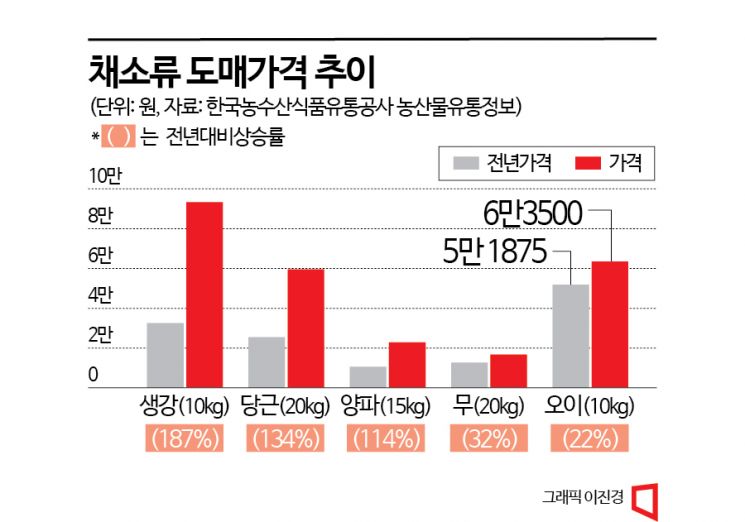
According to the Agricultural Products Distribution Information from the Korea Agro-Fisheries & Food Trade Corporation on the 3rd, the average wholesale price of unwashed carrots weighing 20kg was 59,600 KRW as of the 1st, soaring 134% compared to 25,420 KRW a year ago. This means the price has more than doubled compared to the previous year. It has also risen significantly compared to the average price of 30,453 KRW. Ginger also rose 187% compared to last year (32,530 KRW) to 93,380 KRW for 10kg. Compared to the average price (58,711 KRW), it became 59% more expensive.
In addition, onions, which were 10,639 KRW for 15kg a year ago, are being traded at 22,820 KRW, up 114%. Cucumbers (thorny variety) are priced at 63,500 KRW for 10kg, a 22% increase from last year (51,875 KRW), and cabbage also rose 22% from 7,402 KRW to 9,082 KRW on average for 8kg. The price of radish increased 32% to 16,760 KRW for 20kg compared to last year (12,650 KRW).
The surge in vegetable prices was largely influenced by climate factors such as cold waves and heavy snowfall that continued since the end of last year. In cultivation areas including Jeju, cold damage occurred to winter vegetables such as radish, cabbage, and carrots due to cold waves and heavy snow. Additionally, the sharp rise in heating costs during winter also pushed up production costs, further driving up vegetable prices. Winter vegetables grown in vinyl greenhouses require heating devices to maintain proper temperatures to prevent cold damage, and with increases in electricity and gas prices, production costs reportedly nearly doubled.
According to the supply and demand trends and outlook for major agricultural and livestock products (18 items) announced by the Ministry of Agriculture, Food and Rural Affairs, winter napa cabbage production has increased, maintaining low prices. Although winter radish production has decreased, considering the previously ongoing surplus situation, production is expected to remain at an appropriate level. However, due to concerns about damage from cold waves in Jeju and southern regions, if this rapid price increase continues, the ministry plans to supply reserved stocks (5,000 tons of radish).
The decrease in production of mid-late maturing onions from the 2022 crop affected prices. However, the cultivation area for early maturing onions in the 2023 crop increased by 5.2% compared to the previous year, and prices are expected to stabilize from next month. For facility-grown vegetables, production is expected to decrease due to cold waves and lack of sunlight, so high prices are expected to continue for cucumbers, Cheongyang chili peppers, zucchini, and others for the time being.
Following the heating cost crisis, rising food prices and ingredient costs are gradually increasing the burden of grocery prices on ordinary citizens. A housewife, Ahn Hyo-min (39), living in Yangcheon-gu, Seoul, said, "The high inflation situation seems likely to continue for a while, and I really feel at a loss about what to do," adding, "My living expenses remain the same, but all necessary expenses have increased, so when I meet people around me, all I hear is how hard it is."
Kim Jeong-hee, Director of the Food Policy Office at the Ministry of Agriculture, Food and Rural Affairs, said, "We will continuously monitor the supply and demand situation of agricultural and livestock products, and if any instability arises, we will expand supply through releasing reserved stocks and tariff allocations, and continue to support discounts on agricultural and livestock products. We will do our best to stabilize supply and prices of agricultural and livestock products."
© The Asia Business Daily(www.asiae.co.kr). All rights reserved.


















