KCCI Hosts Forum to Explore Expansion Plans for Job- and Performance-Based Wage Systems
[Asia Economy Reporter Choi Dae-yeol] It has been pointed out that the current procedure requiring labor union consent when reforming the wage system should be revised first in order to introduce a wage system based on job roles or performance instead of the seniority-based wage system where those who have worked longer receive more.
Son Kyung-sik, Chairman of the Korea Employers Federation, said ahead of the discussion held on the 2nd, "True fairness and the start of innovation lie in motivating workers by compensating them according to the value and performance of the work they perform," adding, "The top priority to spread job- and performance-based wage systems is to resolve the ‘rigidity of the wage system reform procedure.’"
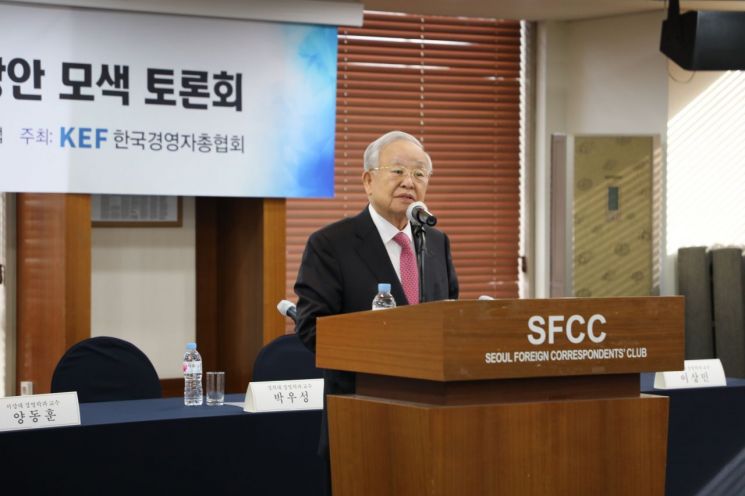
He stated, "The deeply rooted seniority-based wage system restricts members' autonomy and creativity," and evaluated, "It was timely that the Future Labor Market Research Group recommended reforming the existing seniority-based wage system at the end of last year, and that the government selected this as a priority task for labor market reform."
Reforming the wage system requires agreement between labor and management. Even if a job- and performance-based wage system is positive, conflicting interests within the labor union make it difficult to reconcile differences. This is the background for the slow or stalled wage system reform.
Chairman Son said, "To ensure the effectiveness of wage system reform, the system should be improved so that, like in Japan, ‘socially reasonable wage system reforms’ can be made through consultation between labor and management alone," and added, "Labor unions should also actively cooperate in reforming to a fair wage system centered on job roles and performance by relinquishing excessive vested rights that are no longer appropriate for the times."
Professor Park Woo-sung of Kyung Hee University, who gave the first presentation, pointed out that the reform has not been properly promoted due to a lack of driving force for change, saying, "If companies with high acceptance and suitability lead the reform, it can serve as a driving force for spreading it throughout the labor market in the future." He also emphasized the need for a clear direction and a flexible approach that partially reflects the advantages of the existing seniority-based system.
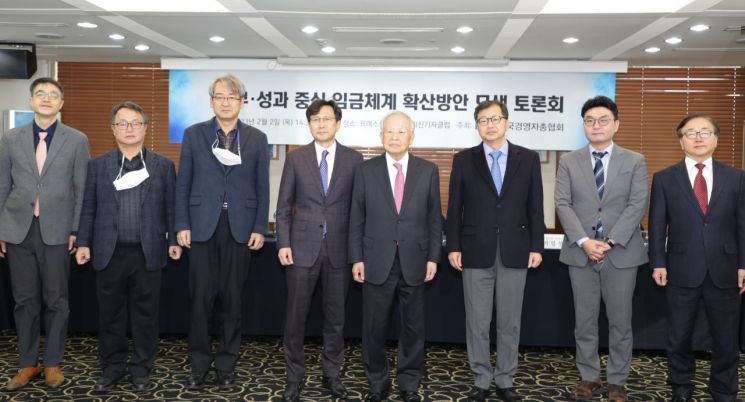 From the left, Sangmin Lee, Professor of Business Administration at Hanyang University; Dongbae Kim, Professor of Business Administration at Incheon National University; Gyetaek Oh, Director of the Wage and Job Innovation Center at the Korea Labor Institute; Woosung Park, Professor of Business Administration at Kyung Hee University; Kyung-sik Son, Chairman of the Korea Employers Federation; Donghoon Yang, Professor of Business Administration at Sogang University; Hyungchul Park, Vice President of Samjong KPMG; and Donggeun Lee, Executive Vice President of the Korea Employers Federation, are posing for a commemorative photo at the forum held on the 2nd.
 Park Hyung-chul, Vice President of Samjong KPMG, said, "Traditional large corporations mainly use ‘partial changes’ that reflect job-specific market values in the basic salary system while maintaining seniority-based ranks to some extent, whereas recently, big tech companies focus on flexible responses such as setting differentiated starting salaries and basic salary increase rates by job group and occupation due to fierce competition for talent acquisition."
Oh Gye-taek, Director of the Wage and Job Innovation Center at the Korea Labor Institute, said, "Now is the time to discuss the ‘method’ of reform rather than the ‘direction’ of the wage system," adding, "To collect and adjust the different preferences and understandings of labor and management when transitioning to a job- and performance-based wage system, active roles from labor, management, and government are necessary." Professor Lee Sang-min of Hanyang University said, "It is important to formalize the job-based pay elements or practices that are unofficially operating within the current seniority-based wage system."
© The Asia Business Daily(www.asiae.co.kr). All rights reserved.


















