Reorganized into International Standards 'Cultural Heritage' and 'Natural Heritage'
Construction of Cultural Property Repair Materials Center in Bonghwa-gun, Gyeongbuk
Rational Adjustment of 'Historical and Cultural Environment Preservation Area' Boundaries
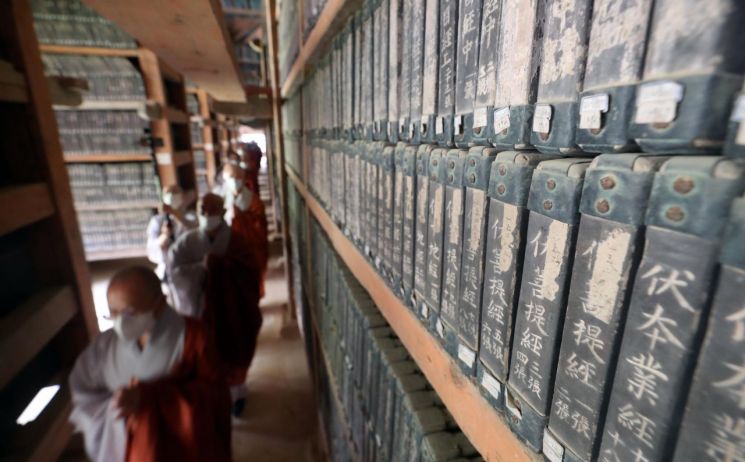
Digitization of Haeinsa Tripitaka Woodblocks in Hapcheon... Securing Basic Data
The government will transition the 'Cultural Properties (文化財)' classification system, maintained since 1962, to a 'National Heritage (國家遺産)' system. It will define these as future cultural assets and focus all efforts on creating and enhancing their value.
 On the 10th, Choi Eungcheon, the Commissioner of the Cultural Heritage Administration, is speaking at the integrated press conference for the 2022 World Heritage Festival held at the Plaza Hotel in Jung-gu, Seoul. / Photo by Moon Honam munonam@
On the 2nd, the Cultural Heritage Administration announced its major work plan for this year under the vision of "Cultural Heritage with the People, A Happy Republic of Korea for All." The policy goals for cultural heritage are: ▲ Creating future value through strengthening preservation and transmission of cultural heritage ▲ Enhancing quality of life by expanding the utilization value of cultural heritage ▲ Implementing preservation and utilization policies that respond to changes in the policy environment ▲ Elevating national brand value through cultural heritage. Underlying these goals is the transition to a national heritage system. The current cultural properties classification system will be reorganized to align with international standards into categories such as 'Cultural Heritage,' 'Natural Heritage,' and 'Intangible Heritage.' The related legislation submitted to the National Assembly's standing committee in December last year will be finalized within this year. The Cultural Heritage Administration stated, "We also plan to establish separate protection measures through surveys and cataloging of non-designated historical cultural resources."
Previously insufficient systems will also be supplemented and improved. This includes research on establishing standard cost estimates for movable cultural property conservation treatment, setting repair standards for modern and contemporary architectural heritage, and research and management of important excavated materials such as human bones and mummies. A system for systematically procuring and managing traditional materials such as pigments, roof tiles, and jeondol (black bricks fired from clay) will also be established. By next year, a Cultural Heritage Repair Materials Center will be built in Bonghwa-gun, Gyeongbuk Province. Temples owning nationally designated cultural properties will receive 5.4 billion KRW this year to support electricity bills and other expenses. Eligibility requires a reduction in cultural heritage admission fees. This aims to achieve both strengthening cultural heritage preservation management and enhancing the public's right to enjoy cultural heritage. A permanent preservation system will also be established through expansion of disaster prevention facilities, deployment of safety guards, and specialized training for local government officials.

The Cultural Heritage Administration will also discover and spread the value of intangible heritage transmitted by communities without specific holders or groups, such as Yutnori. It will support 1.6 billion KRW as part of a project to revitalize transmission communities. Support payments to transmission educators will be increased by 20%, and outstanding transmission trainees will receive a monthly scholarship of 300,000 KRW. Branches of the National Intangible Heritage Center and Intangible Cultural Heritage Art Villages will be established in Miryang-si, Gyeongnam Province, and Jeonju-si, Jeonbuk Province, respectively.
The scope of 'Historical and Cultural Environment Preservation Areas,' where conflicts between cultural heritage preservation and citizens' property rights have intensified, will be reasonably adjusted according to ordinances. These areas are zones designated to protect cultural properties. Within 500 meters from the outer boundary of cultural properties, city and provincial governors set ordinances in consultation with the head of the Cultural Heritage Administration. This year, the Cultural Heritage Administration will readjust regulatory scopes for 680 sites in Gyeonggi and Incheon and assess whether the allowance standards for 461 sites in Gyeongbuk are appropriate. Unreasonable and excessive regulatory standards will be boldly relaxed. The Cultural Heritage Administration announced, "We will also enact the 'Cultural Heritage Impact Assessment Act' within this year to unify scattered regulations," and predicted, "So-called 'one-stop' processing will be realized."
Efforts will accelerate in producing and utilizing digital content to prepare for the loss or damage of cultural heritage. This year, a 3D data catalog (DB) will be established for 730 nationally designated cultural properties, and 750 source materials will be opened and distributed. The most notable cultural heritage is the Haeinsa Temple Tripitaka Koreana woodblocks, a national treasure and UNESCO Memory of the World. By 2030, a digital data DB will be prepared to secure basic data necessary for repair and restoration and to promote academic use. The digital restoration project of the Silla royal capital sites such as Wolseong, Donggung, Wolji, and Cheomseongdae will also be promoted until 2025.
The Cultural Heritage Administration will also take the lead in enhancing the status of Korean culture. This year, efforts will be made to inscribe the 'Gaya Tumuli' as a UNESCO World Heritage and the 'April 19 Revolution Records' and 'Donghak Peasant Revolution Records' as UNESCO Memory of the World. Additionally, the World Heritage Impact Assessment system will be introduced into domestic law, and activities of the UNESCO World Heritage International Interpretation and Explanation Center, established last year, will be fully activated. International development cooperation (ODA), which has been focused on Asia, will be expanded to Africa. By 2027, the restoration of the pylon gate of the Ramesseum Temple in Egypt will be completed, and the Egypt Digital Heritage Center will be established.
To effectively protect and utilize cultural properties located overseas, the 'K-Public Heritage' system will also be introduced. Shared heritage refers to heritage that two or more countries share historical and cultural values. The Cultural Heritage Administration plans to establish a pilot project plan around October and cooperate with countries such as the United States and France. Along with providing information and diversifying content, it aims to build national consensus on the repatriation of overseas cultural properties.
© The Asia Business Daily(www.asiae.co.kr). All rights reserved.



















